What a Crossed-Out Price Has to Have Been
The rule is that the higher number was real, offered openly, recently, for a reasonably substantial period. Drift passes it.
If you buy through our links, we may earn a commission. It never affects our verdicts or scores — how that works. As an Amazon Associate I earn from qualifying purchases.
The crossed-out number is regulated, and the test is narrower than people assume. A former price has to have been the real one, openly offered, recently, for a reasonably substantial period. It does not have to be low, fair, or the same as last year’s.
Which means the most useful thing to understand about sale pricing is not what the rule forbids but what it permits.
The four conditions
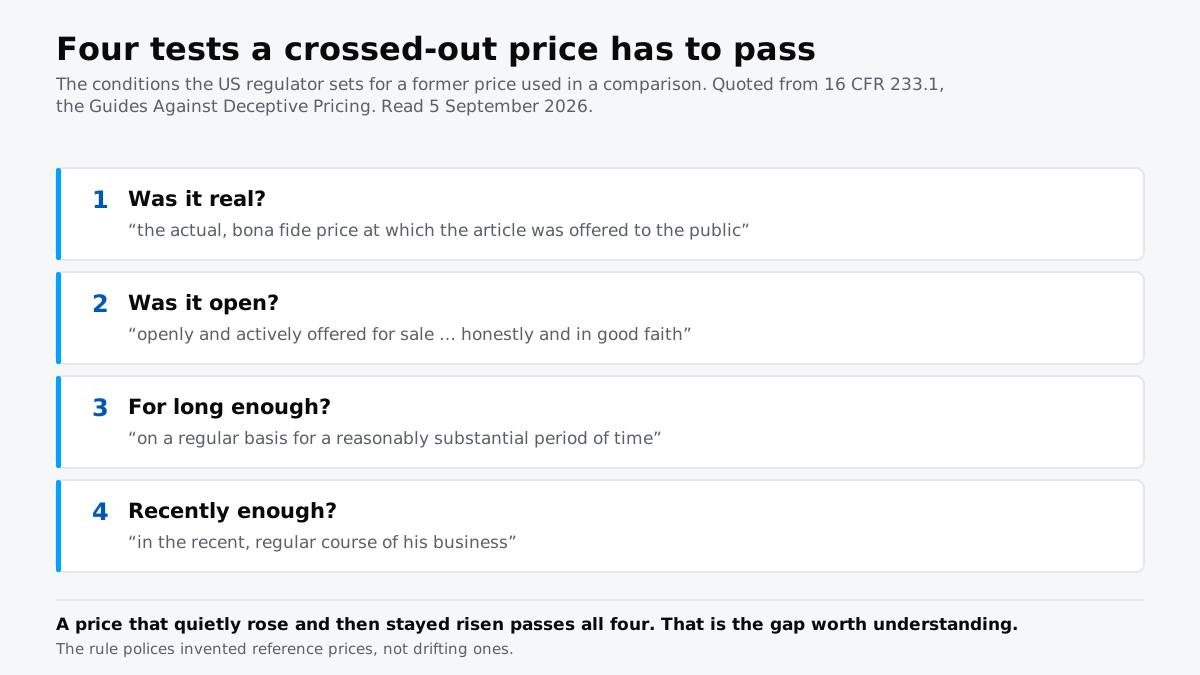
From 16 CFR 233.1, the federal guide on deceptive pricing. A former price used in a comparison must be:
- Real — “the actual, bona fide price at which the article was offered to the public”
- Open — “openly and actively offered for sale … honestly and in good faith”
- Sustained — “on a regular basis for a reasonably substantial period of time”
- Recent — “in the recent, regular course of his business”
The thing the rule was written to stop is named in its own text: a comparison is deceptive where the former price is “not bona fide but fictitious — for example, where an artificial, inflated price was established for the purpose of enabling the subsequent offer of a large reduction.”
And the condition it does not impose
Nothing in those four tests says the former price has to be the launch price, or last year’s price, or a price anybody thought was reasonable.
A price that rose quietly in March and was openly charged all summer is a bona fide former price in November. It is real, it was open, it was sustained, it is recent. A forty per cent discount from it is entirely lawful.
That is not a loophole; it is the rule doing its actual job, which is policing invented reference prices rather than drifting ones. But it is why the percentage can be honest and the saving can still be smaller than it looks. Our ereader shortlist found every device on it now listing above the price its maker announced it at, each of those higher prices openly charged for months. Every one of them would pass all four tests.
The list-price version
There is a second rule for the other kind of crossed-out number, the manufacturer’s list price. 16 CFR 233.3 says a list price “will not be deemed fictitious if it is the price at which substantial sales are made in the advertiser’s trade area.”
The obligation it creates is worth knowing because it points the other way from where shoppers assume. Before advertising a manufacturer’s list price as a comparison, the retailer should ascertain whether that is in fact the price regularly charged by principal outlets in the area. The checking duty is the seller’s.
What this changes about reading a sale
Not much about what is legal, and quite a lot about what is useful.
The percentage tells you the relationship between two numbers the seller chose. The rule guarantees the second number was real at some recent point. Neither tells you whether the price is good, and no rule can, because that is a question about the market rather than about the advertisement.
What to actually do
- Treat the crossed-out figure as a fact about the seller’s recent history, which is what the rule makes it, rather than as a fact about the product’s worth.
- Find the price from before the drift. A launch price or a figure you recorded yourself is the baseline the regulation does not require anyone to show you.
- Be sceptical of a very large reduction on an unfamiliar brand, since that is the exact pattern 233.1 describes and the one hardest to check.
- Remember the checking duty is the retailer’s. If a list price comparison looks unlike what shops near you charge, the rule already says it should have been verified.
- Use the same four questions our deal guide asks. They are, not by coincidence, close to the regulator’s.
How we researched this
No one at bitcritiq has handled this product. Everything here comes from published sources, listed below.
- What this cannot tell you
- This describes a United States federal guide and is not legal advice. The Guides are interpretive rather than a statute creating private rights, enforcement is a matter for the regulator, and state law adds requirements this page does not cover. It says nothing about any specific retailer's conduct, and nothing here should be read as an allegation about one. Practices that comply with a rule can still be a bad deal, which is most of the point.
How we chose this, and what we did
- Why this subject
- Every discount published this season is a comparison between two numbers, and only one of them is the price you pay. The other is governed by a published federal rule that almost nobody reading a sale page has seen. Knowing what that rule does and does not require turns the crossed-out figure from a persuasion device into something checkable, and it explains why some of the least honest-feeling prices are entirely lawful.
- How we looked at it
- Every quoted phrase is taken from the text of 16 CFR Part 233, the Federal Trade Commission's Guides Against Deceptive Pricing, read on 5 September 2026. Where the piece applies the rule to prices on this site, those prices are the ones already published and sourced on the pages linked.
What this rests on
5 claims, 4 official and 1 corroborated. Nothing here was measured by bitcritiq — see how we test for why. Open a claim to read the source it came from.
A former price used in a comparison must have been the actual price at which the item was offered to the public on a regular basis for a reasonably substantial period.Official
16 CFR 233.1 requires the former price to be "the actual, bona fide price at which the article was offered to the public on a regular basis for a reasonably substantial period of time".
The rule names inflating a price in order to discount from it as the thing it exists to prevent.Official
16 CFR 233.1 describes a comparison as deceptive where the former price is "not bona fide but fictitious - for example, where an artificial, inflated price was established for the purpose of enabling the subsequent offer of a large reduction".
A manufacturer's list price is not fictitious if substantial sales are actually made at it in the advertiser's trade area.Official
16 CFR 233.3 states a list price "will not be deemed fictitious if it is the price at which substantial sales are made in the advertiser's trade area".
The rule puts the checking obligation on the retailer, not the shopper.Official
16 CFR 233.3 states that before advertising a manufacturer's list price as a basis for comparison, the retailer should ascertain whether it is in fact the price regularly charged by principal outlets in the area, and that the advertiser must act honestly and in good faith in every case.
A price that rose months ago and stayed risen satisfies all four conditions, so a discount from it is lawful and still smaller than it looks.Corroborated
Our ereader shortlist found every device on it listing above the price its maker announced it at, with the higher figure openly charged for months. That is a bona fide former price under 233.1 and a poor baseline for a shopper at the same time.
Sources 4
- 16 CFR 233.1 — Former price comparisonsOfficialStandards / .govaccessed Sep 5, 2026
- 16 CFR 233.3 — Advertising retail prices which have been established or suggested by manufacturersOfficialStandards / .govaccessed Sep 5, 2026
- The Best Ereaders, According to the Reviews — bitcritiqaccessed Sep 5, 2026
- How to Tell a Real Tech Deal From a Fake One — bitcritiqaccessed Sep 5, 2026
No email, no account
Follow bitcritiq
Every new article, in whatever reader you already use.
Subscribe by RSSAll the ways to follow
Using Chrome on Android? Open the browser menu and tap Follow. New articles then turn up in the Following tab in Discover.
read next
Five Stores Pay Back a Price Drop. Walmart.com Does Not
Best Buy's Price Match Is Off for Twelve Days
The Extended Warranty Offered at Checkout