Why AI Chatbots Make Things Up: Guessing Scores Better
Not a bug in the model so much as an incentive in the scoreboard. OpenAI's own numbers show what honesty costs a model on a leaderboard.

If you buy through our links, we may earn a commission. It never affects our verdicts or scores — how that works. As an Amazon Associate I earn from qualifying purchases.
Because a guess scores better than an admission. OpenAI’s own account is that models hallucinate “because standard training and evaluation procedures reward guessing over acknowledging uncertainty” — the behaviour is an incentive, not a defect.
Its definition is worth keeping, because it explains why these errors are so hard to spot: hallucinations are “plausible but false statements”. Not gibberish. Exactly the shape a right answer would take.
The exam analogy, which is theirs
Think of a multiple-choice test. You do not know the answer. Guessing might get lucky; leaving it blank guarantees zero.
OpenAI applies this to a model asked for someone’s birthday it does not know. Guess “September 10” and there is a 1-in-365 chance of being right. Say “I don’t know” and the score is certainly zero. Across thousands of questions, “the guessing model ends up looking better on scoreboards than a careful model that admits uncertainty.”
That is the whole mechanism. Nobody trained a model to lie. They graded it on how often it was exactly right, and never on how often it was confidently wrong — and the model learned the obvious lesson.
The table that makes it concrete
This is the part worth carrying away. OpenAI published these figures for two of its own models on the SimpleQA evaluation:
| gpt-5-thinking-mini | OpenAI o4-mini | |
|---|---|---|
| Abstention (no answer given) | 52% | 1% |
| Accuracy (higher is better) | 22% | 24% |
| Error (lower is better) | 26% | 75% |
Read the accuracy row alone and the older model wins. Read the error row and it is wrong three times as often. Two points of accuracy cost forty-nine points of error rate.
OpenAI’s own summary of it: “Strategically guessing when uncertain improves accuracy but increases errors and hallucinations.”
And since most leaderboards publish accuracy and not error, the model that bluffs on 99% of questions it cannot answer is the one that looks better.
Why the errors are facts, not typos
There is a second half, about why models get spelling right and birthdays wrong.
Pretraining is next-word prediction over enormous quantities of text, where “the model sees only positive examples of fluent language”. Nothing is labelled false.
Then the analogy that makes it click. Label millions of pet photos “cat” or “dog” and a model learns to classify them. Label each photo with the pet’s birthday and it can never learn, “since birthdays are essentially random”. OpenAI draws the line directly: spelling and parentheses “follow consistent patterns, so errors there disappear with scale. But arbitrary low-frequency facts, like a pet’s birthday, cannot be predicted from patterns alone.”
That is why a model is flawless on grammar and invents a citation. Grammar is a pattern. A specific dissertation title is not — and when OpenAI asked a widely used chatbot for one paper author’s dissertation title, it “confidently produced three different answers—none of them correct.”
Two things people get wrong
“A better model will fix it.” Partly, and only partly. OpenAI’s own finding is that “accuracy will never reach 100% because, regardless of model size, search and reasoning capabilities, some real-world questions are inherently unanswerable.”
“So hallucination is inevitable.” No — and this is the more useful correction. Their finding is explicit: “They are not, because language models can abstain when uncertain.” A model that says it does not know has not hallucinated. What is missing is not capability, it is a scoreboard that rewards saying so.
What to actually do
- Distrust confidence, not fluency. The failure mode is a well-formed, plausible, wrong answer. Fluency tells you nothing about truth, and it never did.
- Ask questions that have a checkable answer, and check it. Names, dates, citations, part numbers, quotations — the arbitrary low-frequency facts — are exactly where the mechanism above predicts failure.
- Treat “I don’t know” as a good sign. Under OpenAI’s own Model Spec it is the intended behaviour: better “to indicate uncertainty or ask for clarification than provide confident information that may be incorrect.”
- Read error rates, not just accuracy, when comparing models. Most leaderboards publish only the metric that rewards guessing. If a comparison does not show what share of answers were confidently wrong, it is not telling you the thing you care about.
- Never pass on a fact you have not verified. That applies to a model’s output the same way it applies to anything else — and if you want the shape of the problem in your own work, whether AI detectors can tell the difference is a related lesson in trusting a confident score.
How we researched this
No one at bitcritiq has handled this product. Everything here comes from published sources, listed below.
- What this cannot tell you
- This explains why the behaviour arises and what reduces it. It is not a technique for making any particular model reliable, and nothing here means a hedged answer is a true one — a model can be uncertain and wrong at the same time. The figures are OpenAI's own, on one evaluation, for two of its models; treat them as an illustration of the mechanism rather than a league table.
How we chose this, and what we did
- Why this subject
- Everyone has been burned by a confident wrong answer, and the usual explanations are either hand-waving about autocomplete or fatalism about it being unfixable. There is a better account, published by OpenAI about its own models, and it comes with a measured table that makes the mechanism visible rather than asserted.
- How we looked at it
- Took the argument, the definition and the evaluation figures from OpenAI's own research summary and the paper it links, because the claim being made is about how OpenAI's own models are trained and graded. Kept the numbers in the form OpenAI published them, including the comparison that makes its newer model look worse on the headline metric.
Sources 2
- Why language models hallucinate — OpenAIOfficialaccessed Aug 29, 2026
- Why Language Models Hallucinate — Kalai et al., arXiv:2509.04664Standards / .govaccessed Aug 29, 2026
Pass it on
Know someone weighing this up? Send them the answer.
bitcritiq.com/55bkThe link is permanent: it opens this article for good, even if the title changes.
No email, no account
Follow bitcritiq
Every new article, in whatever reader you already use.
Subscribe by RSSAll the ways to follow
Using Chrome on Android? Open the browser menu and tap Follow. New articles then turn up in the Following tab in Discover.
read next
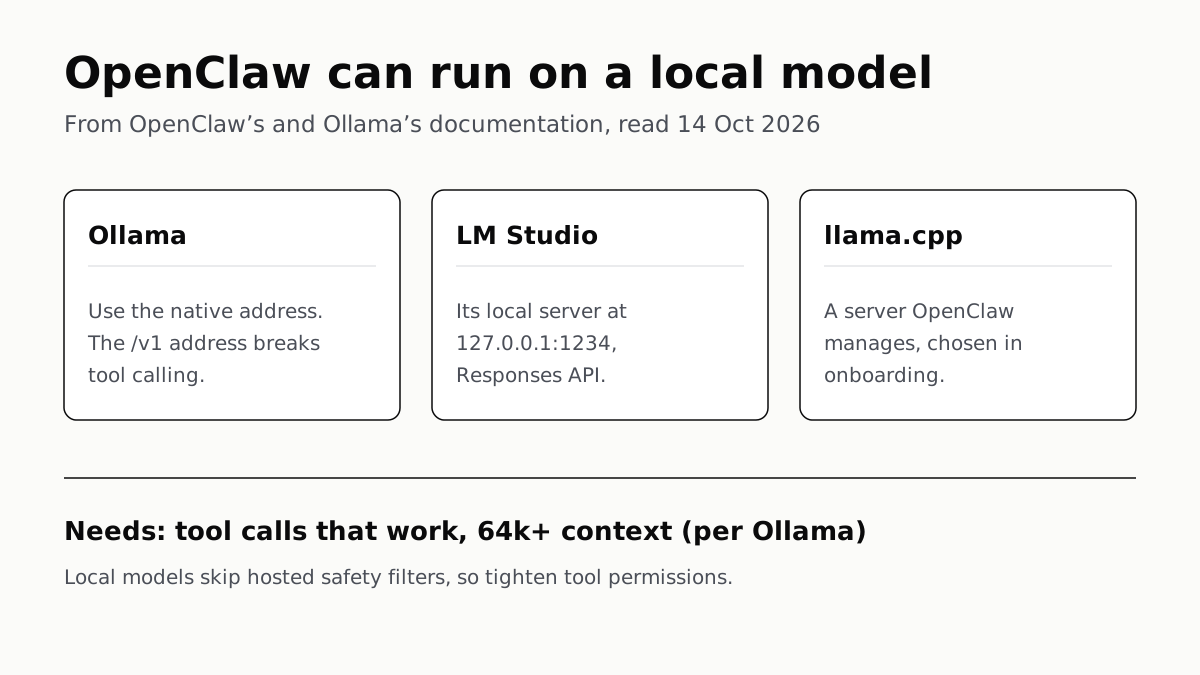
OpenClaw Runs on a Local LLM via Ollama or LM Studio
OpenClaw's docs also cover llama.cpp, vLLM and any OpenAI-compatible server. Ollama advises 64k context; small models are easier to hijack.
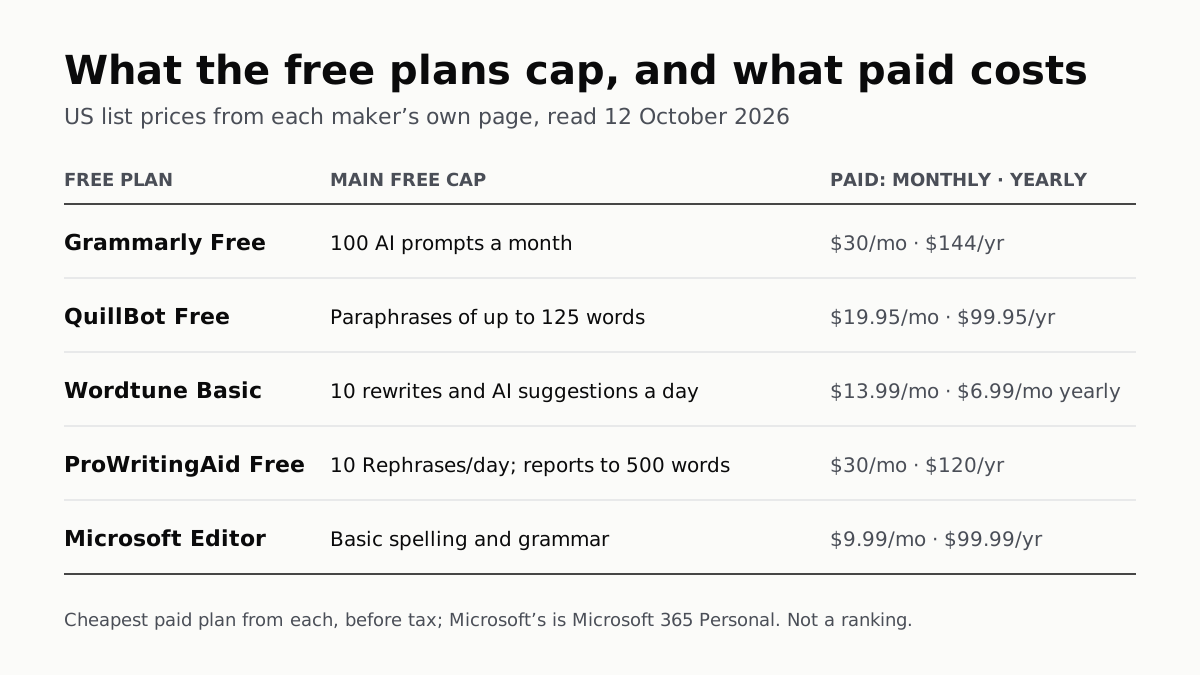
Free AI Writing Tools Ration Rewrites in Different Units
Grammarly gives 100 AI prompts a month, Wordtune 10 rewrites a day, QuillBot 125 words a paraphrase. Yearly billing halves most prices.
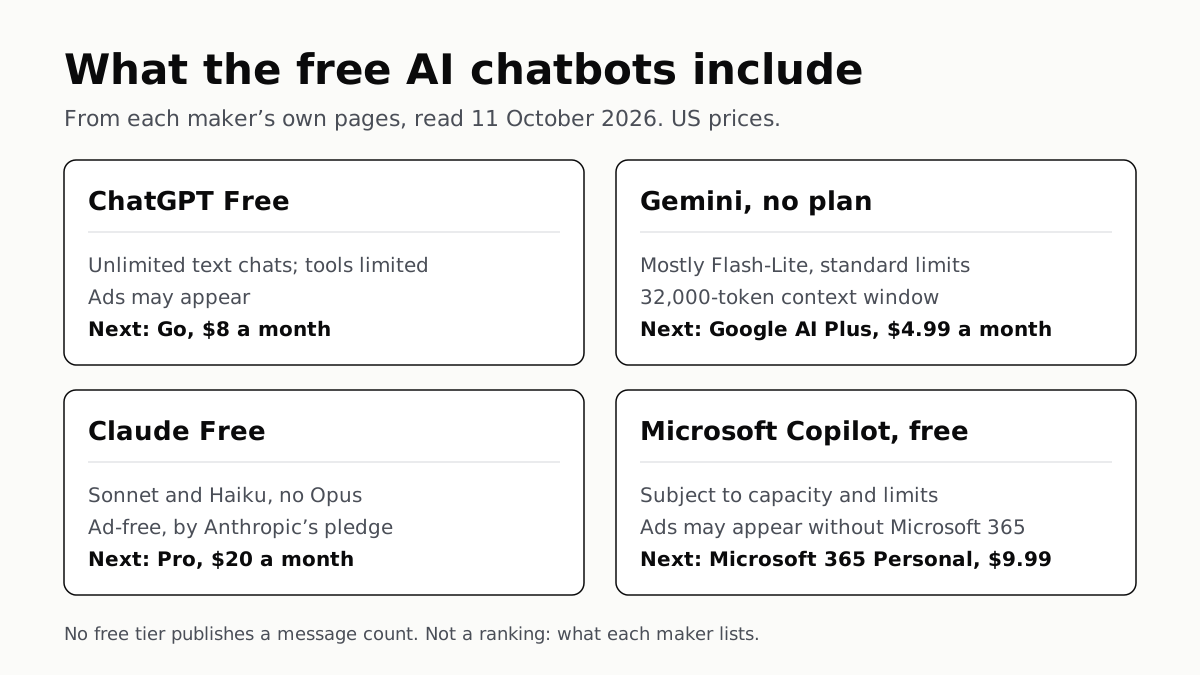
Of Four Free AI Chatbots, Only ChatGPT Lists Unlimited Chat
ChatGPT’s free tier carries ads, as Copilot’s may; Gemini’s leans on Flash-Lite and Claude’s leaves out Opus.
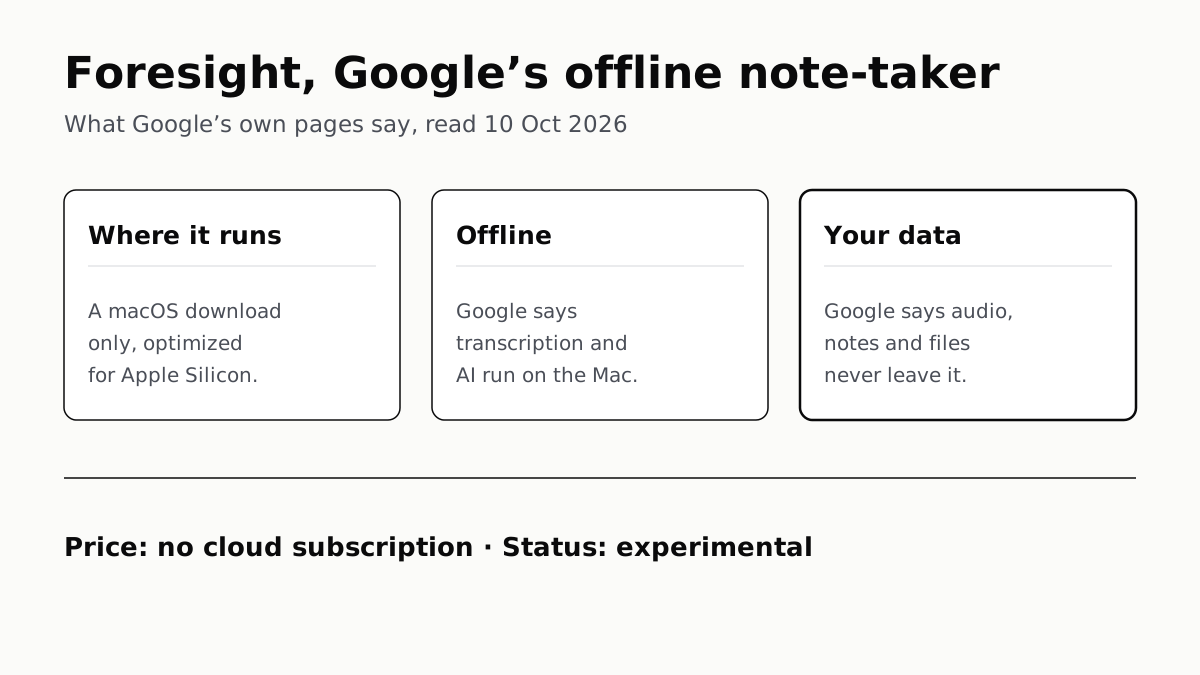
Google’s Offline AI Note-Taker Runs Only on a Mac
Transcription and AI run on the Mac itself, with no phone version. Google says your audio, notes and files never leave the computer.