Why Handheld Gaming Battery Life Is Always Short
The ROG Ally X carries twice the Steam Deck's battery and lasts about as long at full tilt. The capacity bought performance, not hours.

If you buy through our links, we may earn a commission. It never affects our verdicts or scores — how that works. As an Amazon Associate I earn from qualifying purchases.
Because every generation spends its bigger battery on being faster. The ROG Ally X carries twice the Steam Deck LCD’s battery and lasts about the same at full load, because its power ceiling doubled at the same time.
Runtime is capacity divided by draw. Manufacturers keep raising both.
The arithmetic, from their own sheets
Two figures per machine, both published by the maker:
| Steam Deck LCD | Steam Deck OLED (affiliate link to Amazon, opens in a new tab) | ROG Ally X | |
|---|---|---|---|
| Battery | 40Whr | 50Whr | 80Whr |
| Power envelope | 4–15W | 4–15W | 9–30W |
| At the ceiling | ~2.7h | ~3.3h | ~2.7h |
| Weight | 669g | 640g | 678g |
Divide capacity by the top of the envelope and the Ally X lands in the same place as the Deck it doubles. Twice the battery, twice the appetite, same worst case — and that is before the screen, the radios and the storage take their share, which is why real figures come in lower than this.
The Ally X is genuinely the faster machine. It is not the longer-lasting one at full tilt, and buying it expecting both is the mistake the specification invites.
The number that actually moves runtime
Not capacity. The envelope — the wattage cap, exposed on most handhelds as a TDP setting.
Because the relationship is a division, halving the draw roughly doubles the hours. That is a far bigger lever than any battery upgrade on sale, it is free, and it is a slider in a menu.
This is also what Valve’s published range is describing. It quotes “2 - 8 hours of gameplay” for the LCD and “3-12 hours” for the OLED. A fourfold spread is not vagueness, it is the envelope — the bottom of the range is a demanding title at the ceiling, the top is a light one near the floor.
One maker publishes hours, the other does not
Worth noticing, because it tells you something about both.
Valve gives a range with the unflattering end included. ASUS’s ROG Ally X sheet lists “80WHrs, 4S1P, 4-cell Li-ion” and no hours at all.
Neither is dishonest. A range is harder to market than a single number and more useful than one, and publishing no figure is more defensible than publishing an optimistic one. But it does mean the only handheld runtime figure you can hold a manufacturer to is Valve’s.
What to actually do
- Cap the wattage before you change anything else. Most handhelds expose a TDP slider. Dropping from the ceiling to the middle typically costs less than it sounds and buys back most of an hour.
- Cap the frame rate too. A game rendering 90 frames when the panel shows 60 is spending battery on frames nobody sees. This is the single most wasteful default in handheld gaming.
- Read the envelope, not the battery, when comparing. A larger cell alongside a higher ceiling is a performance upgrade wearing a battery upgrade’s clothes.
- Treat published hours as the shape, not the answer. Where a range exists, the bottom of it is the number to plan around.
- Carry watts, not milliamp-hours. A power bank that cannot sustain your handheld’s draw will slow the discharge rather than charge it — the spec that matters is sustained output, and it is on the box. If the pack is going on a plane, its watt-hours decide whether it can fly.
How we researched this
No one at bitcritiq has handled this product. Everything here comes from published sources, listed below.
- What this cannot tell you
- Dividing capacity by peak draw gives the worst case, not real runtime — the screen, radios and storage draw too, and no game sits at the ceiling continuously. bitcritiq has measured no runtimes. Treat the numbers as the shape of the constraint, not as results, and note that the two makers do not define their envelopes identically.
How we chose this, and what we did
- Why this subject
- Battery life is the first complaint about every handheld and the one specification buyers most expect a bigger number to fix. The published figures show why it does not, and the comparison is available from two manufacturers' own spec sheets without anyone needing to run a test.
- How we looked at it
- Took capacities and power envelopes from Valve's two Steam Deck spec sheets and ASUS's ROG Ally X sheet, then divided one by the other. The arithmetic is deliberately shown rather than asserted so a reader can check it, and it is labelled as our calculation rather than a measurement.
What you would need
A USB-C PD power bank
Two numbers decide it: sustained output in watts must meet or beat what your handheld draws (45W for a Steam Deck, 65W for a ROG Ally X), and capacity in watt-hours tells you how many refills you get. A 100Wh pack is the usual airline ceiling and roughly one full Ally X charge.
Check price on Amazon (affiliate link, opens in a new tab)
We have not tested these and are not picking one for you — each link is a search for the class of thing described above. If you buy through one we may earn a commission, which changes nothing on this page. How that works. As an Amazon Associate I earn from qualifying purchases.
What this rests on
3 claims, 2 official and 1 corroborated. Nothing here was measured by bitcritiq — see how we test for why.
The Steam Deck's APU operates in a 4-15W envelope; the ROG Ally X's is 9-30W.Official
Valve's and ASUS's own published tech specs.
Doubling battery capacity did not double worst-case runtime, because the power ceiling doubled too.Corroborated
Arithmetic on the published capacities and envelopes, set out below. It is our calculation from their figures, not a measured runtime test.
Valve publishes a battery-life range; ASUS publishes no hours figure at all.Official
Valve states 2-8 hours (LCD) and 3-12 hours (OLED). The ROG Ally X spec sheet lists capacity and cell chemistry only.
Sources 3
- Steam Deck Tech Specs (LCD) — ValveOfficialaccessed Aug 30, 2026
- Steam Deck Tech Specs (OLED) — ValveOfficialaccessed Aug 30, 2026
- ROG Ally X (2024) Tech Specs — ASUSOfficialaccessed Aug 30, 2026
Pass it on
Know someone weighing this up? Send them the answer.
bitcritiq.com/ya3gThe link is permanent: it opens this article for good, even if the title changes.
No email, no account
Follow bitcritiq
Every new article, in whatever reader you already use.
Subscribe by RSSAll the ways to follow
Using Chrome on Android? Open the browser menu and tap Follow. New articles then turn up in the Following tab in Discover.
read next
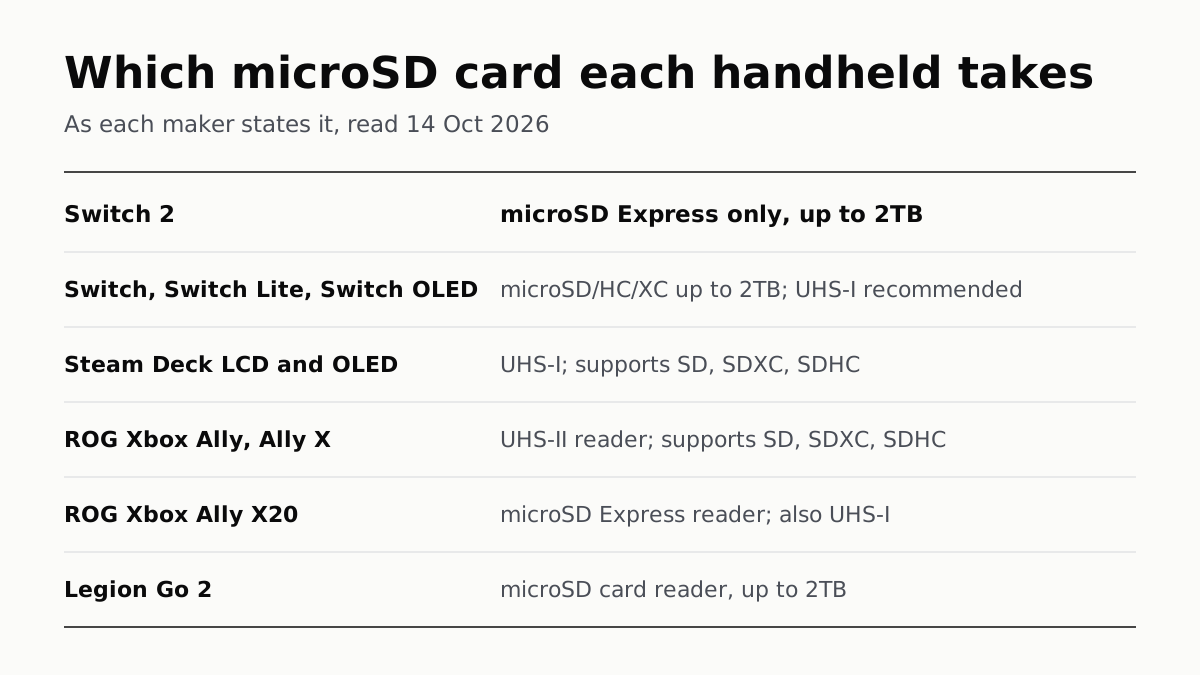
Switch 2 Needs microSD Express; Steam Deck Takes UHS-I
Asus’s Xbox Allys list UHS-II readers, the X20 an Express reader that also takes UHS-I, and Lenovo states 2TB for the Legion Go 2.

Switch Online Is $19.99 a Year; Expansion Pack Adds $30
The $49.99 tier adds N64, GBA, Virtual Boy and Genesis games and three DLC packs; GameCube games come only on Switch 2.

PS Plus: Essential for Online Play, Premium to Stream
Extra adds a catalog of hundreds of games for $134.99 a year; Premium adds classics and trials at $159.99. Essential is $79.99.

On Xbox, Day-One Games Need Ultimate; Online Play Is $9.99
PC Game Pass has day-one games at $13.99 but no cloud play, which from November is capped at 5, 10 or 15 hours a month by tier.