In NYC, You Can Now Cancel the Way You Signed Up
A city rule in force since 1 October adds online cancellation, renewal reminders and fines from $525. Complaints go to DCWP through 311.
If you buy through our links, we may earn a commission. It never affects our verdicts or scores — how that works. As an Amazon Associate I earn from qualifying purchases.
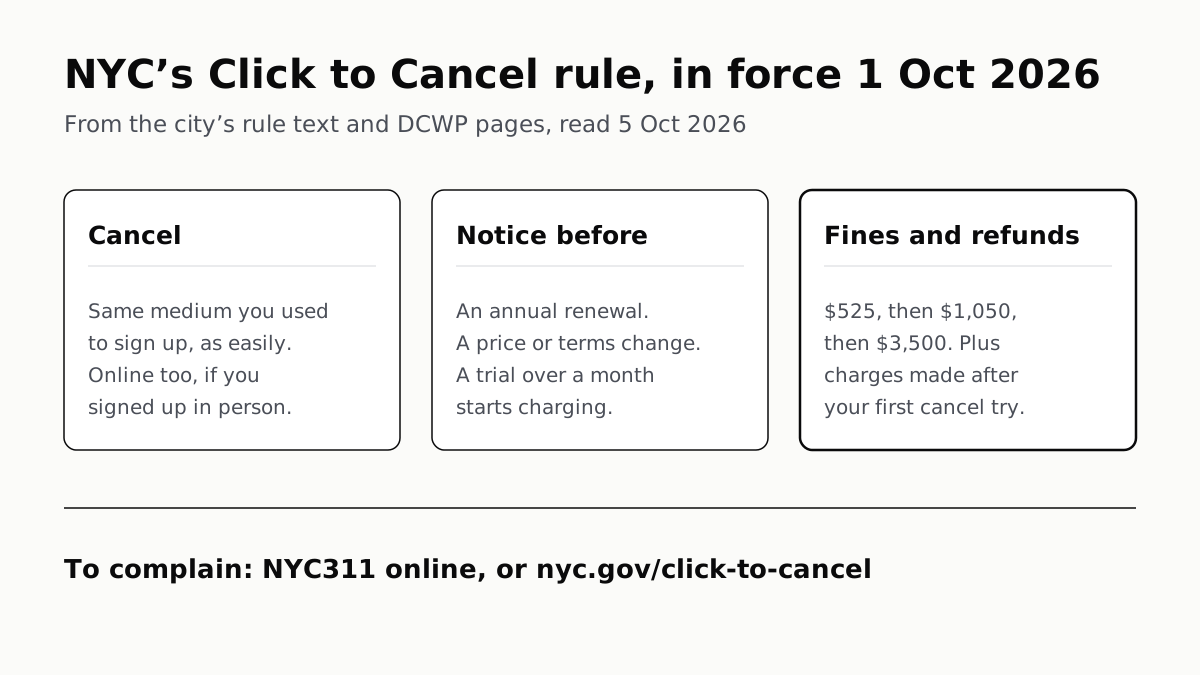
If you are a consumer in New York City, a business selling you a subscription must now let you cancel at any time, through the same medium you signed up with and as easily, and must remind you before certain renewals and price changes. If it does not, you can complain to the city’s Department of Consumer and Worker Protection (DCWP) through 311; fines start at $525 per violation.
The rule took effect on 1 October 2026. It arrives after the federal version was struck down in court, which left no national click-to-cancel requirement in force. DCWP calls this the first municipal rule of its kind in the country.
What a business now has to let you do
The rule covers any subscription that is an “automatic renewal” (renews at the end of a fixed term) or “continuous service” (runs until you cancel), for goods or services. Its requirements, from the rule text:
| Requirement | What the rule says |
|---|---|
| Clear terms before you agree | Product, price, how often you are charged, the deadline to stop charges, and how to cancel, shown next to the consent request. Trials and temporary prices must say when and to what the price changes |
| Same medium, as easy | Cancel “at any time” by a mechanism “as easy to use” as the one you consented with, “through the same medium” |
| Every sign-up channel cancels | Cancellation must be possible through all the channels the business accepts sign-ups through |
| Signed up in person | The business must also offer cancellation online, “such as a website or email” |
| No obstruction | No hanging up, no false information about how to cancel, no unreasonable delay |
| Unordered goods | Products sent without your consent are a gift; you owe nothing, including return shipping |
Signing up online and then being told to call, or to visit in person, is the case the city itself names as something to report.
Save offers survive, with a limit. A business may still answer a cancellation with a discount, a retention perk or an explanation of what you lose. It breaks the rule when that offer puts conditions on cancelling, obstructs it or unreasonably delays it. After industry groups said the draft discouraged save offers, DCWP made minor wording changes to make clear the clause matches New York State law.
The reminders you are now owed
| When | Applies to | Notice window |
|---|---|---|
| Before a renewal | First paid term of a year or more, renewing for six months or more | 15 to 45 days before the cancellation deadline, with instructions on how to cancel |
| Before a change | Any material change to terms, price increases included | 5 business days to 30 days before the change |
| Before a trial converts | A free gift or trial lasting more than a month | 3 to 21 days before the deadline for the first paid period |
The reminders go by the channel you chose — text, email, app notification or anything else the business offers. A monthly plan with no trial gets no renewal reminder under this rule, only the notice before a price or terms change.
The annual reminder matters most for plans like the long VPN deals whose renewal price is well above the introductory one. The change notice applies to monthly plans too, such as the streaming tiers in our comparison of what it costs to remove the ads.
Who is covered, and who is not
The rule applies to “any person” offering an automatic renewal or continuous service “to a consumer”. Its definitions section defines automatic renewal, continuous service and person, but says nothing about where the business has to be. NYC311 says DCWP handles complaints about businesses in New York City, and sends complaints about businesses elsewhere to local consumer offices or the State Attorney General. Whether a national online service falls under the city rule is for DCWP to decide case by case.
Explicitly exempt:
- services from a business operating under a franchise issued by a New York political subdivision
- entities regulated by the state Department of Financial Services, banks, credit unions and other licensed financial institutions
- security alarm operators licensed by the New York Department of State
- sellers and administrators of service contracts under the state Insurance Law
Phone and broadband companies are not on the list. Wireless and telecom companies asked for an exemption, arguing federal rules already protect their customers. DCWP rejected it, saying they had not identified any federal requirement to offer click to cancel.
What a violation costs the business
| Violation | Fine |
|---|---|
| First | $525 |
| Second | $1,050 |
| Third and later | $3,500 |
On top of the fine, a business found in violation owes the amount it charged after your first attempt to cancel. That makes the date of your first attempt the number to record.
New York State law already required a cancellation mechanism as easy as the sign-up (General Business Law § 527-a). DCWP’s statement says the city rule matches that approach, and adds its own penalty amounts, the refund provision and the extra cancellation channels.
How to complain
- Keep evidence first. Screenshots of the sign-up and cancellation screens, emails, and the date you first tried to cancel.
- File online through NYC311, in its “Click to Cancel Complaint” article, under “Report a problem with a subscription”.
- Give an address or email. Without one, DCWP treats the report as a tip and you get no follow-up. With one, DCWP sends you a complaint form to complete and return.
- Or skip 311 and use the form directly. Download it from nyc.gov/click-to-cancel (it comes in 12 languages) and mail it, with copies of receipts or contracts, to DCWP Consumer Services Division, 42 Broadway, New York, NY 10004, or fax it to (212) 487-4482.
- Check progress by calling 311 or 212-639-9675 with your complaint number.
DCWP says it reviews each complaint and may assign a mediator, who sends the complaint to the business for a written response and then talks to both sides to reach an agreement.
If you pay for several of the subscriptions now attached to hardware — our count of what a household’s devices need came to $339.80 a year across five — write down each renewal date anyway. The city’s reminders cover only some of them.
Questions people ask
What is the NYC click to cancel rule?
A New York City consumer protection rule, 6 RCNY Part 8, in force since 1 October 2026. It makes it a deceptive and unconscionable trade practice to sell an auto-renewing or continuous subscription without clear terms, an easy cancellation in the same medium as sign-up, and advance renewal reminders.
Can a company make me call to cancel if I signed up online?
Not under the NYC rule. Cancellation must be through the same medium you used to consent and as easy to use. The city’s own page gives signing up online but being forced to cancel by phone or in person as an example of what to report.
Are retention offers still allowed when I cancel?
Yes, with a limit. A business may show a discount or explain what you lose, but not if the offer obstructs, conditions or unreasonably delays the cancellation you asked for.
How do I file a click to cancel complaint in NYC?
Online through NYC311 (“Report a problem with a subscription”), or download the complaint form and mail it to DCWP at 42 Broadway, New York, NY 10004, or fax it to (212) 487-4482. Include an address or email, or DCWP treats it as a tip.
Will I get my money back if a company refused to cancel?
The rule makes a violator liable for what it charged after your first attempt to cancel, so note that date and keep proof. Whether you are repaid depends on how DCWP resolves the complaint, which can include mediation with the business.
Does the NYC click to cancel rule apply to cable or phone companies?
Wireless and telecom companies asked for an exemption and DCWP refused it. The rule does exempt services provided under a franchise from a New York political subdivision, banks and other licensed financial institutions, DFS-regulated entities, licensed alarm operators and service-contract sellers.
Is there still a federal click to cancel rule?
No. The FTC’s 2024 rule was vacated by a federal court, and the FTC now calls it “the vacated 2024 Rule”. New York City’s rule is a local one.
How we researched this
No one at bitcritiq has handled this product. Everything here comes from published sources, listed below.
- What this cannot tell you
- This is not legal advice. The rule does not define where a business must be located to be covered; NYC311 says DCWP handles complaints about businesses in New York City and sends others to local consumer offices or the State Attorney General, so whether a particular national online service falls under the city rule is something DCWP decides, not something we can settle from the text. The rule is five days old at the time of writing, and no enforcement action under it had been published. We have not filed a complaint, so the steps describe what the city says happens, not what we observed.
How we chose this, and what we did
- Why this subject
- The federal click-to-cancel rule was vacated, which our September explainer covers, and readers of that page search for “cancel option” and “need to cancel”. New York City’s own rule took effect on 1 October 2026, and The Verge and Engadget both reported it that day. The practical question for a New Yorker is what a business now has to let them do, and where to complain when it does not.
- How we looked at it
- Every requirement is quoted or paraphrased from the rule itself: DCWP’s Notice of Adoption, which adds Part 8, “Click to Cancel”, to Title 6 of the Rules of the City of New York, read in full (seven pages) on 5 October 2026. The complaint route is from the city’s Click to Cancel page and NYC311 article KA-03737; dates and the savings estimate are from DCWP’s press release of 10 July 2026.
What this rests on
6 claims, all official. Nothing here was measured by bitcritiq — see how we test for why. Open a claim to read the source it came from.
New York City's Click to Cancel rule took effect on 1 October 2026 and is enforced by DCWP.Official
Rule text, Section 3: “This rule takes effect October 1, 2026.” nyc.gov/click-to-cancel: “The Department of Consumer and Worker Protection (DCWP) will enforce this rule.”
A business must let you cancel at any time, as easily as you consented and through the same medium; if you signed up in person, it must also offer online cancellation.Official
6 RCNY § 5-110.1(c): cancellation “as easy to use as the mechanism that the consumer used to provide consent and that is through the same medium”. § 5-110.1(d): “where consent was obtained in-person… the person must offer cancellation through an online mechanism, such as a website or email.”
Save offers are allowed only if they do not obstruct or unreasonably delay the cancellation.Official
§ 5-110.1(e)(2) bars presenting “a discounted offer, retention benefit or information regarding the effect of cancellation if such offer… imposes unreasonable or unlawful conditions upon the consumer’s ability to cancel”, obstructs it or unreasonably delays it.
Businesses must send reminders before annual renewals, before material changes including price increases, and before a free trial of more than a month converts.Official
§ 5-110.1(g): 15 to 45 days before the cancellation deadline for an initial paid term of one year or longer renewing for six months or longer. (h): 5 business days to 30 days before a material change. (i): 3 to 21 days before the deadline for a free trial of more than a month.
Penalties are $525 for a first violation, $1,050 for a second and $3,500 for a third or later, and a violator owes back what it charged after the consumer's first attempt to cancel.Official
Rule Section 2 penalty chart for 6 RCNY § 5-110.1: $525 / $1,050 / $3,500. § 5-110.2: liable for “the monetary amount charged… after the consumer’s first attempt at cancellation.”
Complaints can be made online through NYC311 or by mail or fax to DCWP.Official
NYC311 KA-03737: “Online — Report a problem with a subscription. By Mail — Download a complaint form.” nyc.gov/click-to-cancel: mail to DCWP Consumer Services Division, 42 Broadway, New York, NY 10004, or fax (212) 487-4482.
Sources 5
- Click to Cancel — NYC Department of Consumer and Worker Protection, nyc.govOfficialStandards / .govaccessed Oct 5, 2026
- Notice of Adoption: Click to Cancel rule, 6 RCNY Part 8 (Statement of Basis and Purpose and rule text) — NYC DCWPOfficialStandards / .govaccessed Oct 5, 2026
- Click to Cancel Complaint — NYC311 (KA-03737)OfficialStandards / .govaccessed Oct 5, 2026
- Mamdani Administration Announces Landmark Consumer Protection Rules to Ban Subscription Traps and Junk Fees — NYC DCWP, 10 July 2026OfficialStandards / .govaccessed Oct 5, 2026
- The Cancel Button You Think Is Required Is Not — bitcritiqaccessed Oct 5, 2026
Pass it on
Know someone weighing this up? Send them the answer.
bitcritiq.com/uyf8The link is permanent: it opens this article for good, even if the title changes.
No email, no account
Follow bitcritiq
Every new article, in whatever reader you already use.
Subscribe by RSSAll the ways to follow
Using Chrome on Android? Open the browser menu and tap Follow. New articles then turn up in the Following tab in Discover.
read next
Free Airline Wi-Fi Needs a Loyalty Login, Except JetBlue
Delta, United, American, Southwest, Alaska and Hawaiian are free on equipped planes for members; JetBlue asks for a short ad.
Spotify Premium Is $12.99; Family Covers 6 for $21.99
Duo is $18.99 for two at one address and Student $6.99 with Hulu. Individual and plan managers get 15 audiobook hours a month.
YouTube Premium Lite Keeps Ads on Music and Shorts
At $8.99 a month against $15.99, Lite also leaves out the YouTube Music app and downloads or background play for songs.
Apple One Costs $13 to $35 a Month Less Than Its Parts
Individual $21.95: Music, TV, Arcade, 50GB. Family $27.95: the same with 200GB, for six. Premier $39.95 adds News+, Fitness+, 2TB.