OLED Lights Each Pixel; Mini-LED Lights an LCD Behind It
Self-lit pixels give OLED its blacks and a burn-in risk; a zoned backlight gives Mini-LED brightness and a halo risk.
If you buy through our links, we may earn a commission. It never affects our verdicts or scores — how that works. As an Amazon Associate I earn from qualifying purchases.
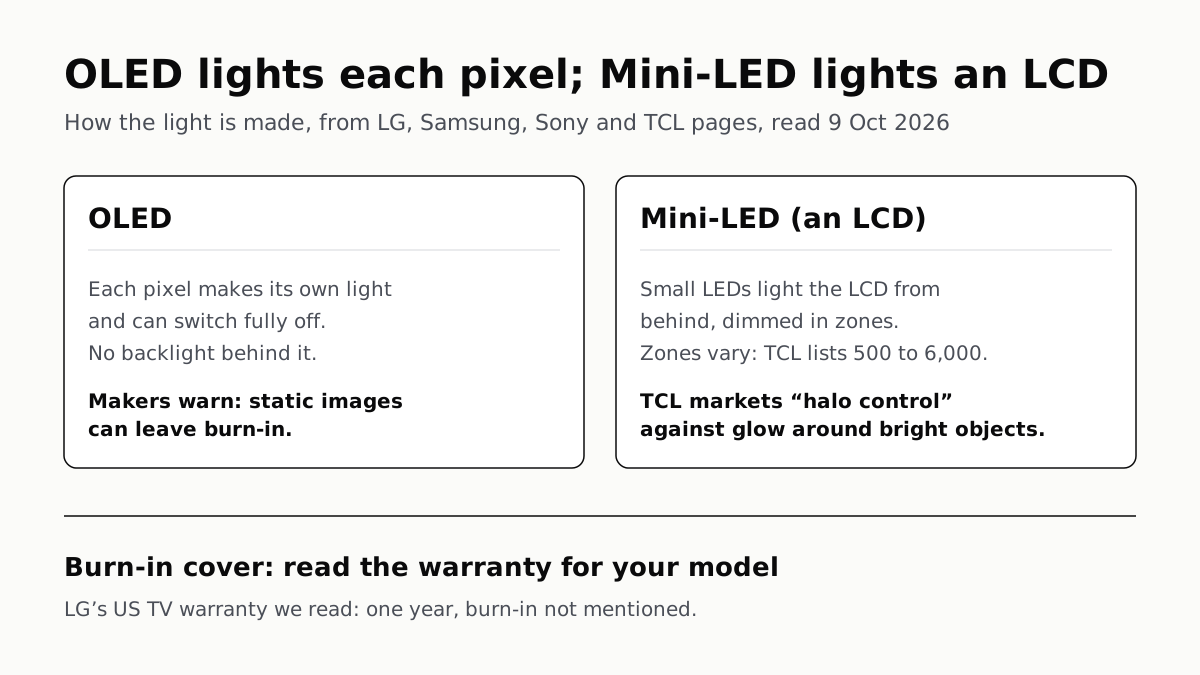
An OLED TV makes light in each pixel and can switch each one off; a Mini-LED TV is an LCD lit from behind by many small LEDs, dimmed in zones. That is why the makers who sell both describe OLED as the one for black level and dark rooms and Mini-LED as the brighter one, and why burn-in is an OLED question and halo a Mini-LED one.
Everything below is the makers’ own description, read on their US pages on 9 October 2026. We have not measured any set.
How each one makes light
OLED. LG describes “self-emitting pixels made of organic compounds that light up when an electric current passes through them”, each turning “on or off independently… without the need for a backlight”. Samsung’s OLED guide says the same: each pixel “can turn off completely”. A black pixel is a switched-off pixel.
Mini-LED. The picture is still made by an LCD. TCL, which says it introduced the first Mini-LED TV in 2019, explains that an LED TV “uses an LCD panel, and LEDs function as the backlight… shining through the LCD panel”. Mini-LEDs are smaller diodes, around 0.2 millimetres or less, so a set can carry many more of them, which TCL says reaches “upwards of 25,000” on some models against “maybe a few hundred” on a conventional backlight. Groups of them dim and brighten together: TCL calls these “Contrast Control Zones”, also known as local dimming. Sony’s spec sheets put it plainly, listing the BRAVIA 9 (affiliate link to Amazon, opens in a new tab) and BRAVIA 7 as display type “LCD” with a “Mini LED (QLED)” backlight.
What that changes, property by property
| OLED, as makers describe it | Mini-LED, as makers describe it | |
|---|---|---|
| Light source | Each pixel lights itself; no backlight (LG, Samsung) | LEDs behind an LCD, dimmed in zones (TCL, Samsung, Sony) |
| Black level | Pixels “turn off completely to deliver perfect black” (LG) | Local dimming lets “the blackest-blacks and whitest-whites” share the screen (TCL) |
| Halo around bright objects | No backlight zones to spill | TCL markets a “Halo Control System”; zone counts vary by model |
| Peak brightness | Samsung claims “high peak brightness” for its OLEDs | LG says QNED evo “excels in peak brightness”; Samsung points well-lit rooms to Neo QLED |
| Viewing angle | Wide, from self-emission (LG, Samsung, Samsung Display) | A per-model feature: Sony lists it on the BRAVIA 9 (affiliate link to Amazon, opens in a new tab), not the BRAVIA 7 |
| Burn-in | Static images can cause it (LG, Samsung, Sony) | LG sells QNED evo on “durability” for “extended daily use” |
Black level and halo come from the same fact. Samsung Display, which makes QD-OLED panels, says an LCD’s backlight “is always on”, which limits how black a pixel can get, while an OLED pixel’s light source can simply be switched off. Local dimming is the LCD’s answer, and halo is its cost: a zone is far larger than a pixel, so a star on a black sky lights its whole zone, and whatever the LCD fails to block shows as a glow. TCL itself calls this “the halo problem” and sells lens and algorithm work against it.
Zone counts are where Mini-LED sets differ most. TCL’s QM6K (affiliate link to Amazon, opens in a new tab) lists “up to 500 dimming zones”, while the QM9K in the same range lists up to 6,000, and LG warns that its Mini-LED “Dimming Zones may vary by inches, models and region”. Two TVs sold as Mini-LED can have very different backlights, and makers often do not publish the count at all, as our guide to what separates a $400 TV from a $1,200 one found.
Brightness and glare cut the other way. Where one maker sells both, it places Mini-LED as the brighter: LG pitches QNED evo at “bright environments”, and Samsung says to choose Neo QLED “if you prefer brighter screens… particularly for well-lit rooms”. Samsung also concedes that OLED TVs “can be more prone to glare due to their glossy screens”, which it addresses with an anti-glare finish on its S95F.
The spec-sheet names, as their makers define them
- WOLED (LG’s OLEDs and some others): LG Display stacks red, green and blue light sources “to produce pure white light”, then uses red, green, blue and white sub-pixels.
- QD-OLED: Samsung Display uses a blue self-emitting layer and a quantum-dot layer that converts it to colour; it is still self-emissive, with no backlight. Tom’s Guide reports that Samsung’s S90F uses one or the other depending on screen size, which is why the reviewed size matters on our best-TVs shortlist.
- QLED: Samsung’s term for a backlit LCD “combined with quantum dot technology”. It does not by itself mean Mini-LED.
- Neo QLED: Samsung’s Mini-LED LCD, a backlight of “tiny mini-LEDs” with quantum dots and local dimming zones.
- QNED: LG’s “proprietary display technology that utilizes Mini-LED enhancement”; LG’s own FAQ calls QNED the high-end line of its “premium LCD TV brand”.
- QD-Mini LED: TCL’s name for its Mini-LED backlight with quantum dots.
Burn-in, and what the warranties say
The makers agree on the cause. LG says burn-in is “possible on virtually any display” but usually follows static elements left on screen “for many hours or days”, often at peak brightness, naming news-channel logos, paused games and vivid mode. Sony’s OLED article adds letterboxed or 4:3 content, game HUDs, on-screen tickers and Multi-View.
Both build in defences. LG runs a screen saver after about two minutes of inactivity, which cannot be turned off, a refresh after every four hours of cumulative use, and a full Pixel Refresher after 2,000 hours that takes about an hour once the set is off and stops if you turn it back on. Sony lists Panel refresh, Pixel shift, a screen saver and automatic brightness reduction.
The warranties are less clear than the advice. None of the three makers’ US warranty pages we read promises to cover burn-in on a current OLED TV.
- LG: its US limited warranty for “LCD / LED / OLED” televisions runs one year for parts and labor and does not mention burn-in, either way. LG’s OLED page footnotes a five-year panel warranty, panel-only after year one, but only for listed G2, G3 and Z2 models.
- Samsung: its US limited warranty terms do not name burn-in, and they exclude damage “caused by brightness related to normal aging” and by “commercial or non-normal consumer use”. Samsung’s QLED comparison page still carries a burn-in guarantee, but it covers 2017 QLED TVs, which are LCDs.
- Sony: its general image-retention article says “Image retention issues are not covered by Sony® warranty”. That article was last modified in 2019 and lists CRT and plasma sets, not OLED; Sony’s current OLED article does not mention the warranty at all.
So ask for the warranty for the exact model before you pay, and if a store offers an extended plan, the FTC’s test for an extended warranty is whether it covers more than the one already included. Burn-in is a reasonable thing to ask it to name.
Questions people ask
What is the difference between OLED and Mini-LED?
An OLED TV has no backlight: each pixel makes its own light and can switch fully off. A Mini-LED TV is an LCD lit from behind by many small LEDs, dimmed in zones. Makers describe OLED as stronger on black level and viewing angle, and Mini-LED as brighter.
Do Mini-LED TVs get burn-in?
Burn-in is the risk makers attach to OLED. LG says image retention is possible on virtually any display, but sells its QNED Mini-LED sets on durability for extended daily use, and a 2019 Sony support article says its BRAVIA sets, then LCDs, are not subject to permanent image retention.
Is OLED burn-in covered by warranty?
Not that we could find in writing. LG’s US television warranty runs one year and does not mention burn-in; Samsung’s US terms do not name it; Sony’s only statement we found, from 2019, says image retention is not covered. Ask for the warranty for the exact model before you buy.
What is blooming or halo on a Mini-LED TV?
A glow around bright objects on a dark background. Each dimming zone is larger than a pixel, so a lit zone spills light the LCD does not fully block. TCL markets a “Halo Control System” against it, and zone counts vary widely between models.
Is QLED the same as Mini-LED?
No. Samsung defines QLED as a backlight combined with quantum dots, and Neo QLED as a backlight of tiny mini-LEDs with quantum dots and local dimming. Both are LCDs. LG’s QNED evo and TCL’s QD-Mini LED are Mini-LED LCDs under other names.
What is the difference between WOLED and QD-OLED?
Both are OLED. LG Display’s WOLED stacks red, green and blue layers to make white light and uses red, green, blue and white sub-pixels. Samsung Display’s QD-OLED uses a blue light source with a quantum-dot layer that turns it into red and green.
How we researched this
No one at bitcritiq has handled this product. Everything here comes from published sources, listed below.
- What this cannot tell you
- bitcritiq has tested no televisions, and this compares the technologies as their makers describe them, not as any set measures. Makers' brightness and halo claims are their own and use no common measure. The LG warranty we read is the general US television form; LG publishes model-specific forms too, and we could not confirm which form covers a 2026 set. Sony's only warranty statement on image retention that we found is in an article last modified in July 2019 that lists CRT and plasma sets, not OLED. Hisense pages were not read.
How we chose this, and what we did
- Why this subject
- Searches for OLED TVs were at 17% of their peak in our 4 October trends digest and rising into Black Friday on 27 November, and Search Console shows readers arriving at our TV pages on “best tv 2026” wordings. Our best-TVs page reports that the OLEDs outscore the Mini-LED sets and our price-tiers guide says panel type is the largest difference, but neither explains how the two technologies make light, what that does to halo, viewing angle and burn-in, or what the warranties say.
- How we looked at it
- Read through a browser on 9 October 2026, all makers' own pages: LG's US OLED and QNED evo pages and FAQs, LG's TV picture-quality buying guide, LG's OLED reliability page and help-library article on image burn-in, and LG's US LCD/LED/OLED television limited warranty (form 3840TWL056F, a PDF whose text we extracted in the browser); Samsung's US OLED buying guide, its QLED-versus-OLED page and its home-electronics limited warranty terms; Samsung Display's QD-OLED technology page; LG Display's Tandem WOLED page; Sony's US OLED image-retention article, its older general image-retention article, and the US spec sheets for the BRAVIA 9 (K-65XR90) and BRAVIA 7 (K-65XR70); TCL's US QM6K page and its Mini-LED explainer. Absence claims have controls: LG's warranty exclusions list was read in full and names service trips, commercial use, voltage faults and consumables but not burn-in; Samsung's terms name cosmetic damage, line-voltage faults and “brightness related to normal aging” but not burn-in; Sony's OLED article names Panel refresh and Pixel shift but not the warranty.
What this rests on
6 claims, all official. Nothing here was measured by bitcritiq — see how we test for why. Open a claim to read the source it came from.
OLED pixels make their own light and need no backlight.Official
LG USA OLED FAQ: “OLED TVs use self-emitting pixels made of organic compounds that light up when an electric current passes through them. Each pixel turns on or off independently, enabling high contrast and vibrant color without the need for a backlight.”
Samsung's Neo QLED is a Mini-LED backlight with quantum dots and local dimming zones.Official
Samsung US OLED guide: Neo QLED “uses a backlight composed of tiny mini-LEDs combined with quantum dot technology. The mini-LEDs allow for finer control of brightness and contrast through local dimming zones.”
Sony lists its BRAVIA 9 and BRAVIA 7 as LCDs with a Mini LED (QLED) backlight, and only the BRAVIA 9's spec sheet lists a viewing-angle feature.Official
Sony US spec sheets: K-65XR90 “Display type LCD, Backlight type Mini LED (QLED), VIEWING ANGLE Yes”; K-65XR70 “Display type LCD, Backlight type Mini LED (QLED)”, VIEWING ANGLE “-”.
LG OLED TVs run a Pixel Refresher automatically after 2,000 hours of cumulative use, for about an hour after the set is switched off.Official
LG support: “After watching for a total of 2,000 hours or more, such as 5 hours a day for one year, the Pixel Refresher is automatically operated, and the calibration runs for about an hour once you turn off the TV.”
LG's US LCD/LED/OLED television limited warranty runs one year for parts and labor and does not mention burn-in or image retention.Official
LG form 3840TWL056F: “One (1) year from the date of original retail purchase — Parts and Labor (internal/functional parts only)”. Its ‘does not cover’ list names service trips, commercial use, voltage faults and consumables; neither burn-in nor image retention appears anywhere in it.
Sony's general image-retention article says image retention is not covered by Sony's warranty.Official
Sony support article 00025161 (last modified 23 July 2019): “IMPORTANT: Image retention issues are not covered by Sony® warranty.” The article lists CRT, CRT projection and plasma sets as subject to it.
Sources 18
- OLED TVs and FAQ — LG USAOfficialaccessed Oct 9, 2026
- QNED evo AI TVs and FAQ — LG USAOfficialaccessed Oct 9, 2026
- OLED evo vs. Micro RGB evo vs. QNED evo Mini LED: picture quality guide — LG USAOfficialaccessed Oct 9, 2026
- OLED TV Reliability: Burn-In & Lifespan — LG USAOfficialaccessed Oct 9, 2026
Show 14 more · 13 official or standards
- LG TV - Troubleshooting Image Burn-In — LG USA SupportOfficialaccessed Oct 9, 2026
- LG LCD / LED / OLED Television Limited Warranty - USA (3840TWL056F) — LGOfficialaccessed Oct 9, 2026
- Tandem WOLED — LG DisplayOfficialaccessed Oct 9, 2026
- Why OLED TVs Are Worth It — Samsung USOfficialaccessed Oct 9, 2026
- QLED vs OLED TV — Samsung USOfficialaccessed Oct 9, 2026
- HE Terms and Conditions (limited warranty) — Samsung USOfficialaccessed Oct 9, 2026
- QD-OLED — Samsung DisplayOfficialaccessed Oct 9, 2026
- Image retention on OLED TVs — Sony USAOfficialaccessed Oct 9, 2026
- Information about image retention or screen burn-in — Sony USAOfficialaccessed Oct 9, 2026
- K-65XR90 (BRAVIA 9) Specifications — Sony USAOfficialaccessed Oct 9, 2026
- K-65XR70 (BRAVIA 7) Specifications — Sony USAOfficialaccessed Oct 9, 2026
- TCL QM6K Series QD-Mini LED — TCL USAOfficialaccessed Oct 9, 2026
- A TV Larger Than Life: Discover the Mini-LED Experience — TCL USAOfficialaccessed Oct 9, 2026
- Samsung S90F OLED review — Tom's Guideaccessed Sep 21, 2026
Pass it on
Know someone weighing this up? Send them the answer.
bitcritiq.com/ds5cThe link is permanent: it opens this article for good, even if the title changes.
No email, no account
Follow bitcritiq
Every new article, in whatever reader you already use.
Subscribe by RSSAll the ways to follow
Using Chrome on Android? Open the browser menu and tap Follow. New articles then turn up in the Following tab in Discover.
read next
A Soundbar Works Without a Sub; Add One for the Lowest Bass
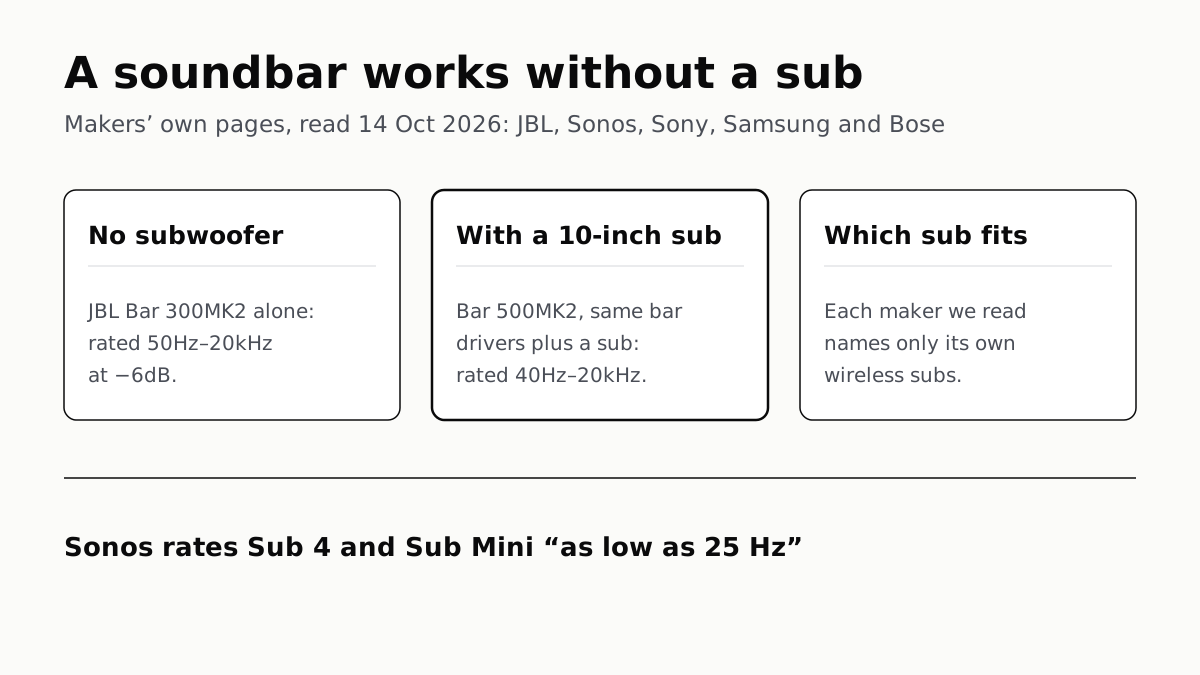
In JBL’s specs, the same bar drivers reach 50Hz alone and 40Hz with a 10-inch sub. Sony, Sonos and Samsung list only their own subs.
Seatback Bluetooth: United on 800+ Planes, Others Starting
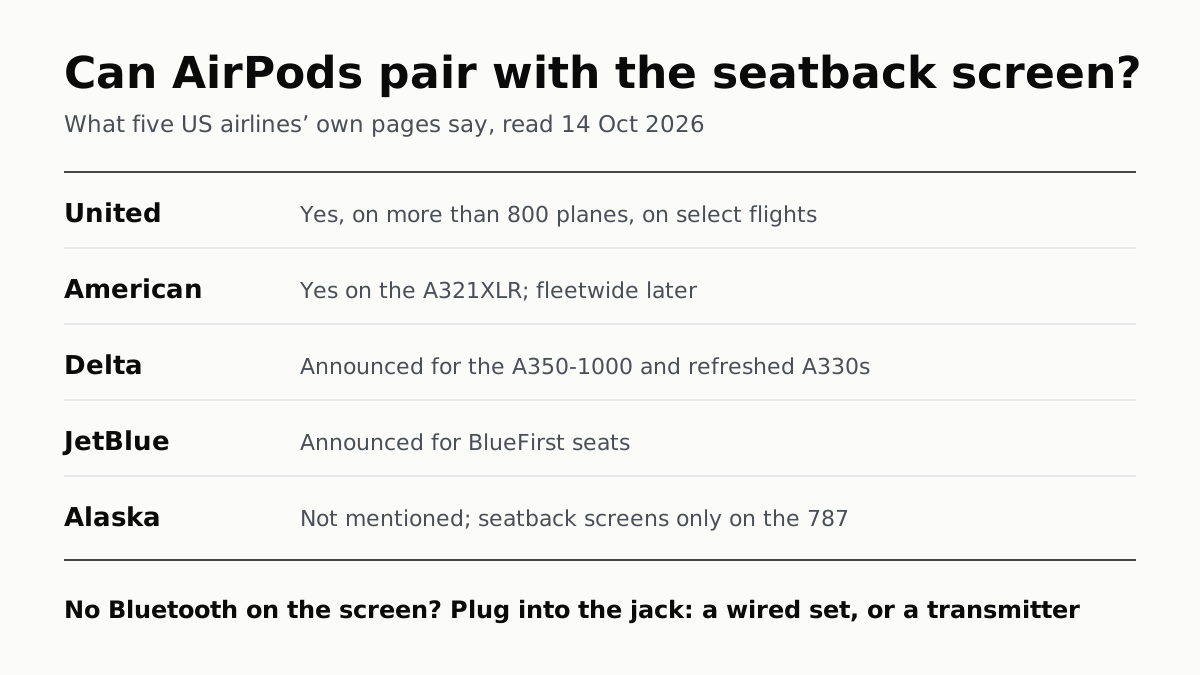
American’s A321XLR has it and JetBlue and Delta have announced it. Without it, the seatback jack needs a wired plug or a transmitter.
HDR10 Is the Fallback; Dolby Vision and HDR10+ Are Upgrades
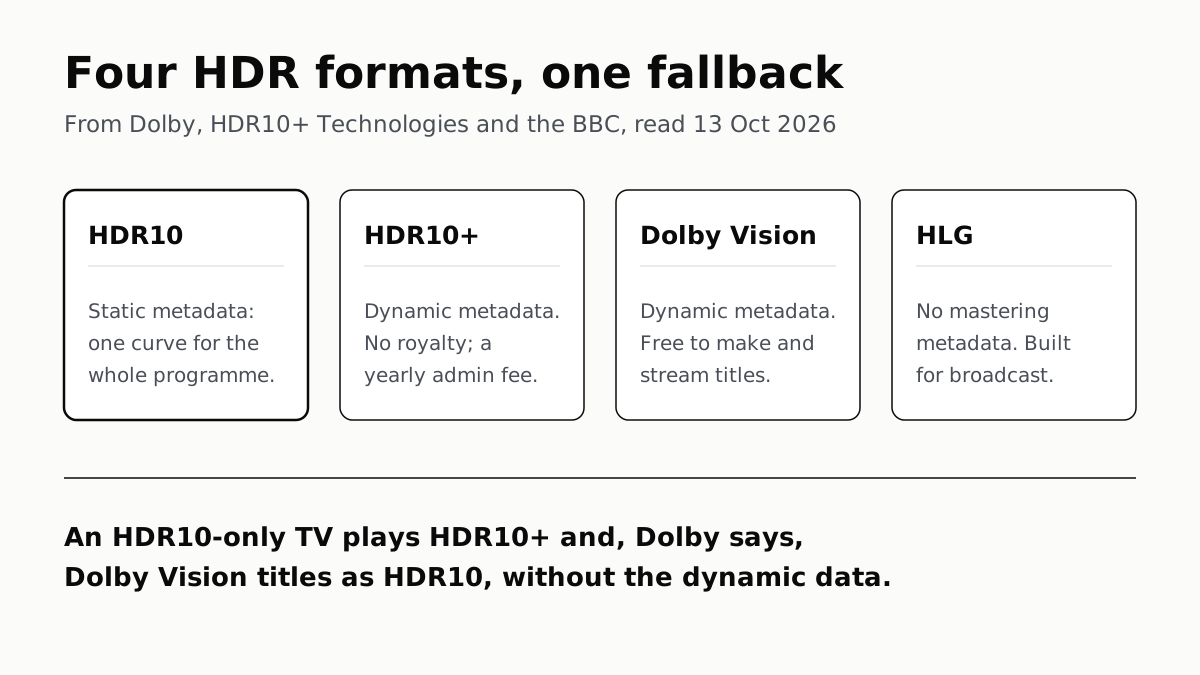
Samsung’s S90F lists HDR10+, not Dolby Vision; LG’s C6 the reverse. TCL’s QM7K lists both.
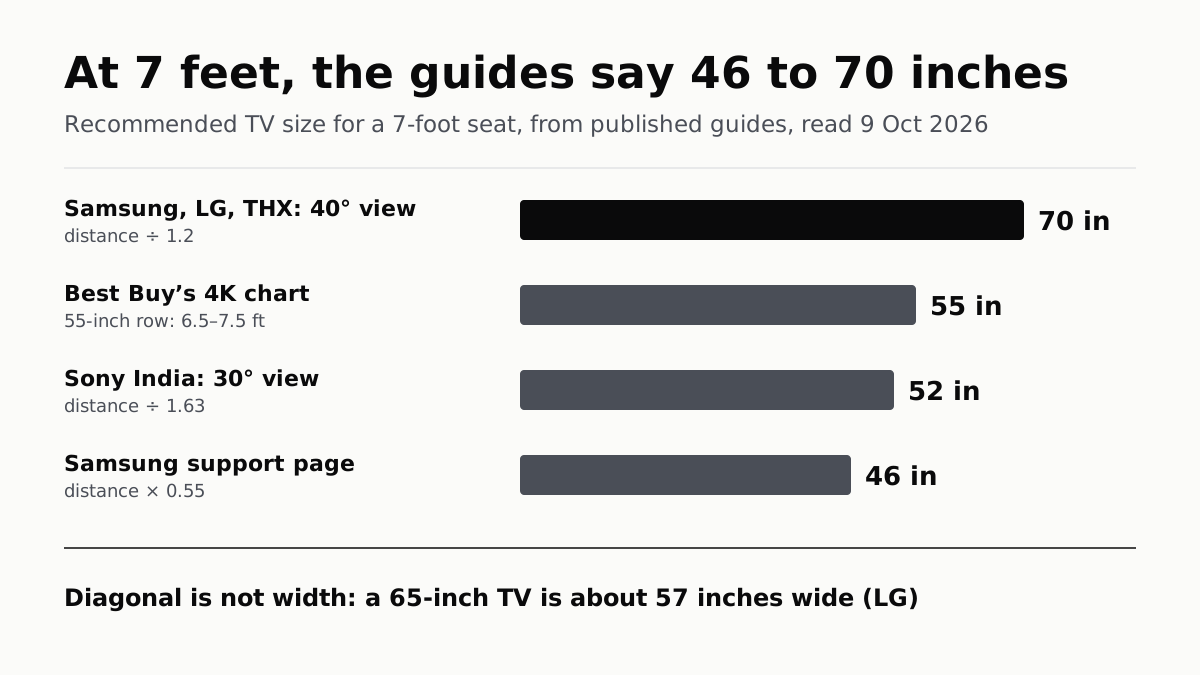
At 7 Feet, TV Makers’ Own Guides Range From 46 to 70 Inches
Samsung, LG and THX divide your distance by 1.2. Sony’s 30° table and Samsung’s own support page point you smaller.