The Best Headphones of 2026, According to the Reviews
Four pairs worth buying, sorted by what you care about most — and why the two at the top both owe it to the same reviewer.
If you buy through our links, we may earn a commission. It never affects our verdicts or scores — how that works. As an Amazon Associate I earn from qualifying purchases.
Our picks
Sony WH-1000XM6
$459.99 · list price at electronics.sony.com, checked Nov 1, 2026
- Why
- Named a top pick by both CNET and PCMag, and the pair every other set here gets compared against.
- Why not
- A full two points separate its highest and lowest score. What Hi-Fi gave it five stars; Tom's Guide gave it four.
Sennheiser Momentum 5 Wireless
- Why
- The only other pair here to take a full five stars from What Hi-Fi, whose reviews weight sound above features.
- Why not
- The same two-point spread as the Sony, and PCMag — which weights features heavily — is the outlet at the bottom of it.
All Sennheiser Momentum 5 Wireless scores, specs and price →
Apple AirPods Max 2
$549 · list price at apple.com, checked Nov 1, 2026
- Why
- CNET's pick specifically for Apple users, and the two US outlets that scored it both landed at 4.5.
- Why not
- What Hi-Fi is the outlier at four stars, and it is the outlet that cares most about how they sound.
Bose QuietComfort Ultra Headphones (2nd Gen)
$449 · list price at bose.com, checked Nov 1, 2026
- Why
- Three outlets, three identical scores. Nothing else in this category is agreed about that cleanly.
- Why not
- That agreement is at four stars, not five — this is the pair everyone thinks is good and nobody calls exceptional.
All Bose QuietComfort Ultra Headphones (2nd Gen) scores, specs and price →
About Amazon prices. Product prices and availability are accurate as of the date/time indicated and are subject to change. Any price and availability information displayed on Amazon.com at the time of purchase will apply to the purchase of this product. Prices, deals and product photos on these cards come from Amazon's affiliate data service and are refreshed at least hourly; a price with no deal label is Amazon's current price, not a discount we have judged.
- Best all-rounder9.0industry avg · 3 outlets
Sony WH-1000XM6
FlagshipTypeOver-ear, closed-backBattery30hBluetooth codecsSBC, AAC, LDAC, LC3ChargingUSB-CNoise cancellingActive, with Transparency modeCaseMagnetic clasp, book-style — stores flatFinishesBlack, Silver, Midnight BlueWeight254 g$459.99 · list price at electronics.sony.com
- Why
- Named a top pick by both CNET and PCMag, and the pair every other set here gets compared against.
- Why not
- A full two points separate its highest and lowest score. What Hi-Fi gave it five stars; Tom's Guide gave it four.
The outlets disagree by 2.0 points
3 outlet scores · they disagree by 2 points
- What Hi-Fi?5/510.0/10
- PCMag4.5/59.0/10
- Tom's Guide4/58.0/10
- Best for sound quality9.0industry avg · 3 outlets
Sennheiser Momentum 5 Wireless
FlagshipTypeOver-ear, closed-backBatteryUp to 57h with ANC onBluetooth5.4 (6.0 promised via firmware)CodecsSBC, AAC, aptX, aptX HD, aptX Adaptive, aptX LosslessNoise cancellingActive — 4 mics per sideAppSmart Control Plus, 8-band EQTransducerMade at Sennheiser's Tullamore, Ireland plantWeight290 g- Why
- The only other pair here to take a full five stars from What Hi-Fi, whose reviews weight sound above features.
- Why not
- The same two-point spread as the Sony, and PCMag — which weights features heavily — is the outlet at the bottom of it.
The outlets disagree by 2.0 points
3 outlet scores · they disagree by 2 points
- What Hi-Fi?5/510.0/10
- Trusted Reviews4.5/59.0/10
- PCMag4/58.0/10
- Best for an Apple household8.7industry avg · 3 outlets
Apple AirPods Max 2
FlagshipTypeOver-ear, closed-backChipApple H2, one per ear cupDriverApple-designed dynamic driverNoise cancellingActive, with Transparency modeAdaptive featuresAdaptive Audio, Conversation AwarenessBatteryUp to 20h with ANC onFast charge5 min for ~1.5h playbackControlsDigital Crown (volume, transport, calls)Weight13.6 oz (386.2 g)$549 · list price at apple.com
- Why
- CNET's pick specifically for Apple users, and the two US outlets that scored it both landed at 4.5.
- Why not
- What Hi-Fi is the outlier at four stars, and it is the outlet that cares most about how they sound.
Close agreement between outlets
3 outlet scores
- PCMag4.5/59.0/10
- Tom's Guide4.5/59.0/10
- What Hi-Fi?4/58.0/10
- Best low-regret buy8.0industry avg · 3 outlets
Bose QuietComfort Ultra Headphones (2nd Gen)
FlagshipTypeOver-ear, closed-backBattery30hBluetooth codecsSBC, AAC, aptX AdaptiveMultipointYesChargingUSB-CNoise cancellingActive, with Transparency modeFinishesBlack, White Smoke, Midnight Violet, Driftwood Sand, Desert GoldWeight250 g$449 · list price at bose.com
- Why
- Three outlets, three identical scores. Nothing else in this category is agreed about that cleanly.
- Why not
- That agreement is at four stars, not five — this is the pair everyone thinks is good and nobody calls exceptional.
Close agreement between outlets
3 outlet scores
- Trusted Reviews4/58.0/10
- What Hi-Fi?4/58.0/10
- PCMag4/58.0/10
About Amazon prices. Product prices and availability are accurate as of the date/time indicated and are subject to change. Any price and availability information displayed on Amazon.com at the time of purchase will apply to the purchase of this product. Prices, deals and product photos on these cards come from Amazon's affiliate data service and are refreshed at least hourly; a price with no deal label is Amazon's current price, not a discount we have judged.
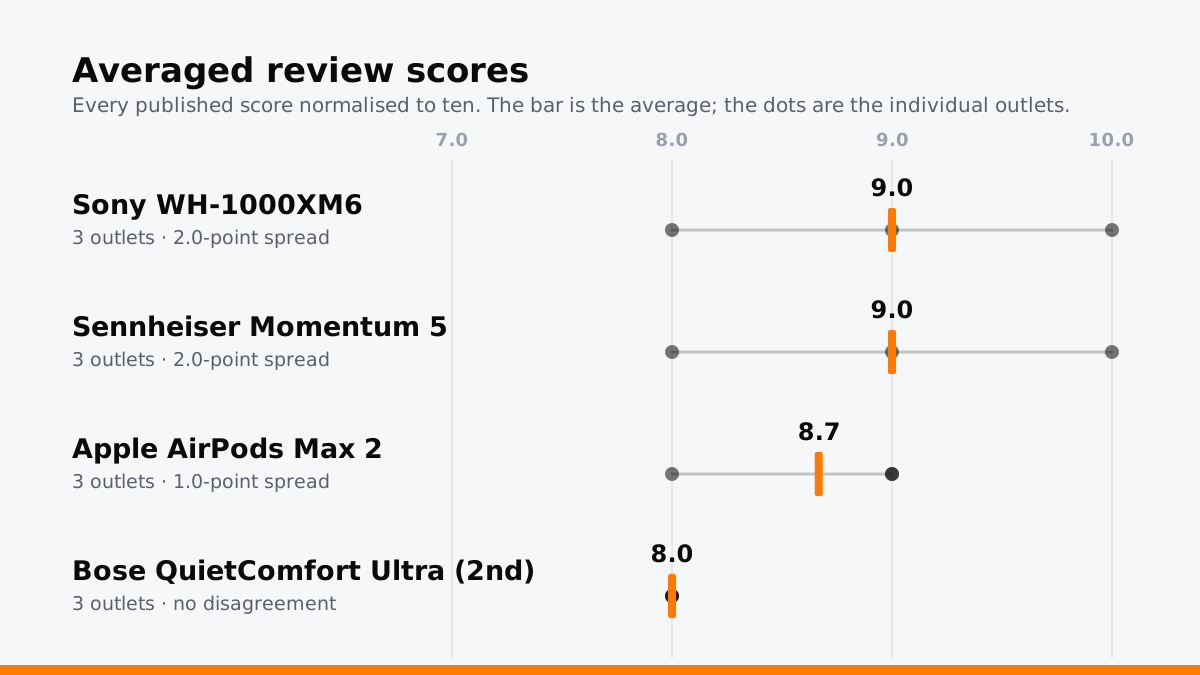
Start with the Sony WH-1000XM6, the pair both CNET and PCMag default to. It ties for the top of this list on 9.0 with the Sennheiser Momentum 5 Wireless — and both got there the same way, which is worth knowing before you spend anything. What Hi-Fi? gave each of them five stars out of five, and PCMag gave each of them four. Remove one outlet from the average and the ranking changes.
That is not a flaw in the reviews. It is a real difference in what they are measuring, and it is the most useful thing on this page.
If it is the Sony you are weighing, how Sony’s current noise-cancelling headphones differ sets the XM6 beside the cheaper models in the same lineup. For the Sennheiser, which Sennheiser is which sets the Momentum 5 beside Sennheiser’s other wireless pairs. Other makers’ ranges are set out the same way, for example Skullcandy’s wireless headphones and Audio-Technica’s M-Series and wireless models.
What this list is, and is not
We have not worn any of these. Everything below is published testing from named outlets, converted to a common ten-point scale and averaged, with every score linked.
Scope is narrow on purpose: over-ear wireless noise-cancelling, which is what most people mean by headphones at this price. Earbuds answer a different question and are not mixed in.
The disagreement is the finding
Sort the four pairs by how much their reviewers argued and a pattern appears immediately.
The Sony and the Sennheiser both carry a two-point spread. In both cases What Hi-Fi? sits at the top and PCMag at the bottom. What Hi-Fi? weights sound quality above nearly everything; PCMag weights features, app behaviour and value. So the same pair of headphones can be a five-star product and a four-star product without either reviewer being wrong — they are answering different questions.
The Bose is the opposite case: three outlets, three identical four-star scores, no argument at all. It averages lowest of the four and it is the one you are least likely to regret, because there is no reviewer whose priorities would have warned you off it.
So the honest summary is not a winner. It is: if you care most about how music sounds, the outlet that also cares most rates the Sony and the Sennheiser at full marks. If you want a pair nobody has a specific complaint about, that is the Bose, and it will cost less.
What to actually do
- Decide which reviewer you are before you read further: if sound quality is why you are buying, weight What Hi-Fi?; if you want features to work reliably, weight PCMag.
- If you cannot decide, the Bose is the low-regret option — unanimously good, never described as exceptional.
- Buy on fit if you can try them. Every limitation of this method lands on the same point: nobody else’s head is your head, and comfort over three hours is the thing no score captures.
- Expect the discounts in late November, and expect them to be deepest on last generation rather than on these. That is often the better buy, and this page will not pretend otherwise.
We will revisit this when new reviews land. If we buy and test these ourselves, this page becomes a scored list at the same address, keeping whatever standing it has earned by then.
How we researched this
No one at bitcritiq has handled this product. Everything here comes from published sources, listed below.
- What this cannot tell you
- Averaging other people's scores cannot tell you how a headband feels on your head after three hours, and fit is the single most personal thing about this category. It also inherits each reviewer's taste in sound signature, which varies more between audio outlets than between the products they are scoring. No prices here — headphone discounting is heavier and more erratic than any other category we cover, and a figure we have not checked today would mislead.
How we chose this, and what we did
- Why this subject
- Headphone buying searches climb from September and peak in the Black Friday window, so this was written in August rather than in November when it would be too late to matter. Scope is deliberately narrow — over-ear wireless noise-cancelling, the thing most people mean by headphones at this price. Earbuds are a different product answering a different question and are not mixed in here.
- How we looked at it
- Took published numeric scores from named outlets for each pair, normalised to a ten-point scale, and averaged them. Both the original score and the conversion are shown so the arithmetic can be checked. Picks are segmented by who each pair suits rather than ranked, and where outlets disagree that disagreement is reported instead of being averaged away.
Sources 15
- The 6 Best Headphones of 2026 — RTINGSaccessed Aug 27, 2026
- Best Headphones to Buy in 2026, Tested and Reviewed — CNETaccessed Aug 27, 2026
- The Best Headphones We've Tested for 2026 — PCMagaccessed Aug 27, 2026
- Sony WH-1000XM6 review — What Hi-Fi?accessed Aug 27, 2026
Show 11 more
- Sony WH-1000XM6 review — PCMagaccessed Aug 27, 2026
- Sony WH-1000XM6 review — Tom's Guideaccessed Aug 27, 2026
- Sennheiser Momentum 5 Wireless review — What Hi-Fi?accessed Aug 27, 2026
- Sennheiser Momentum 5 Wireless review — Trusted Reviewsaccessed Aug 27, 2026
- Sennheiser Momentum 5 Wireless review — PCMagaccessed Aug 27, 2026
- Apple AirPods Max 2 review — PCMagaccessed Aug 27, 2026
- Apple AirPods Max 2 review — Tom's Guideaccessed Aug 27, 2026
- Apple AirPods Max 2 review — What Hi-Fi?accessed Aug 27, 2026
- Bose QuietComfort Ultra Headphones (2nd Gen) review — Trusted Reviewsaccessed Aug 27, 2026
- Bose QuietComfort Ultra Headphones (2nd Gen) review — What Hi-Fi?accessed Aug 27, 2026
- Bose QuietComfort Ultra Headphones (2nd Gen) review — PCMagaccessed Aug 27, 2026
Pass it on
Know someone weighing this up? Send them the answer.
bitcritiq.com/dk4xThe link is permanent: it opens this article for good, even if the title changes.
No email, no account
Follow bitcritiq
Every new article, in whatever reader you already use.
Subscribe by RSSAll the ways to follow
Using Chrome on Android? Open the browser menu and tap Follow. New articles then turn up in the Following tab in Discover.
read next
To Use One TV Remote, Turn On HDMI-CEC at Both Ends
Samsung calls it Anynet+, LG Simplink, Sony BRAVIA Sync, Vizio CEC. Consoles, Apple TV and Switch 2 have their own switch.
7 TV Makers Build AirPlay Into Some Sets, No Apple TV Needed
Samsung lists 2018–2025 sets and LG 2018–2024. Switch AirPlay on in the TV’s settings, then use Screen Mirroring in Control Center.
Soap Opera Effect: Set the TV’s Motion Setting to Off
Samsung calls it Auto Motion Plus, LG TruMotion, Sony Motionflow, Roku Action Smoothing. Filmmaker Mode switches it off where offered.
4 of 5 TV Platforms: Antenna and HDMI Work Without Sign-In
Google TV’s basic mode needs no account or internet. Vizio and Samsung let you skip signing in; on Roku it depends on the model.