Sony’s Seven Noise Cancelling Headphones: What Each Adds
Sony’s US store pages, read 17 October: processor, codecs, battery with noise cancelling on, weight and list price for each.
If you buy through our links, we may earn a commission. It never affects our verdicts or scores — how that works. As an Amazon Associate I earn from qualifying purchases.
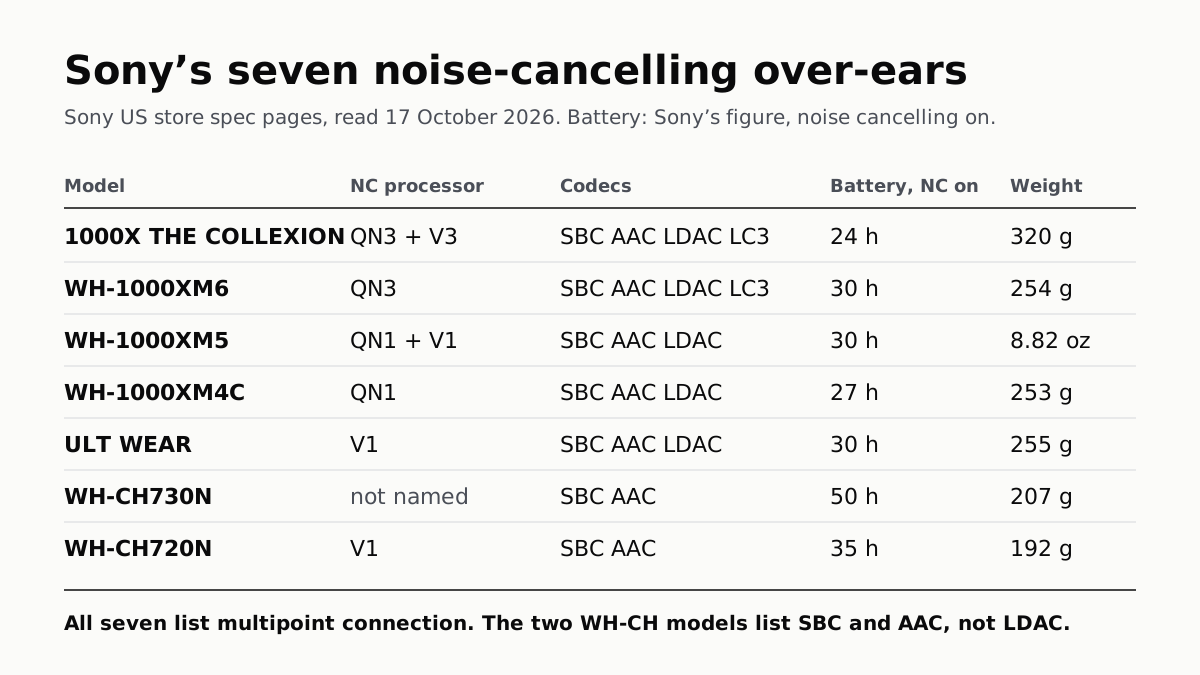
Sony’s US store sells seven wireless noise-cancelling over-ear headphones, and the steps up add three things: LDAC from the ULT WEAR upward, Sony’s QN noise-cancelling processors from the WH-1000XM4C upward, and the newest QN3 chip in the WH-1000XM6 and the 1000X THE COLLEXION. Battery with noise cancelling on does not follow the price: the WH-CH730N, one of the two lowest-priced pairs, lists 50 hours, and the dearest, the COLLEXION, lists 24.
All seven list Multipoint Connection, so the ability to stay connected to two devices does not separate them. What separates them is the processor, the codecs, the battery and the weight.
The seven side by side
From Sony’s US product pages, read 17 October 2026. Battery is Sony’s figure for music playback with noise cancelling on; prices are Sony’s store prices that day.
| Model | Noise-cancelling processor Sony names | Codecs | Battery, NC on | Weight | Driver | Folds (per Sony’s page) | Sony store price |
|---|---|---|---|---|---|---|---|
| 1000X THE COLLEXION | QN3 + Integrated Processor V3 | SBC, AAC, LDAC, LC3 | 24 h | 320 g | 30 mm | Not mentioned | $649.99 |
| WH-1000XM6 | QN3, 12 microphones | SBC, AAC, LDAC, LC3 | 30 h | 254 g | 30 mm | Yes | $459.99 |
| WH-1000XM5 | QN1 + Integrated Processor V1, 8 microphones | SBC, AAC, LDAC | 30 h | 8.82 oz (about 250 g) | 30 mm | Not mentioned | $399.99 list ($228.00 sale) |
| WH-1000XM4C | QN1 | SBC, AAC, LDAC | 27 h | 253 g | 40 mm | Yes | $299.99 |
| ULT WEAR | Integrated Processor V1 | SBC, AAC, LDAC | 30 h | 255 g | 40 mm | Yes | $249.99 |
| WH-CH730N | Not named | SBC, AAC | 50 h | 207 g | 30 mm | Yes | $179.99 |
| WH-CH720N | Integrated Processor V1 | SBC, AAC | 35 h | 192 g | 30 mm | Not mentioned | $179.99 |
Sony’s store also sells three INZONE gaming headsets with noise cancelling and a wired, on-ear MDR-ZX110NC; they are left out here.
WH-CH720N and WH-CH730N: the entry pair
The two WH-CH models share a price and the same two codecs, SBC and AAC. Sony’s FAQ says the WH-CH720N (affiliate link to Amazon, opens in a new tab)’s noise cancelling uses its Integrated Processor V1 with two microphones in each earcup, and calls it Sony’s “lightest wireless noise-canceling headband ever”, at about 192 g.
The WH-CH730N (affiliate link to Amazon, opens in a new tab) is heavier, at about 207 g, and its page names Dual Noise Sensor technology but no processor. What it lists over the WH-CH720N is battery and Bluetooth: up to 50 hours with noise cancelling on against 35, and Bluetooth 6.0 against 5.2. Its page calls it foldable; the WH-CH720N page does not mention folding.
ULT WEAR: adds LDAC and bass
The ULT WEAR keeps the V1 processor and Dual Noise Sensor technology of the WH-CH720N, by Sony’s FAQ, and adds LDAC, a 40 mm driver and the ULT button, which Sony says boosts bass. It lists 30 hours with noise cancelling on and a fold design with a carry case.
If you listen on an iPhone, the LDAC line matters less: Sony’s own help guide describes AAC as the codec mainly used by Apple products, as our codec explainer quotes. And on the ULT WEAR, Sony’s help guide says LDAC switches off when two devices are connected.
WH-1000XM4C and WH-1000XM5: the QN1 models
The WH-1000XM4C (affiliate link to Amazon, opens in a new tab), which Sony sells as “M4 2nd Gen”, is the cheapest model in this range that names Sony’s HD Noise Cancelling Processor QN1, working with two microphones on each earcup. It keeps a 40 mm driver, lists 27 hours with noise cancelling on, and Sony calls it foldable. Its page does not say what changed from the original WH-1000XM4.
The WH-1000XM5 (affiliate link to Amazon, opens in a new tab) pairs the QN1 with the Integrated Processor V1 to control eight microphones, and lists 30 hours with noise cancelling on and an Auto NC Optimizer that tunes cancelling to how you wear it. Sony’s page for it does not mention folding. On 17 October Sony’s store had it on sale well below its $399.99 list price.
WH-1000XM6: the QN3 step
The WH-1000XM6 moves to the HD Noise Canceling Processor QN3, which Sony says is “7x faster than the QN1 (found in our WH-1000XM5 headphones)”, optimising 12 microphones in real time. Sony names its tuning feature the Adaptive NC Optimizer, adjusting to outside noise, air pressure and how you wear it. It adds LC3, the LE Audio codec, and Sony’s FAQ says it folds. Battery stays at 30 hours with noise cancelling on.
1000X THE COLLEXION: the same chip, different build
The COLLEXION pairs the QN3 with an Integrated Processor V3, which Sony says powers 360 Upmix for music, cinema and game modes. It lists vegan leather, metal accents and a wider headband, Bluetooth 6.0 and the same four codecs as the WH-1000XM6. It is also the heaviest of the seven, at about 320 g, and lists the shortest battery: 24 hours with noise cancelling on.
What the spec sheets tell you, and what they do not
They answer the feature questions: which pairs have LDAC, which fold, how long each lists for a charge. They do not say how much quieter any pair makes a room; Sony’s own help guide, quoted in how noise cancelling works, says its cancelling works mainly on low-frequency noise and reduces it rather than removing it. How the pairs compare in use is a question for reviewers who have worn them, which is what our over-ear headphone shortlist averages.
Questions people ask
What is the difference between the Sony WH-1000XM5 and WH-1000XM6?
Sony says the XM6’s QN3 processor is 7x faster than the XM5’s QN1 and works with 12 microphones against the XM5’s eight. The XM6 adds LC3 to the XM5’s SBC, AAC and LDAC, and Sony’s FAQ says it folds; the XM5 page does not mention folding. Both list 30 hours with noise cancelling on.
Is the Sony WH-1000XM5 still sold?
Yes. Sony’s US store listed it on 17 October 2026, on sale at $228.00 against a $399.99 original price.
What is the Sony 1000X THE COLLEXION?
Sony’s highest-priced 1000X over-ear model, at $649.99 list. It pairs the QN3 noise-cancelling processor with an Integrated Processor V3, uses vegan leather and metal accents, and lists 24 hours with noise cancelling on. At about 320 g it is the heaviest of the seven.
Does the Sony WH-CH720N have LDAC?
No. Sony’s spec table lists SBC and AAC for the WH-CH720N, and the same two for the newer WH-CH730N. LDAC starts with the ULT WEAR in Sony’s noise-cancelling over-ear range.
What is the difference between the Sony WH-CH720N and WH-CH730N?
Both were $179.99 at Sony’s store on 17 October 2026. The WH-CH730N lists up to 50 hours with noise cancelling on against 35, Bluetooth 6.0 against 5.2, and a foldable design; the WH-CH720N is lighter, at about 192 g against 207 g.
What does the ULT WEAR add over the WH-CH720N?
LDAC, a 40 mm driver instead of 30 mm, and the ULT button, which Sony says boosts bass. It also lists 30 hours with noise cancelling on and a fold design. Both use Sony’s Integrated Processor V1 for noise cancelling, by Sony’s FAQ.
Do all Sony noise cancelling headphones support multipoint?
All seven over-ear noise-cancelling models on Sony’s US store list Multipoint Connection, in their feature list or FAQ. Sony’s ULT WEAR help guide says LDAC cannot be used while two devices are connected.
How we researched this
No one at bitcritiq has handled this product. Everything here comes from published sources, listed below.
- What this cannot tell you
- We have not worn, heard or measured any of these headphones; nothing here says how well any of them cancels noise or sounds, and no pair is scored. Sony’s spec tables label battery fields inconsistently from page to page, so where the table and the FAQ disagree we use the FAQ’s noise-cancelling-on figure and say so. Sony’s FAQ confirms the list price (“MSRP”) for the COLLEXION, WH-1000XM5, ULT WEAR and WH-CH720N; for the WH-1000XM6, WH-1000XM4C and WH-CH730N we report the store price, shown without a sale marker. The WH-1000XM4C page does not say how it differs from the original WH-1000XM4, and we did not read a Bluetooth version for it. Prices change; these are one day’s reading.
How we chose this, and what we did
- Why this subject
- Google Trends shows “sony headphones”, “best sony headphones” and “noise cancelling headphones” among top and rising queries across six pulls. Our headphone posts rank pairs on outlets’ review scores or explain how noise cancelling works; none sets Sony’s own over-ear range side by side.
- How we looked at it
- Read Sony’s US store (electronics.sony.com) over-ear headphones listing and the product pages for the WH-1000XX (1000X THE COLLEXION), WH-1000XM6, WH-1000XM5, WH-1000XM4C, WH-ULT900N (ULT WEAR), WH-CH730N and WH-CH720N on 17 October 2026, through a browser. Specs are from each page’s embedded specification table; processor names, folding and multipoint from the page’s feature text and its FAQ (FAQPage structured data); prices from the page’s price and, for the WH-1000XM5, its struck-through original price. Where we say a page does not mention folding (WH-1000XX, WH-1000XM5, WH-CH720N), we searched the page text for “fold” and found nothing, against the control “ultipoint”, which appears on the same page. The WH-CH730N’s processor was searched for “Processor”, “V1” and “QN” in its text; the control “Dual Noise Sensor” appears.
What this rests on
6 claims, all official. Nothing here was measured by bitcritiq — see how we test for why. Open a claim to read the source it came from.
Sony’s US store lists seven wireless noise-cancelling over-ear models outside its INZONE gaming range: the 1000X THE COLLEXION, WH-1000XM6, WH-1000XM5, WH-1000XM4C, ULT WEAR, WH-CH730N and WH-CH720N.Official
Sony over-ear listing, 17 October 2026: “1000X THE COLLEXION Wireless Noise Cancelling Headphones”, “WH-1000XM6 … Noise Cancelling Headphones”, “WH-1000XM4C Wireless Noise Cancelling Headphones”, “WH-1000XM5 Premium Wireless Noise Cancelling Headphones”, “WH-CH730N Wireless Noise Cancelling Headphones”, “ULT WEAR Wireless Noise Cancelling Headphones”, “WH-CH720N Wireless Noise Cancelling Headphone”.
The WH-1000XM6 uses Sony’s QN3 noise-cancelling processor with 12 microphones; the WH-1000XM5 pairs the QN1 with the Integrated Processor V1 and eight microphones.Official
WH-1000XM6 page: “The HD Noise Canceling Processor QN3 is 7x faster than the QN1 (found in our WH-1000XM5 headphones), optimizing 12 microphones in real time”. WH-1000XM5 page: “the Integrated Processor V1 unlocks the full potential of our HD Noise Canceling Processor QN1. This unique combination of technology controls eight microphones”.
The 1000X THE COLLEXION pairs the QN3 with an Integrated Processor V3 and lists 24 hours of playback with noise cancelling on.Official
WH-1000XX page: “HD Noise Cancelling Processor QN3 improves D/A conversion, while the Integrated Processor V3 powers 360 Upmix”; FAQ: “Sony lists up to 24 hours of battery life, and up to 32 hours when using a Bluetooth connection with noise cancelling switched off.”
The WH-CH730N and WH-CH720N list SBC and AAC; the five other models add LDAC, and the COLLEXION and WH-1000XM6 also list LC3.Official
Spec tables, “Supported Audio Format(s)”: WH-CH730N and WH-CH720N “SBC, AAC”; WH-1000XM5, WH-1000XM4C and ULT WEAR “SBC, AAC, LDAC”; WH-1000XX and WH-1000XM6 “SBC, AAC, LDAC, LC3”.
The WH-CH730N lists up to 50 hours with noise cancelling on, against 35 hours for the WH-CH720N, at the same store price.Official
WH-CH730N spec table: “Max. 50 hrs (NC ON), Max. 75 hrs (NC OFF)”, price 179.99. WH-CH720N FAQ: “up to 35 hours of battery life with noise canceling on”; “MSRP is listed as $179.99”.
Sony’s store had the WH-1000XM5 on sale at $228.00 against a $399.99 original price on 17 October 2026.Official
WH-1000XM5 page: “Sale Price $228.00 Save $171.99 Original Price $399.99”; FAQ: “MSRP is listed as $399.99.”
Sources 8
- Over-ear headphones — Sony Electronics US store (listing)Officialaccessed Oct 17, 2026
- 1000X THE COLLEXION Wireless Noise Cancelling Headphones (WH-1000XX) — Sony ElectronicsOfficialaccessed Oct 17, 2026
- WH-1000XM6 Wireless Noise Cancelling Headphones — Sony ElectronicsOfficialaccessed Oct 17, 2026
- WH-1000XM5 Wireless Noise Cancelling Headphones — Sony ElectronicsOfficialaccessed Oct 17, 2026
Show 4 more · 4 official or standards
- WH-1000XM4C Wireless Noise Cancelling Headphones (M4 2nd Gen) — Sony ElectronicsOfficialaccessed Oct 17, 2026
- ULT WEAR Wireless Noise Cancelling Headphones (WH-ULT900N) — Sony ElectronicsOfficialaccessed Oct 17, 2026
- WH-CH730N Wireless Noise Cancelling Headphones — Sony ElectronicsOfficialaccessed Oct 17, 2026
- WH-CH720N Wireless Noise Cancelling Headphones — Sony ElectronicsOfficialaccessed Oct 17, 2026
Pass it on
Know someone weighing this up? Send them the answer.
bitcritiq.com/2bxwThe link is permanent: it opens this article for good, even if the title changes.
No email, no account
Follow bitcritiq
Every new article, in whatever reader you already use.
Subscribe by RSSAll the ways to follow
Using Chrome on Android? Open the browser menu and tap Follow. New articles then turn up in the Following tab in Discover.
read next
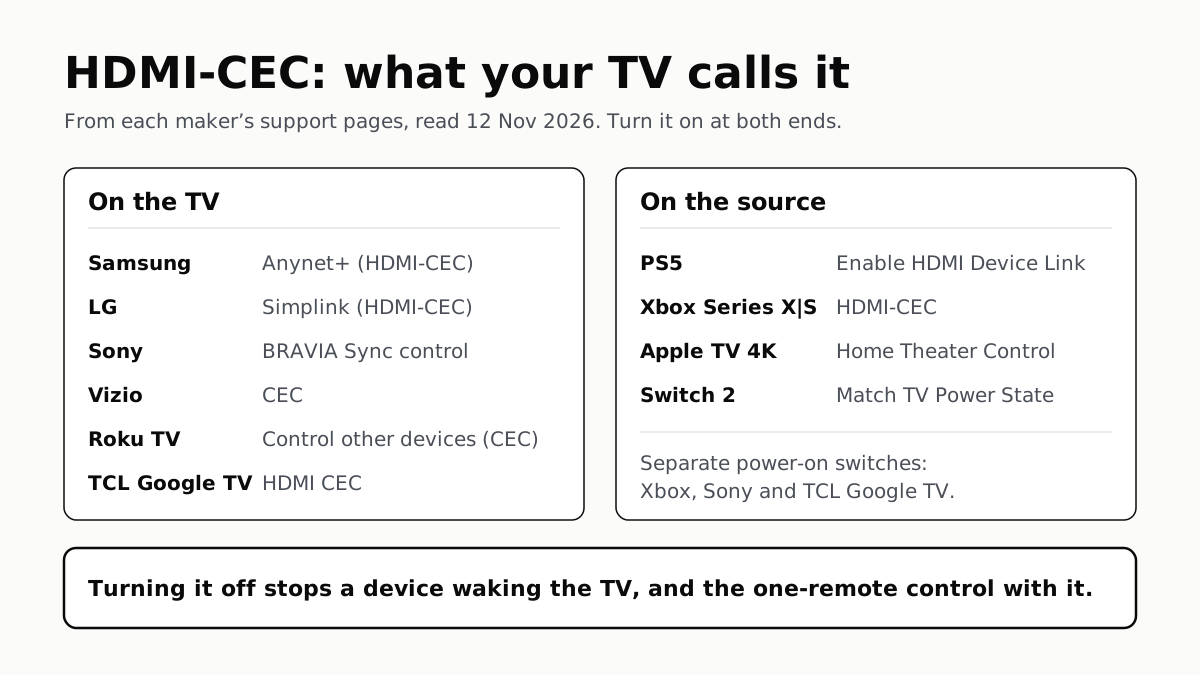
To Use One TV Remote, Turn On HDMI-CEC at Both Ends
Samsung calls it Anynet+, LG Simplink, Sony BRAVIA Sync, Vizio CEC. Consoles, Apple TV and Switch 2 have their own switch.
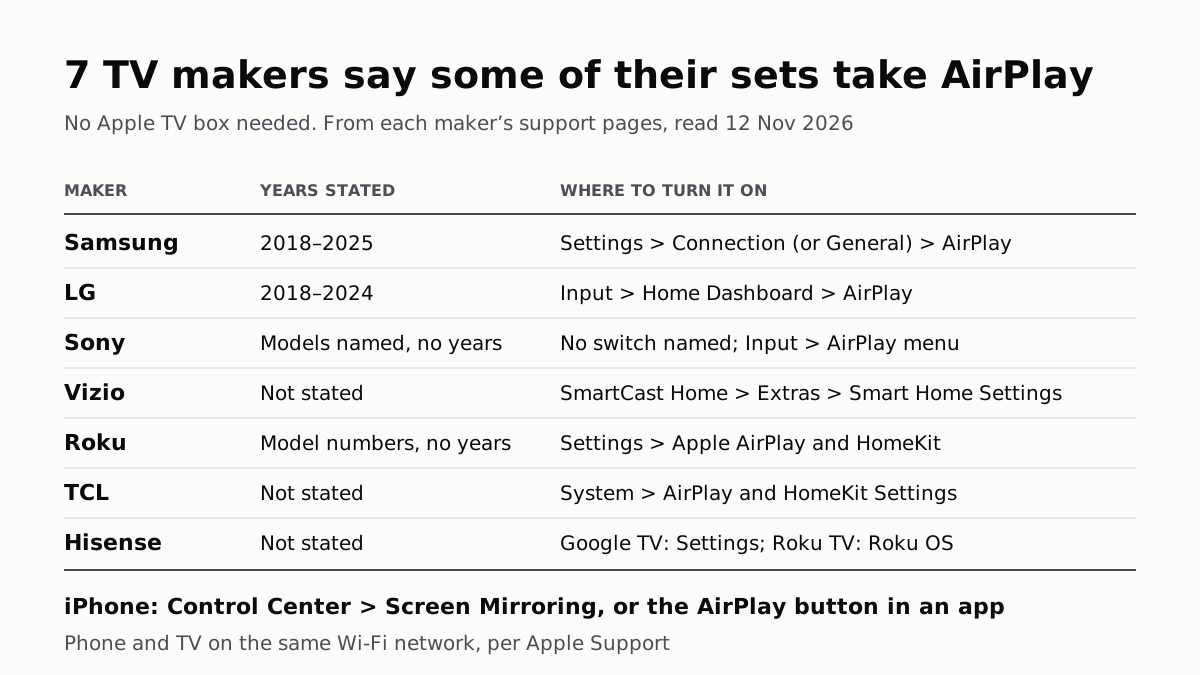
7 TV Makers Build AirPlay Into Some Sets, No Apple TV Needed
Samsung lists 2018–2025 sets and LG 2018–2024. Switch AirPlay on in the TV’s settings, then use Screen Mirroring in Control Center.
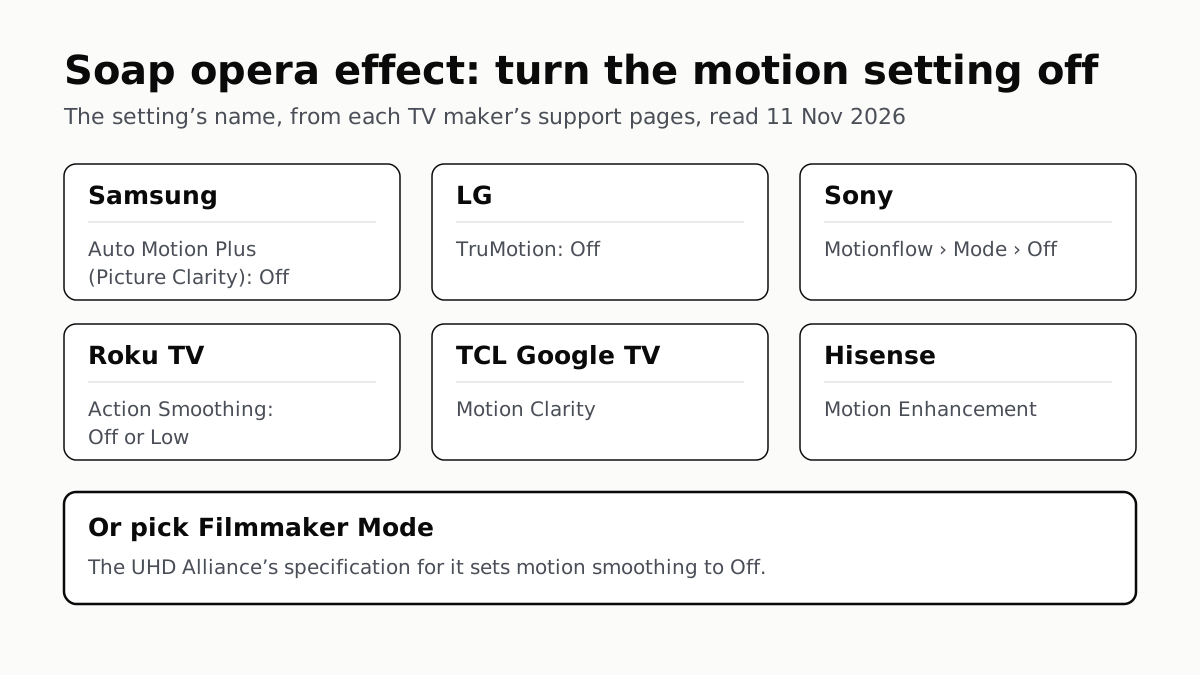
Soap Opera Effect: Set the TV’s Motion Setting to Off
Samsung calls it Auto Motion Plus, LG TruMotion, Sony Motionflow, Roku Action Smoothing. Filmmaker Mode switches it off where offered.
4 of 5 TV Platforms: Antenna and HDMI Work Without Sign-In
Google TV’s basic mode needs no account or internet. Vizio and Samsung let you skip signing in; on Roku it depends on the model.