The Best Wireless Earbuds, According to the Reviews
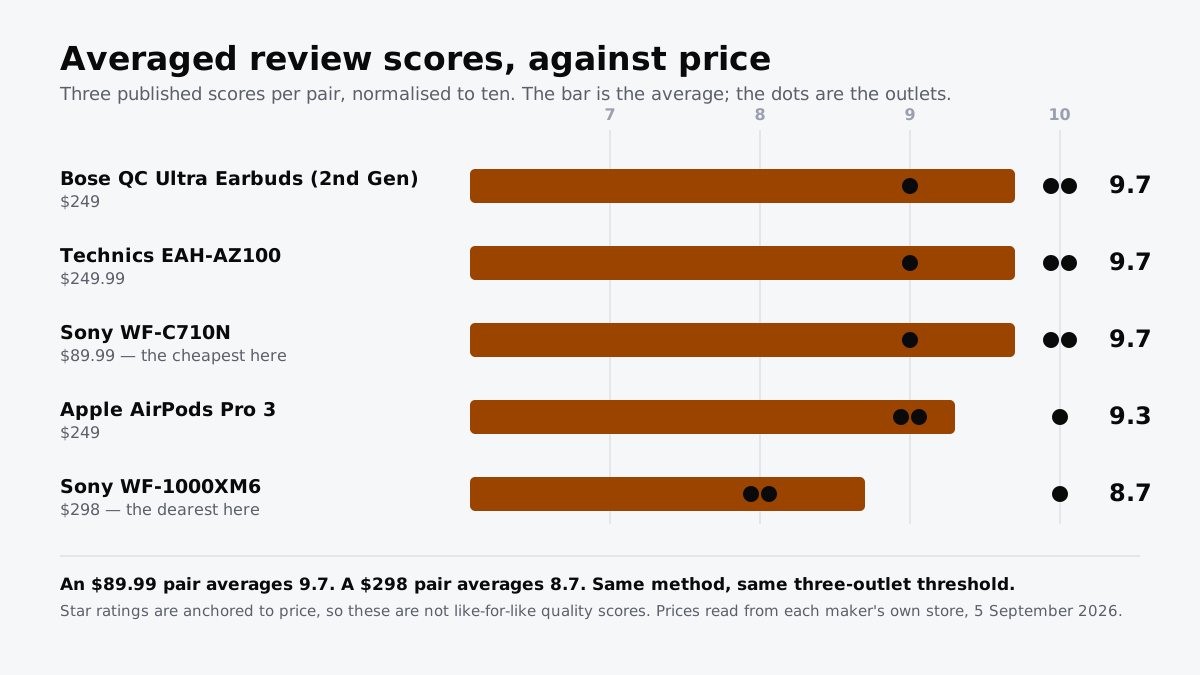
A $129.99 pair averages exactly what a $299 pair averages. What that says about star ratings is the useful part.
If you buy through our links, we may earn a commission. It never affects our verdicts or scores — how that works. As an Amazon Associate I earn from qualifying purchases.
Our picks
Bose QuietComfort Ultra Earbuds (2nd Gen)
$299 · list price at bose.com, checked Oct 4, 2026
- Why
- The highest consensus on this page, and the only pair with two full five-out-of-fives for noise cancellation specifically. TechRadar's headline calls it the best noise cancellation in earbuds to date; Tom's Guide says the same in different words. Wireless charging on the case is new this generation and fixes the old model's most-complained-about omission.
- Why not
- Battery is the weak point every outlet raised — around six hours against eight on most rivals — and the buds are physically large. Tom's Guide, the low mark of the three, went further and said it is not enough of an upgrade to replace a working first-generation pair.
All Bose QuietComfort Ultra Earbuds (2nd Gen) scores, specs and price →
Technics EAH-AZ100
$299.99 · list price at us.technics.com, checked Oct 4, 2026
- Why
- Ties the Bose at the top, and does it with fives from What Hi-Fi and Trusted Reviews — the two outlets on this page that weight sound quality hardest. The drivers come down from Technics' wired reference monitors, it holds three devices at once, and it runs ten hours a charge, the longest here. Trusted Reviews named it their wireless earbuds of the year, and TechRadar's best-earbuds guide, updated 16 October, names it the best wireless earbuds overall.
- Why not
- TechRadar is the outlier and its reservation is that noise cancellation and battery are merely good rather than best in class, which is the trade for the sound. It is also the least familiar name here, which matters more than it should when you cannot try before you buy.
Sony WF-C710N
$129.99 · list price at electronics.sony.com, checked Oct 4, 2026
- Why
- It averages exactly what the Bose and the Technics average, at $129.99 against $299 and $299.99. TechRadar's verdict is that this is the best noise cancellation you can get for the price; What Hi-Fi and Trusted Reviews both gave it five out of five. Eight and a half hours a charge is longer than the Bose manages.
- Why not
- The score is not the whole story and this page will not pretend otherwise: reviewers rate against price, so five stars here means outstanding for about a hundred and thirty dollars. There is no LDAC, the app is thinner, and the noise cancellation that impresses at this price would not lead the page at $299.
Apple AirPods Pro 3
$249 · list price at apple.com, checked Oct 4, 2026
- Why
- What Hi-Fi gave it a full five, calling the sound and noise cancelling the best Apple has managed. The features that do not appear in a score are the argument: instant pairing across every Apple device you own, hearing-aid capability, heart-rate sensing during workouts and live translation. IP57 makes it the most durable pair here.
- Why not
- At $249 it costs $50 less than the Bose and averages four tenths less, and the recurring complaint is stamina — TechRadar measured around five and a half hours in use against Apple's claimed eight. On Android most of what justifies the price simply does not switch on.
Samsung Galaxy Buds4 Pro
- Why
- The only pair here scored by all four outlets. TechRadar, Tom's Guide and Trusted Reviews each gave four and a half, and Trusted Reviews calls it Samsung's best wireless earbuds so far, with stronger noise cancelling, more balanced sound and better call quality than the previous Pro. What Hi-Fi credits clear, refined sound and a strong feature set.
- Why not
- What Hi-Fi, the low mark at four, says it needs a compatible Samsung device to sound its best and that the class leaders are better with rhythm and dynamics. Trusted Reviews makes the same point about needing a Galaxy phone and calls the controls fiddly. TechRadar's headline: not everything's upgraded.
Sony WF-1000XM6
$329.99 · list price at electronics.sony.com, checked Oct 4, 2026
- Why
- The most configurable pair here by a distance, with LDAC, the deepest app on this page and a set of controls nothing else matches. What Hi-Fi gave it five out of five and said it worries every major rival at the money.
- Why not
- The widest disagreement on this page and the lowest average on it. TechRadar and Tom's Guide both landed on four out of five, and both give the same reason: the noise cancellation is better than the last generation but still short of Bose. It is also the most expensive pair here, at $329.99.
About Amazon prices. Product prices and availability are accurate as of the date/time indicated and are subject to change. Any price and availability information displayed on Amazon.com at the time of purchase will apply to the purchase of this product. Prices, deals and product photos on these cards come from Amazon's affiliate data service and are refreshed at least hourly; a price with no deal label is Amazon's current price, not a discount we have judged.
- Best if silence is what you are buying9.7industry avg · 3 outlets
Bose QuietComfort Ultra Earbuds (2nd Gen)
FlagshipTypeIn-ear, active noise cancellingBatteryUp to 6 hours with ANC onChargingUSB-C, with wireless charging on the caseNoted strengthNoise cancellation, which every outlet here rates at the top of the classNoted limitationShorter battery than most rivals, and physically large buds$299 · list price at bose.com
- Why
- The highest consensus on this page, and the only pair with two full five-out-of-fives for noise cancellation specifically. TechRadar's headline calls it the best noise cancellation in earbuds to date; Tom's Guide says the same in different words. Wireless charging on the case is new this generation and fixes the old model's most-complained-about omission.
- Why not
- Battery is the weak point every outlet raised — around six hours against eight on most rivals — and the buds are physically large. Tom's Guide, the low mark of the three, went further and said it is not enough of an upgrade to replace a working first-generation pair.
Close agreement between outlets
3 outlet scores
- TechRadar5/510.0/10
- What Hi-Fi?5/510.0/10
- Tom's Guide4.5/59.0/10
- Best if sound is what you are buying9.7industry avg · 3 outlets
Technics EAH-AZ100
FlagshipTypeIn-ear, active noise cancellingBatteryUp to 10 hoursDrivers10mm magnetic fluid drivers, derived from the EAH-TZ700 wired monitorsMultipointThree devices at onceNoted strengthSound quality and call handling; two outlets gave it a full five$299.99 · list price at us.technics.com
- Why
- Ties the Bose at the top, and does it with fives from What Hi-Fi and Trusted Reviews — the two outlets on this page that weight sound quality hardest. The drivers come down from Technics' wired reference monitors, it holds three devices at once, and it runs ten hours a charge, the longest here. Trusted Reviews named it their wireless earbuds of the year, and TechRadar's best-earbuds guide, updated 16 October, names it the best wireless earbuds overall.
- Why not
- TechRadar is the outlier and its reservation is that noise cancellation and battery are merely good rather than best in class, which is the trade for the sound. It is also the least familiar name here, which matters more than it should when you cannot try before you buy.
Close agreement between outlets
3 outlet scores
- What Hi-Fi?5/510.0/10
- Trusted Reviews5/510.0/10
- TechRadar4.5/59.0/10
- Best value, and the reason to read the section below9.7industry avg · 3 outlets
Sony WF-C710N
BudgetTypeIn-ear, active noise cancellingBatteryAround 8.5 hours with ANC onBluetooth codecsSBC, AACWater resistanceIPX4Noted strengthNoise cancellation well beyond what the price normally buys$129.99 · list price at electronics.sony.com
- Why
- It averages exactly what the Bose and the Technics average, at $129.99 against $299 and $299.99. TechRadar's verdict is that this is the best noise cancellation you can get for the price; What Hi-Fi and Trusted Reviews both gave it five out of five. Eight and a half hours a charge is longer than the Bose manages.
- Why not
- The score is not the whole story and this page will not pretend otherwise: reviewers rate against price, so five stars here means outstanding for about a hundred and thirty dollars. There is no LDAC, the app is thinner, and the noise cancellation that impresses at this price would not lead the page at $299.
Close agreement between outlets
3 outlet scores
- What Hi-Fi?5/510.0/10
- Trusted Reviews5/510.0/10
- TechRadar4.5/59.0/10
- Best if you carry an iPhone9.3industry avg · 3 outlets
Apple AirPods Pro 3
FlagshipTypeIn-ear, active noise cancellingBatteryUp to 8 hours with ANC onBluetooth codecsSBC, AACWater resistanceIP57ExtraHeart-rate sensing, Live Translation, hearing-aid capability$249 · list price at apple.com
- Why
- What Hi-Fi gave it a full five, calling the sound and noise cancelling the best Apple has managed. The features that do not appear in a score are the argument: instant pairing across every Apple device you own, hearing-aid capability, heart-rate sensing during workouts and live translation. IP57 makes it the most durable pair here.
- Why not
- At $249 it costs $50 less than the Bose and averages four tenths less, and the recurring complaint is stamina — TechRadar measured around five and a half hours in use against Apple's claimed eight. On Android most of what justifies the price simply does not switch on.
Close agreement between outlets
3 outlet scores
- What Hi-Fi?5/510.0/10
- TechRadar4.5/59.0/10
- Tom's Guide4.5/59.0/10
- Best if you carry a Samsung Galaxy phone8.8industry avg · 4 outlets
Samsung Galaxy Buds4 Pro
- Why
- The only pair here scored by all four outlets. TechRadar, Tom's Guide and Trusted Reviews each gave four and a half, and Trusted Reviews calls it Samsung's best wireless earbuds so far, with stronger noise cancelling, more balanced sound and better call quality than the previous Pro. What Hi-Fi credits clear, refined sound and a strong feature set.
- Why not
- What Hi-Fi, the low mark at four, says it needs a compatible Samsung device to sound its best and that the class leaders are better with rhythm and dynamics. Trusted Reviews makes the same point about needing a Galaxy phone and calls the controls fiddly. TechRadar's headline: not everything's upgraded.
Close agreement between outlets
4 outlet scores
- TechRadar4.5/59.0/10
- Tom's Guide4.5/59.0/10
- Trusted Reviews4.5/59.0/10
- What Hi-Fi?4/58.0/10
- Only if you want the features and will pay for them8.7industry avg · 3 outlets
Sony WF-1000XM6
FlagshipTypeIn-ear, active noise cancellingBatteryAround 8 hours with ANC on, about 24 with the caseBluetooth codecsSBC, AAC, LDACWater resistanceIPX4Noted limitationTwo of three outlets rate the noise cancellation short of the class leaders$329.99 · list price at electronics.sony.com
- Why
- The most configurable pair here by a distance, with LDAC, the deepest app on this page and a set of controls nothing else matches. What Hi-Fi gave it five out of five and said it worries every major rival at the money.
- Why not
- The widest disagreement on this page and the lowest average on it. TechRadar and Tom's Guide both landed on four out of five, and both give the same reason: the noise cancellation is better than the last generation but still short of Bose. It is also the most expensive pair here, at $329.99.
The outlets disagree by 2.0 points
3 outlet scores · they disagree by 2 points
- What Hi-Fi?5/510.0/10
- TechRadar4/58.0/10
- Tom's Guide4/58.0/10
About Amazon prices. Product prices and availability are accurate as of the date/time indicated and are subject to change. Any price and availability information displayed on Amazon.com at the time of purchase will apply to the purchase of this product. Prices, deals and product photos on these cards come from Amazon's affiliate data service and are refreshed at least hourly; a price with no deal label is Amazon's current price, not a discount we have judged.
Going by the reviews, the best wireless earbuds are the Bose QuietComfort Ultra Earbuds (2nd Gen), the Technics EAH-AZ100 and the Sony WF-C710N: each averages 9.7 out of 10 across the published earbud reviews of TechRadar, What Hi-Fi?, Tom’s Guide and Trusted Reviews. We have not reviewed or tested any of the six pairs here; this page collects those outlets’ scores, converted to ten, and what their reviewers found.
Update, 26 October 2026. All 15 scores were re-read on the outlets’ own review pages, and none had changed. The Samsung Galaxy Buds 4 Pro is new to this page: released this year, it now has scores from all four outlets and averages 8.8, so it is listed as the pick for Samsung phone owners. Prices for the original five were read on 4 October and were not re-read for this update.
Update, 4 October 2026. Every price was re-read on the makers’ own US stores, and four had risen. Sony now lists the WF-C710N at $129.99, up from $89.99, and the WF-1000XM6 at $329.99, up from $298. Bose lists the QuietComfort Ultra Earbuds (2nd Gen) at $299, not $249. And the Technics EAH-AZ100’s $249.99 turned out to be a sale price against a $299.99 list. No score changed, and the finding stands at the new prices: the cheapest pair here still averages what pairs costing more than twice as much average.
Buy the Bose if you want silence, the Technics if you want sound, and the Sony WF-C710N if you want neither badly enough to spend $299. All three average the same 9.7 from three published outlet scores each.
Then read the section after the table, because a $129.99 pair averaging exactly what a $299 pair averages is not the bargain it looks like, and the reason is in how star ratings work rather than in the earbuds.
The six, at a glance
| Review consensus | Outlets | Price | Best at | The catch | |
|---|---|---|---|---|---|
| Bose QC Ultra Earbuds (2nd Gen) | 9.7 — one outlet cooler | 3 | $299 | Noise cancelling | Six hours a charge |
| Technics EAH-AZ100 | 9.7 — one outlet cooler | 3 | $299.99 | Sound quality | Cancelling is good, not best |
| Sony WF-C710N | 9.7 — one outlet cooler | 3 | $129.99 | Price | Scored against cheap rivals |
| Apple AirPods Pro 3 | 9.3 — close agreement | 3 | $249 | Living on an iPhone | Battery, and Android |
| Samsung Galaxy Buds 4 Pro | 8.8 — one outlet cooler | 4 | $249.99 | Living on a Galaxy phone | Best only with Samsung devices |
| Sony WF-1000XM6 | 8.7 — genuinely contested | 3 | $329.99 | Features and control | Dearest, lowest average |
Consensus averages the published star ratings for each pair, normalised to ten. Every price is the seller’s own US price: Apple, Bose, Sony and Technics read on 4 October 2026, and Samsung’s own store on 26 October 2026, rather than a retailer’s. The “best at” column is ours, read off what those reviewers found — none of them ranked these six against each other.
What a five-star budget product actually means
This is the thing to carry into the sales, and it is worth more than any pick on this page.
Reviewers do not score in a vacuum. They score against what a thing costs, which is why the same outlet can give five out of five to a $129.99 pair and five out of five to one costing two and a half times as much without contradicting itself. What Hi-Fi did exactly that, to the Sony WF-C710N and the Sony WF-1000XM6, and neither review claims the two sound alike.
So the honest reading of the table is not “the cheap one is as good”. It is: for what it costs, the cheap one is as impressive as the expensive one is for what it costs. Those are different statements, and only the second survives contact with a listening test.
The practical consequence is simple. A star rating tells you whether something is worth its own price. It does not tell you how two things at different prices compare — which is precisely the question most people are asking when they open a buying guide in November. Our piece on the cheap one against the flagship works through what that pattern looks like across every shortlist we hold.
Sony against Sony
The cleanest illustration is inside one brand. Sony makes both the cheapest pair here and the dearest, and the cheap one comes out ahead on averaged score.
TechRadar reviewed both and preferred the budget pair — four and a half out of five for the WF-C710N, four for the WF-1000XM6. Its complaint about the flagship is specific and repeated by Tom’s Guide: the noise cancelling improved over the last generation but still does not reach Bose. Two of the three outlets that scored the XM6 marked it down for the one thing its price is meant to buy.
That is not a reason to avoid the XM6. It is the most configurable pair on this page and What Hi-Fi rates it a five. It is a reason to know what you are paying the extra $200 for, which is codec support, app depth and control — not silence. All eight of Sony’s current earbuds, and which of them carry noise cancelling and LDAC, are set out in which Sony earbuds model is which.
The 2026 pair that now qualifies
The Galaxy Buds 4 Pro went on sale this year, and by 26 October all four outlets had scored it: four and a half from TechRadar, Tom’s Guide and Trusted Reviews, four from What Hi-Fi?. That makes it the only pair on this page with four scores, and its 8.8 sits just above the Sony WF-1000XM6.
What the four reviews share is a condition. What Hi-Fi? and Trusted Reviews both say it needs a Samsung device to sound its best, so its score describes it on a Galaxy phone, in the way the AirPods Pro 3’s case rests on owning Apple devices. The product page has its specifications.
What to actually do
- Decide which one thing you want first. Silence, sound, or spending as little as possible. All three answers are on this page and they are different products, not better and worse versions of one.
- If you are buying a gift, the $129.99 Sony is the low-risk answer. Three outlets, one of them twice, put it at the top of what its money buys, and nobody resents an earbud that cost less than they expected.
- Ignore the average when comparing across price brackets. It is the one thing a star rating cannot do, and the section above says why.
- Check the price the week you buy. Every figure here was read from the maker’s own store on one day, in a category that reprices constantly. Two of the first five were on sale when we looked on 4 October, so the gaps in the table are that day’s, not permanent.
- If you want earbuds from your phone’s maker, the six above include Apple’s and Samsung’s Pro pairs and none from Google. Each maker’s own range is set out in which Pixel Buds model is which and which Galaxy Buds model is which. For a maker with no phone of its own, Soundcore’s 26 earbuds are sorted by which ones cancel noise.
Questions people ask
What are the best wireless earbuds according to reviews?
Going by the published scores, three pairs tie at 9.7 out of 10: the Bose QuietComfort Ultra Earbuds (2nd Gen), the Technics EAH-AZ100 and the Sony WF-C710N. Each average comes from three of TechRadar, What Hi-Fi?, Tom’s Guide and Trusted Reviews. We have not reviewed or tested any of them; these are the outlets’ scores.
Which earbuds have the best reviews?
Of the six pairs on this page, the Bose, Technics and Sony WF-C710N average 9.7, the AirPods Pro 3 9.3, the Samsung Galaxy Buds 4 Pro 8.8 and the Sony WF-1000XM6 8.7. Every one has at least three published outlet scores, converted to a ten-point scale.
Are cheap earbuds with five-star reviews as good as expensive ones?
Not necessarily. Reviewers score against price, so What Hi-Fi? gave five out of five to both Sony pairs here, the budget WF-C710N and the flagship WF-1000XM6, and neither review says they sound alike. A star rating says a pair is worth its own price, not how it compares with a dearer one.
What are the best earbuds for a Samsung phone?
The Galaxy Buds 4 Pro average 8.8 from all four outlets. What Hi-Fi? and Trusted Reviews both say they need a compatible Samsung device to give their best, so they suit a Galaxy phone owner more than anyone else. Samsung’s full range is laid out in our Galaxy Buds explainer.
What are the best earbuds for an iPhone?
The AirPods Pro 3 average 9.3, with five out of five from What Hi-Fi?. Their case rests on features that only work fully with Apple devices, such as instant pairing across your devices. On Android, most of what justifies the price does not switch on.
Which wireless earbuds have the best noise cancelling, by the reviews?
The Bose QuietComfort Ultra Earbuds (2nd Gen). TechRadar’s review headline calls its noise cancellation the best in earbuds to date, and Tom’s Guide agrees. The trade every outlet raised is battery, around six hours a charge.
How we researched this
No one at bitcritiq has handled this product. Everything here comes from published sources, listed below.
- What this cannot tell you
- bitcritiq has listened to none of these, and has not reviewed or tested any pair. The larger limitation is in the scale itself: outlets score against what a product costs, so a five out of five on a $129.99 pair and a five out of five on a $329.99 pair are not the same judgement, and this page says so rather than letting the arithmetic imply otherwise. Fit is the other thing an average cannot carry — the single most common reason people return earbuds, and invisible in every review here. Prices in this category move weekly, and the first five were read on 4 October, not re-read on 26 October. Two of those five were on sale at the maker's own store when we read them, so they sit below the figure those products list at normally. Our search for 2026 pairs started from one outlet's guide and can miss a pair that three outlets have scored.
How we chose this, and what we did
- Why this subject
- Bluetooth audio is the biggest single category spike of the American sale season, and our existing headphone shortlist covers over-ear pairs only, which left the larger half of the category unwritten. Candidates came from the current earbud coverage at TechRadar, What Hi-Fi, Tom's Guide and Trusted Reviews, then kept only the models where three of those named outlets had published a numeric score for the same pair. On 26 October we looked again for 2026 pairs that now meet that rule, starting from TechRadar's best-earbuds guide (last updated 16 October 2026).
- How we looked at it
- Published star ratings from TechRadar, What Hi-Fi, Tom's Guide and Trusted Reviews, each normalised to a ten-point scale by doubling the score out of five. Both the original and the conversion sit beside every pick. On 26 October every score was re-read from the rating in each review page's structured data (ratingValue against bestRating): 15 scores on 15 pages, three for each of the five original pairs, and none had changed. The Samsung Galaxy Buds 4 Pro's four scores were read the same way, one from each outlet; it is the only pair on the page with four, and its average uses all four. Prices for the original five are the makers' own US list prices read on 4 October 2026; the Samsung's is Samsung's own US store price, read on 26 October 2026.
What this rests on
6 claims, all corroborated. Nothing here was measured by bitcritiq — see how we test for why. Open a claim to read the source it came from.
Three pairs on this page average 9.7 from three published outlet scores each, and one of them costs less than half what the other two do.Corroborated
Bose: TechRadar 5/5, What Hi-Fi 5/5, Tom's Guide 4.5/5, $299 at Bose. Technics: What Hi-Fi 5/5, Trusted Reviews 5/5, TechRadar 4.5/5, $299.99 list at Technics. Sony WF-C710N: What Hi-Fi 5/5, Trusted Reviews 5/5, TechRadar 4.5/5, $129.99 at Sony. Scores re-read from each page's ratingValue on 26 October 2026; prices read 4 October 2026.
The Samsung Galaxy Buds 4 Pro averages 8.8 from all four outlets, the only pair here with four scores.Corroborated
TechRadar 4.5/5 (March 2026), Tom's Guide 4.5/5 (February 2026), Trusted Reviews 4.5/5 (March 2026), What Hi-Fi 4/5 (February 2026), each page's ratingValue against bestRating 5, read 26 October 2026. 9 + 9 + 9 + 8 = 35, divided by four is 8.75.
TechRadar scored both Sony pairs and rated the cheaper one higher.Corroborated
TechRadar gave the WF-C710N 4.5/5 in April 2025 and the WF-1000XM6 4/5 in February 2026.
What Hi-Fi gave a full five out of five to both a $129.99 pair and a $329.99 pair, which is only coherent if the scale is read against price.Corroborated
What Hi-Fi: Sony WF-C710N 5/5, Sony WF-1000XM6 5/5. Neither review claims the two sound alike.
The Sony WF-1000XM6 carries the widest spread on this page, two points on a ten-point scale.Corroborated
What Hi-Fi 5/5 normalises to 10; TechRadar and Tom's Guide 4/5 each normalise to 8. Every other pair here has a spread of one point.
The AirPods Pro 3 average 9.3, four tenths below the Bose pair.Corroborated
AirPods Pro 3: What Hi-Fi 5/5, TechRadar 4.5/5, Tom's Guide 4.5/5, at $249. The Bose is $50 dearer and averages 9.7; the Technics lists at $299.99 and averages 9.7; the Sony WF-C710N is about half the price and averages 9.7.
Sources 22
- Bose QuietComfort Ultra Earbuds (2nd Gen) review — TechRadaraccessed Oct 26, 2026
- Bose QuietComfort Ultra Earbuds (2nd Gen) review — What Hi-Fi?accessed Oct 26, 2026
- Bose QuietComfort Ultra Earbuds (2nd Gen) review — Tom's Guideaccessed Oct 26, 2026
- Technics EAH-AZ100 review — TechRadaraccessed Oct 26, 2026
Show 18 more · 2 official or standards
- Technics EAH-AZ100 review — What Hi-Fi?accessed Oct 26, 2026
- Technics EAH-AZ100 review — Trusted Reviewsaccessed Oct 26, 2026
- Sony WF-C710N review — TechRadaraccessed Oct 26, 2026
- Sony WF-C710N review — What Hi-Fi?accessed Oct 26, 2026
- Sony WF-C710N review — Trusted Reviewsaccessed Oct 26, 2026
- AirPods Pro 3 review — TechRadaraccessed Oct 26, 2026
- Apple AirPods Pro 3 review — What Hi-Fi?accessed Oct 26, 2026
- Apple AirPods Pro 3 review — Tom's Guideaccessed Oct 26, 2026
- Sony WF-1000XM6 review — TechRadaraccessed Oct 26, 2026
- Sony WF-1000XM6 review — What Hi-Fi?accessed Oct 26, 2026
- Sony WF-1000XM6 review — Tom's Guideaccessed Oct 26, 2026
- Samsung Galaxy Buds 4 Pro review — TechRadaraccessed Oct 26, 2026
- Samsung Galaxy Buds 4 Pro review — Tom's Guideaccessed Oct 26, 2026
- Samsung Galaxy Buds 4 Pro review — What Hi-Fi?accessed Oct 26, 2026
- Samsung Galaxy Buds 4 Pro review — Trusted Reviewsaccessed Oct 26, 2026
- The best wireless earbuds in 2026 — TechRadaraccessed Oct 26, 2026
- Buy Galaxy Buds4 Pro (SM-R640NZWAXAR) — Samsung USOfficialaccessed Oct 26, 2026
- Technics EAH-AZ100 — Technics US storeOfficialaccessed Sep 4, 2026
Pass it on
Know someone weighing this up? Send them the answer.
bitcritiq.com/3sq6The link is permanent: it opens this article for good, even if the title changes.
No email, no account
Follow bitcritiq
Every new article, in whatever reader you already use.
Subscribe by RSSAll the ways to follow
Using Chrome on Android? Open the browser menu and tap Follow. New articles then turn up in the Following tab in Discover.
read next
To Use One TV Remote, Turn On HDMI-CEC at Both Ends
Samsung calls it Anynet+, LG Simplink, Sony BRAVIA Sync, Vizio CEC. Consoles, Apple TV and Switch 2 have their own switch.
7 TV Makers Build AirPlay Into Some Sets, No Apple TV Needed
Samsung lists 2018–2025 sets and LG 2018–2024. Switch AirPlay on in the TV’s settings, then use Screen Mirroring in Control Center.
Soap Opera Effect: Set the TV’s Motion Setting to Off
Samsung calls it Auto Motion Plus, LG TruMotion, Sony Motionflow, Roku Action Smoothing. Filmmaker Mode switches it off where offered.
4 of 5 TV Platforms: Antenna and HDMI Work Without Sign-In
Google TV’s basic mode needs no account or internet. Vizio and Samsung let you skip signing in; on Roku it depends on the model.