The Cheap One Wins Five Times Out of Six
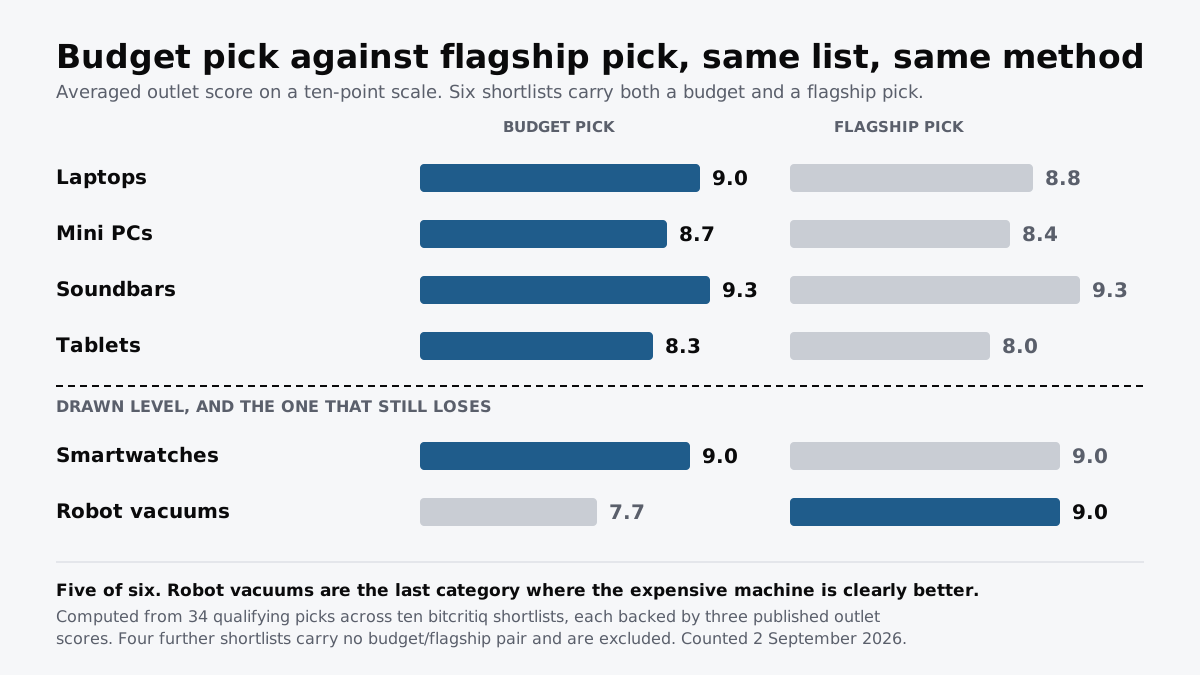
Across our own shortlists the budget pick matches or beats the flagship in five of six. The one exception says more than the rule.
If you buy through our links, we may earn a commission. It never affects our verdicts or scores — how that works. As an Amazon Associate I earn from qualifying purchases.
Buying the most expensive thing in a category is no longer a reliable way to buy the best-reviewed one. Across ten of our shortlists, six carry both a budget pick and a flagship pick. In five of those six, the budget pick matches or beats the flagship — judged by the same outlets, in the same category, on the same day.
| Category | Budget pick | Flagship pick | Gap |
|---|---|---|---|
| Laptops | MacBook Neo 9.0 | ThinkPad X1 Carbon 8.8 | +0.2 |
| Mini PCs | Geekom A5 8.7 | AtomMan G1 Pro 8.4 | +0.3 |
| Soundbars | Sony HT-S2000 9.3 | Sonos Arc Ultra 9.3 | level |
| Tablets | OnePlus Pad Go 2 8.3 | Galaxy Tab S11 Ultra 8.0 | +0.3 |
| Smartwatches | Amazfit Active 3 Premium 9.0 | Apple Watch Ultra 3 9.0 | level |
| Robot vacuums | Roborock Q7 M5 7.7 | Roborock Saros 20 9.0 | −1.3 |
The exception is more informative than the rule
Robot vacuums, by 1.3 points. It is the only category left where the expensive machine wins, and it wins by four times any other gap in the table. A cheap robot vacuum is still visibly worse at the job than an expensive one, and reviewers say so consistently: navigation, mopping and getting out of trouble are where the money goes, and they are not solved problems.
Smartwatches used to be the second exception, and stopped being one while this page was live. The Apple Watch led the Amazfit Active 2 by 0.3 — already inside the noise of a five-star scale. Then Amazfit’s Active 3 Premium qualified at 9.0, drawing exactly level with a watch costing four and a half times as much. The correction is noted here because it is the second time recomputing this table has changed its answer.
So the honest version of the finding is not “cheap always wins”. It is that the cheap option has caught up in categories where the hardware has stopped changing quickly, and has not in the ones where it is still moving. Soundbars, laptops, mini PCs and tablets are mature. Robot vacuums are not.
Why a tie is not the same as “just as good”
An averaged score is one number, and it hides what the number was made of. When the Sony soundbar ties the Sonos, that is not a claim that they are the same product — the Sonos expands into a full system and the Sony does not. When the OnePlus tablet beats the Samsung, the Samsung still has the better screen.
What a tie says is narrower and more checkable: the people who tested both rated them equally. Everything you would pay extra for still exists; it has simply stopped showing up in the score. That is worth knowing precisely because the score is what most buying pages lead with, including ours.
What we got wrong, and the correction
This page began as a claim inside our tablet shortlist that the cheapest product had matched or beaten the dearest in three consecutive categories. Computing it properly across every shortlist showed that was wrong on the smartwatches: the $99 Amazfit matched Samsung’s Galaxy Watch 8, but the most expensive watch on that page is Apple’s, and it scored higher.
The tablet page has been corrected. We are noting it here rather than quietly amending it, because a pattern is exactly the kind of claim that gets easier to believe each time it is repeated, and the discipline that catches it is computing the thing rather than remembering it.
What to do with this
- Do not treat price as a proxy for quality in a mature category. Soundbars, laptops, tablets and mini PCs are the four here where it failed.
- Do treat it as a signal in a young one. Robot vacuums are now the only case here: the expensive machine is measurably better at the task.
- Read the spread, not just the average. Our analysis of where the reviewers disagree found a median gap of 1.5 points between the harshest and kindest outlet — larger than every gap in the table above except the vacuums.
- Ask what the extra money buys that a score cannot show. Expandability, a better screen, a longer support window. Those are real, and they are invisible here.
How we researched this
No one at bitcritiq has handled this product. Everything here comes from published sources, listed below.
- What this cannot tell you
- Six comparisons is a small sample and this is our own data about our own picks, which is a real conflict — the tiers are our labels, and a different labelling would move the result. The products are the ones that cleared a three-outlet threshold, which skews toward well-covered hardware and away from the cheapest end of every category. And an averaged score flattens exactly what people pay extra for, so a tie in this table is not a claim that two products are equivalent. It is a claim that the reviewers rated them equally, which is a narrower and more checkable thing.
How we chose this, and what we did
- Why this subject
- Our shortlists average published scores from named outlets, and each pick carries a tier — budget, mid-range or flagship — set when the product record is written. That means the site has been accumulating a comparison nobody set out to make: what the cheap option scores against the expensive one, judged by the same reviewers, in the same category, on the same day. This page is that comparison.
- How we looked at it
- Took all 34 picks across ten bitcritiq shortlists that carry three or more published outlet scores, normalised every score to ten, and averaged them per product. Within each shortlist, compared the highest-scoring budget-tier pick against the highest-scoring flagship-tier pick. Six shortlists carry both tiers; four do not and are excluded rather than filled in.
What this rests on
Each claim below, and how firmly it is held. Nothing here was measured by bitcritiq — see how we test for why.
In five of the six bitcritiq shortlists carrying both a budget and a flagship pick, the budget pick matches or beats the flagship on averaged review score.
The flagship now wins in only one category: robot vacuums, by 1.33 points.
The comparison covers 34 picks across ten shortlists, each backed by at least three published outlet scores.
Sources 4
- The Best Soundbars, According to the Reviews — bitcritiqaccessed Sep 2, 2026
- The Best Tablets, According to the Reviews — bitcritiqaccessed Sep 2, 2026
- The Best Robot Vacuums, According to the Reviews — bitcritiqaccessed Sep 2, 2026
- Where the Reviewers Disagree, and by How Much — bitcritiqaccessed Sep 2, 2026
Follow bitcritiq
New articles, no email address, no account. Subscribe by RSS in any reader.
Using Chrome on Android? Open the browser menu and tap Follow. New articles then turn up in the Following tab in Discover.
read next
How to Tell a Real Tech Deal From a Fake One
The Best Tablets, According to the Reviews

Buying a Laptop in a Sale? Spend on What You Can't Change
