ChatGPT Will Watermark Its Text in the EU, Not Elsewhere Yet
It hides in word choice, fades with heavy editing, and only approved researchers can test for it. OpenAI names no off switch.
If you buy through our links, we may earn a commission. It never affects our verdicts or scores — how that works. As an Amazon Associate I earn from qualifying purchases.
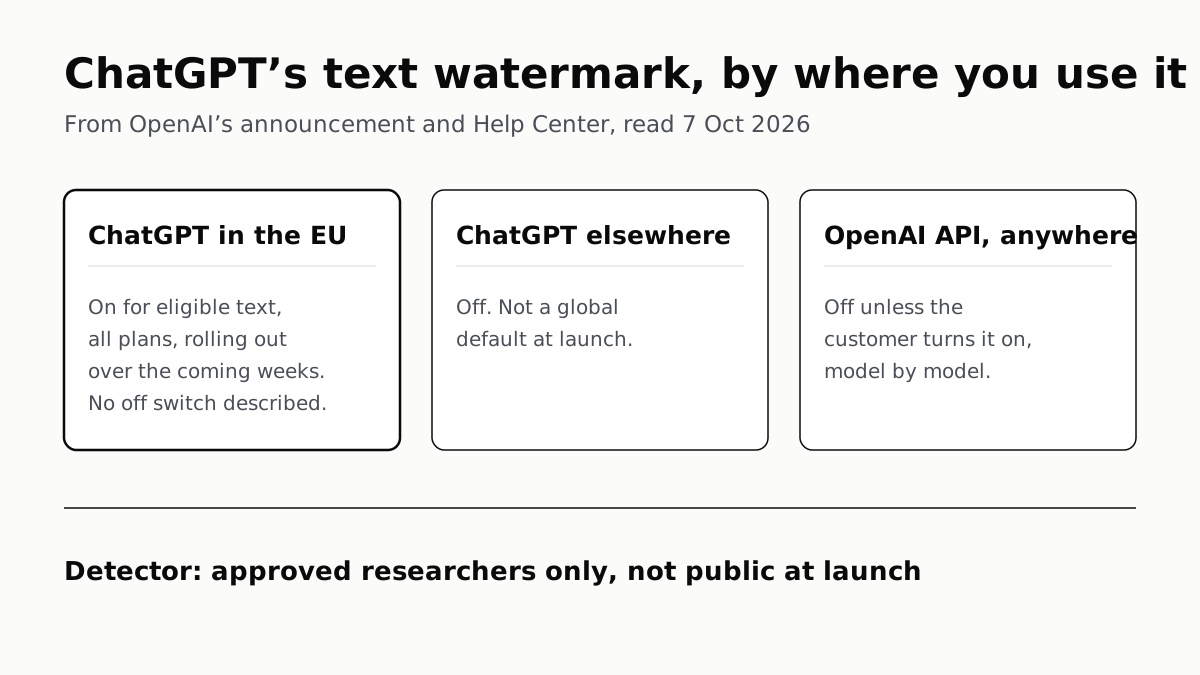
Yes in the European Union, and not elsewhere for now: OpenAI says it will add an invisible watermark to eligible ChatGPT and Codex text in the EU over the coming weeks, on all plans, and is “not making text watermarking a global default at launch”. OpenAI’s announcement and Help Center describe no setting that lets a ChatGPT user turn it off.
The one switch OpenAI does document is for developers. In its API, watermarking is off unless a customer turns it on.
Where the watermark is on
| Where you use it | Text watermark | Can you switch it off? |
|---|---|---|
| ChatGPT and Codex in the EU, all plans | On for eligible output, rolling out over the coming weeks from 5 October 2026 | OpenAI describes no setting |
| ChatGPT and Codex outside the EU | Off; not a global default at launch | Nothing to switch off; OpenAI describes no opt-in either |
| OpenAI API, any country | Off by default | Yes: it is opt-in, per project or for a whole organisation, model by model |
| OpenAI models through cloud partners | OpenAI says it is working with partners “in the coming weeks” | OpenAI does not say |
Outside the EU, ChatGPT text carries no OpenAI watermark at launch, and inside it there is no documented way to opt out.
API customers find the switch under Organization settings › Data controls › Text provenance, or Project Settings › Text provenance for one project: turn on Allow text watermarking, choose the models, then Save.
Images and audio already carry marks. OpenAI’s Help Center says images from ChatGPT, Codex and the API carry Content Credentials (the C2PA standard) and a SynthID watermark, and audio carries SynthID. Those can be checked by anyone at openai.com/verify. Text cannot.
What the mark actually is
OpenAI calls it textGrain. As the model writes, it chooses each next word piece at random from a set of likely candidates; textGrain tilts those choices according to a secret key, in a way that averages out to the model’s normal odds. A detector holding the same key checks whether a passage follows the pattern more often than chance would allow.
That has two practical consequences. There is nothing to find by looking: OpenAI says it “does not add hidden characters, invisible spaces, or unusual punctuation”, so there are no stray characters to strip out. And it needs room to work: the Help Center says answers that must be precise, like a maths result, and text the model is asked to reproduce unchanged leave little room for the pattern.
OpenAI reports no meaningful quality cost. On the eight benchmarks it published for its Astra model, the largest gap between watermarked and unwatermarked scores is about three points, and on several the watermarked version scored higher; OpenAI says the differences fall within the noise it normally sees between runs.
Can anyone tell your text came from ChatGPT?
Not through the watermark, at launch. OpenAI is opening its text detector only to approved researchers and expert organisations, case by case, and says that “given the risk of missed watermarks and false positives, we are not making it publicly available”. A teacher or an employer has no OpenAI tool to run your essay through.
Even with the detector, OpenAI’s own figures show where it struggles, all measured at a 1% target false-positive rate:
| Condition, per OpenAI | Watermark found |
|---|---|
| 400-token passage, psychology question | about 95% |
| 200-token passage, same kind of content | about 80% |
| Maths content | “substantially lower” |
| Across the 24 official EU languages | from 69.0% (Spanish) down to 42.2% (Romanian), before OpenAI strengthened the weaker ones |
Short text is the gap. The EU Code of Practice does not require a watermark on outputs under 200 tokens, which OpenAI puts at about 150 words of English, or on code snippets. A token is the unit a chatbot counts text in, roughly three-quarters of an English word.
The tools people already worry about are a different thing. Classifier-style detectors guess from writing style after the fact, and the evidence on how well those work is poor enough that OpenAI withdrew its own in 2023. textGrain instead checks for a signal OpenAI planted with a secret key, and only works on text from OpenAI models that carried it.
What it survives
Copying and pasting keeps it, as long as the wording is unchanged. Editing wears it down, fast:
- Replacing 10% of words with synonyms cut detection on 400-token passages from about 92% to 66%.
- Replacing 25% of words cut it to 17%.
The Help Center adds that “substantial rewriting, paraphrasing, or translation can make detection less reliable”, and that heavier changes “can make a watermark undetectable”. A quarter of the words swapped, and OpenAI’s detector found the mark 17% of the time in its own test.
What a detection would and would not mean
OpenAI is unusually direct about the limits. A watermark hit says an OpenAI model “likely generated or processed” some of the text. By OpenAI’s account, it does not:
- show how much a person wrote or edited;
- identify the user: it carries no account, prompt or conversation;
- say who owns the text or whether its use was lawful;
- say whether the text is accurate.
And a miss proves nothing. OpenAI lists the reasons its own text can come back clean: too short, edited, translated, made before watermarking started, made by an unsupported model, or made with another company’s tool. No watermark is not evidence of human authorship. What OpenAI keeps of the conversation behind the text is a separate question, covered in whether ChatGPT trains on your chats.
Why only the EU
The EU AI Act requires it there. The European Commission summarises Article 50 as requiring providers of generative AI to ensure output, text included, is “marked in a machine-readable format and detectable as artificially generated or manipulated”, and says those obligations apply from 2 August 2026. OpenAI says it signed the Commission’s Code of Practice on transparency of AI-generated content, which the Commission accepts as a way to show compliance.
OpenAI cites no rule outside the EU that requires it, and says the regional rollout “gives us room to learn from real-world use and feedback”. It says it will revisit each part of the approach, but has given no date for a wider default. Ars Technica, reporting the change on 6 October, framed it as on by default only where regulators require it.
What OpenAI has not said is which output counts as “eligible”, or whether “in the EU” follows your location or your account. Until it does, an EU user should assume longer ChatGPT replies carry the mark.
Questions people ask
Does ChatGPT watermark text?
In the EU, yes, from a rollout OpenAI says takes place over the coming weeks after 5 October 2026, on all plans. Elsewhere it is off: OpenAI says it is not making text watermarking a global default at launch.
Can people tell my text came from ChatGPT?
Not from the watermark, for now. It is invisible to readers, and OpenAI’s detector is limited to approved researchers and expert organisations. Schools, employers and the public cannot use it at launch.
Can I turn off the ChatGPT watermark?
OpenAI’s announcement and Help Center describe no setting for ChatGPT users to turn it off in the EU. The only switch they document is for API customers, where watermarking is off unless the customer turns it on.
Does the ChatGPT watermark add hidden characters?
No. OpenAI says it adds no hidden characters, invisible spaces or unusual punctuation. The mark is a pattern in which words the model picks, so copying and pasting the text carries no extra material.
Does paraphrasing remove the ChatGPT watermark?
It weakens it. In OpenAI’s test on 400-token passages, swapping 10% of words for synonyms cut detection from about 92% to 66%, and swapping 25% cut it to 17%. OpenAI says substantial paraphrasing or translation can make it undetectable.
Does the watermark identify who wrote the text?
No. OpenAI says the watermark does not associate a person, account, prompt or conversation with the text, and that a detection does not show how much a human contributed.
How we researched this
No one at bitcritiq has handled this product. Everything here comes from published sources, listed below.
- What this cannot tell you
- OpenAI does not define which ChatGPT and Codex output is ‘eligible’, does not say whether ‘in the EU’ means where you are or where your account is registered, and gives no date beyond ‘over the coming weeks’. All detection figures are OpenAI’s own, from its own evaluations; no independent test exists yet because the detector is not public. We have not used the detector or a watermarked ChatGPT account.
How we chose this, and what we did
- Why this subject
- On 5 October 2026 OpenAI said it would start watermarking ChatGPT and Codex text in the European Union, and outlets including Ars Technica reported it as on by default only there. Our piece on AI detectors covers tools that guess after the fact; it does not cover a mark built into the text. Readers are asking three things: does ChatGPT do this, can anyone tell, and can I turn it off.
- How we looked at it
- Read in full through a browser on 7 October 2026: OpenAI’s announcement ‘Our approach to EU text provenance rules’ (5 October 2026), OpenAI Help Center article 8912793 ‘Provenance signals in OpenAI-generated content’, Help Center article 12141645 on the EU AI Act, and the European Commission’s page on the Code of Practice on Transparency of AI-generated Content. The claim that OpenAI describes no off switch for ChatGPT users rests on reading both OpenAI pages in full; as a control, the Help Center article does describe the switch for API customers, with its menu path (Organization settings, Data controls, Text provenance). Ars Technica’s report of 6 October is used only for how the change was reported.
What this rests on
6 claims, all official. Nothing here was measured by bitcritiq — see how we test for why. Open a claim to read the source it came from.
OpenAI will add an invisible watermark to eligible ChatGPT and Codex text in the EU, for all plans, and is not making it a global default.Official
OpenAI, 5 October 2026: “Over the coming weeks, we will introduce text watermarking to eligible ChatGPT and Codex users across all plans in the EU only. We are not making text watermarking a global default at launch.”
In the API, text watermarking is off by default and customers can turn it on for selected models.Official
OpenAI: “Starting today, API customers globally will be able to opt in to text watermarking for select models. Text watermarking will remain off by default in the API.” Help Center 8912793: “Organization default: Organization settings → Data controls → Text provenance.”
The watermark is a statistical pattern in word choice, with no hidden characters.Official
Help Center 8912793: “It does not add hidden characters, invisible spaces, or unusual punctuation.”
Replacing a quarter of the words with synonyms cut detection to 17% in OpenAI’s test.Official
OpenAI: “In an evaluation of 400-token passages, replacing 10% of words with synonyms reduced detection from about 92% to 66%. Replacing 25% of words reduced it to 17%.”
The text detector is limited to approved researchers and expert organisations and is not public at launch.Official
OpenAI: “Given the risk of missed watermarks and false positives, we are not making it publicly available at launch.”
The EU AI Act’s Article 50 marking obligations apply from 2 August 2026.Official
European Commission: “These transparency obligations, applicable from 2 August 2026… pertain to marking and detection of AI-generated content.”
Sources 5
- Our approach to EU text provenance rules — OpenAI, 5 October 2026Officialaccessed Oct 7, 2026
- Provenance signals in OpenAI-generated content — OpenAI Help Center 8912793Officialaccessed Oct 7, 2026
- EU AI Act: OpenAI Resources and Customer Guidance — OpenAI Help Center 12141645Officialaccessed Oct 7, 2026
- Code of Practice on Transparency of AI-generated Content — European CommissionOfficialStandards / .govaccessed Oct 7, 2026
- OpenAI will watermark ChatGPT outputs by default—but only in the EU — Ars Technica, 6 October 2026accessed Oct 7, 2026
Pass it on
Know someone weighing this up? Send them the answer.
bitcritiq.com/53s6The link is permanent: it opens this article for good, even if the title changes.
No email, no account
Follow bitcritiq
Every new article, in whatever reader you already use.
Subscribe by RSSAll the ways to follow
Using Chrome on Android? Open the browser menu and tap Follow. New articles then turn up in the Following tab in Discover.
read next
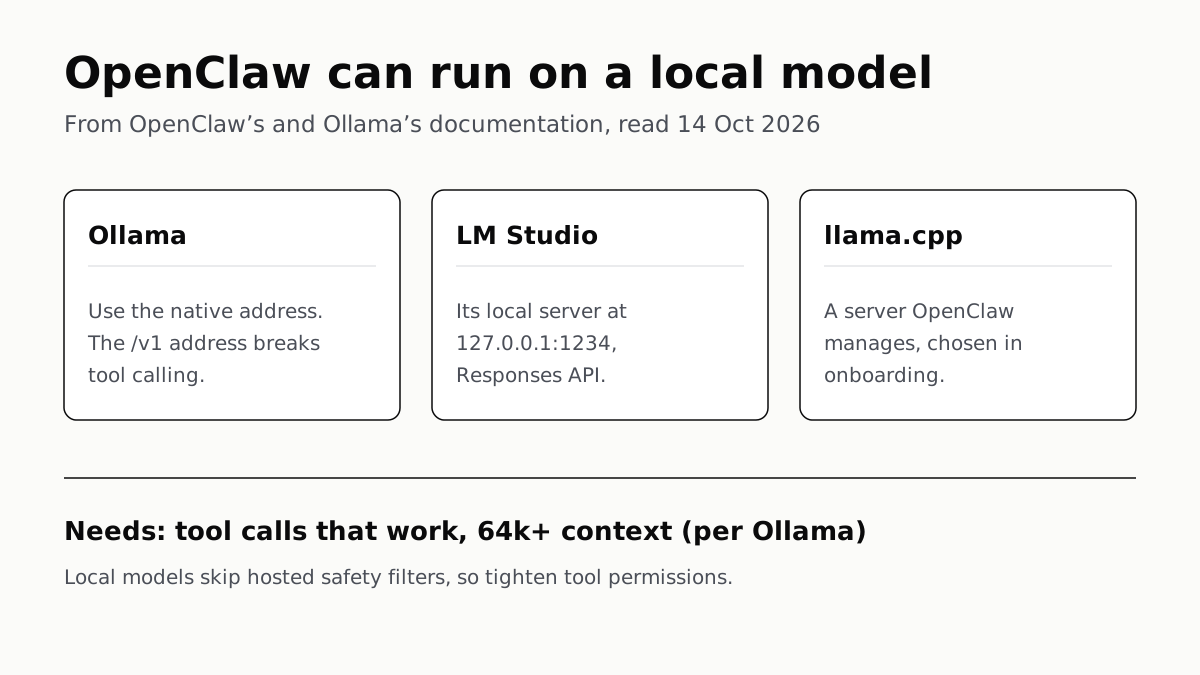
OpenClaw Runs on a Local LLM via Ollama or LM Studio
OpenClaw's docs also cover llama.cpp, vLLM and any OpenAI-compatible server. Ollama advises 64k context; small models are easier to hijack.
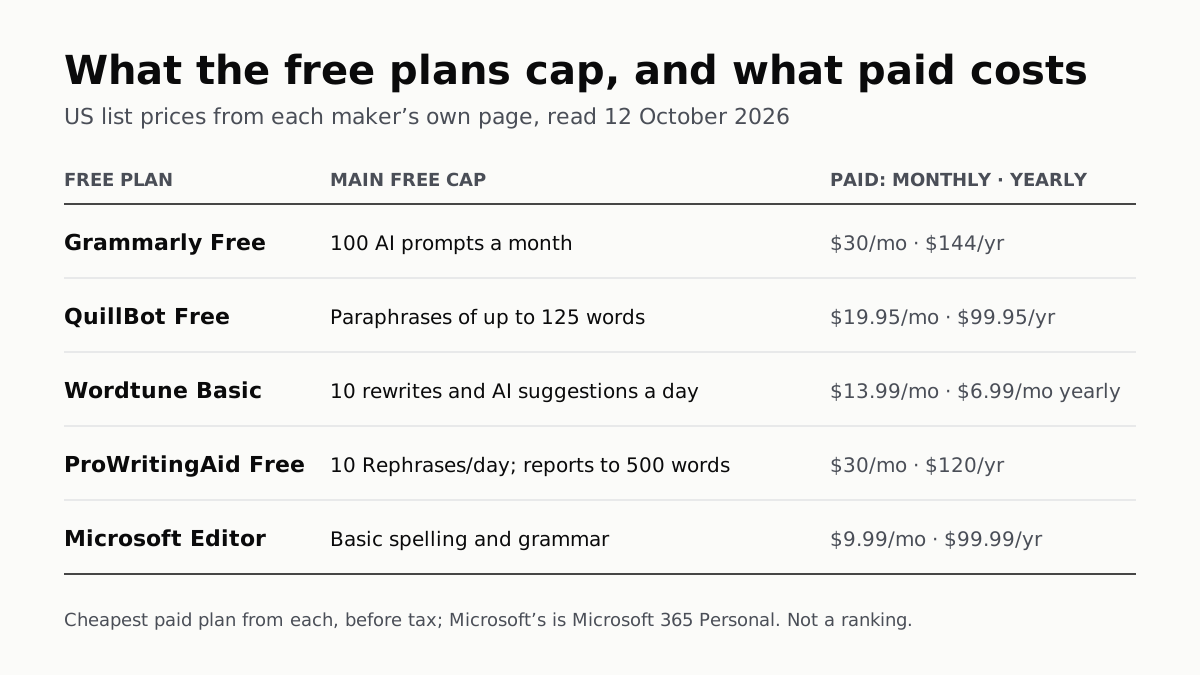
Free AI Writing Tools Ration Rewrites in Different Units
Grammarly gives 100 AI prompts a month, Wordtune 10 rewrites a day, QuillBot 125 words a paraphrase. Yearly billing halves most prices.
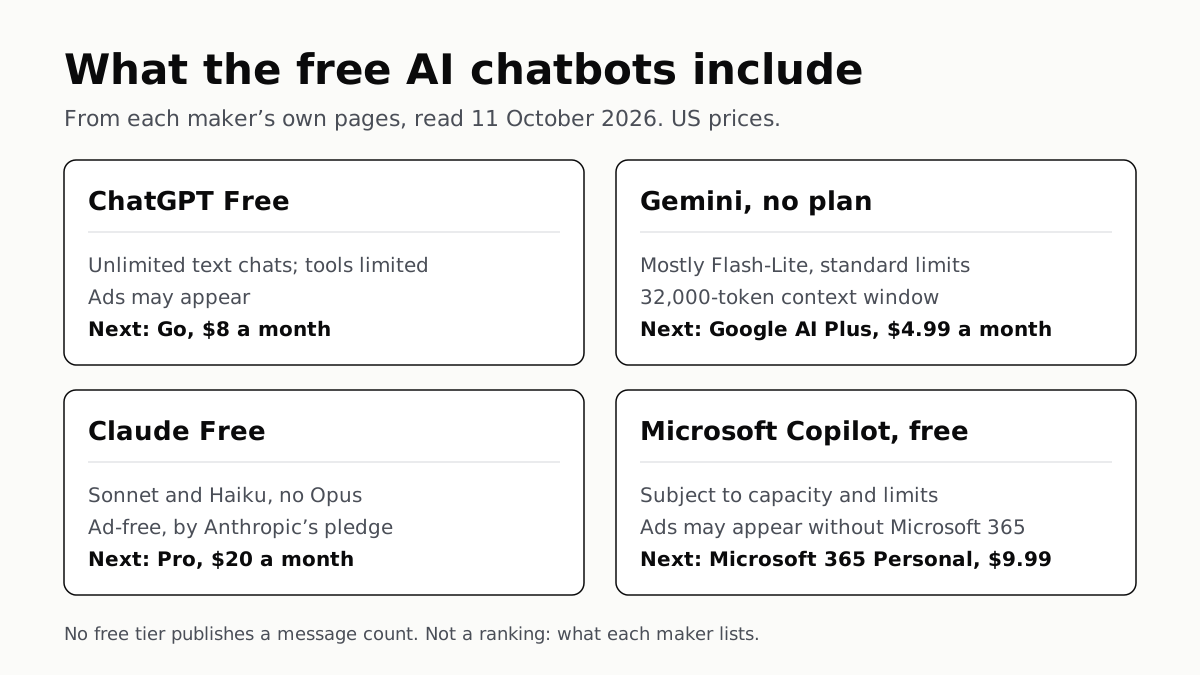
Of Four Free AI Chatbots, Only ChatGPT Lists Unlimited Chat
ChatGPT’s free tier carries ads, as Copilot’s may; Gemini’s leans on Flash-Lite and Claude’s leaves out Opus.
Google’s Offline AI Note-Taker Runs Only on a Mac
Transcription and AI run on the Mac itself, with no phone version. Google says your audio, notes and files never leave the computer.