Every Googlebook Has 16GB. The $250 Buys Screen and Ports
Google announced five models and lists three with prices. Only two of those three can actually be ordered today.
If you buy through our links, we may earn a commission. It never affects our verdicts or scores — how that works. As an Amazon Associate I earn from qualifying purchases.
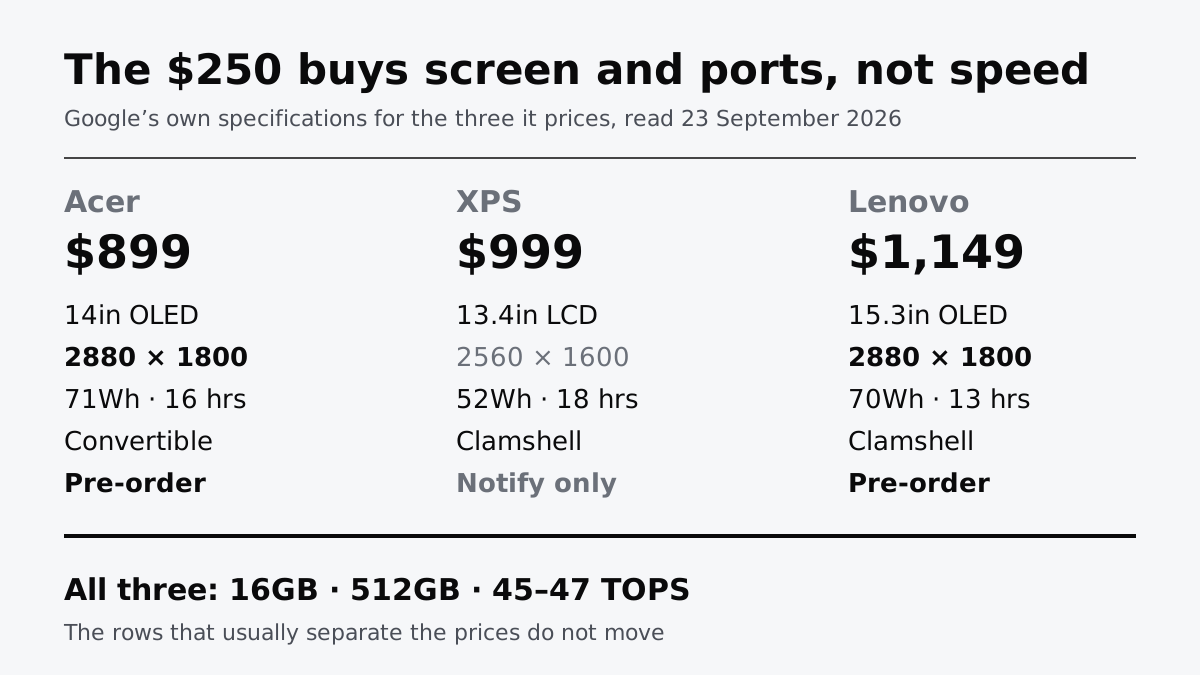
All three Googlebooks Google lists on its own store carry the same 16GB of memory, the same 512GB of storage and NPUs within two TOPS of each other — so the $250 between the cheapest and the dearest buys screen size, ports and a hinge, not speed. On Google’s published figures the $899 Acer carries the same 2880 × 1800 OLED panel as the $1,149 Lenovo in a smaller frame, the largest battery of the three, and the only screen that folds back into a tablet.
This is a comparison of published specifications, not a review. Nobody here has touched a Googlebook, no independent reviewer has either, and the machines do not reach buyers until 4 October. Every number below is Google’s own, read on 23 September 2026.
The three Googlebooks Google prices
| Acer Googlebook | XPS Googlebook | Lenovo Googlebook | |
|---|---|---|---|
| Price | $899 | $999 | $1,149 |
| Orderable today | Pre-order | Notify me only | Pre-order |
| Form factor | Convertible | Clamshell | Clamshell |
| Screen | 14.0in OLED, 500 nit | 13.4in IPS LCD, 500 nit | 15.3in OLED, 500 nit |
| Resolution | 2880 × 1800 | 2560 × 1600 | 2880 × 1800 |
| Refresh | Up to 120Hz | 30–120Hz variable | 120Hz |
| Processor | Intel Core Ultra 5 325 | Snapdragon X Elite X1E-80-100 | Intel Core Ultra 5 325 |
| NPU | Up to 47 TOPS | Up to 45 TOPS | Up to 47 TOPS |
| Memory | 16GB LPDDR5X | 16GB LPDDR5X | 16GB LPDDR5X |
| Storage | 512GB | 512GB | 512GB |
| Battery | 71 Wh, up to 16 hrs | 52 Wh, up to 18 hrs | 70 Wh, up to 13 hrs |
| Charging | 100W USB-C | 65W USB-C | 65W USB-C |
| Ports | 3 × USB-C, one USB4 40Gbps | 2 × USB-C 10Gbps | 2 × USB-C TB4, USB-A, HDMI 2.0, 3.5mm |
| Webcam | 5MP, privacy shutter | 2MP | 5MP, physical shutter |
| Weight | 2.51 lb | 2.2 lb | 2.82 lb |
| Also | USI 2.0 stylus support, Bluetooth 6.0 | — | Facial unlock, Lenovo AI mouse in the box |
Every one has a touchscreen in 16:10, a backlit keyboard, a glass haptic trackpad, Wi‑Fi 7, a fingerprint reader, Google’s Titan C2 security module and the Glowbar lid light. Battery figures are Google’s, footnoted as controlled web-browsing tests.
Five announced, three priced, two orderable
Google’s design post names five makers — Acer, ASUS, Dell, HP and Lenovo — and calls them “five distinctive models”. Its store carries three. There is no ASUS Googlebook and no HP Googlebook on Google’s own store: no price, no specification sheet, no product page.
It thins further at the checkout. The XPS listing’s button reads Sign in to get notified where the Acer’s and the Lenovo’s read Pre-order, on the category page, the comparison page and its own product page alike. Google gives no reason and no date. So of five announced machines, two can be ordered from Google today.
What the price ladder does not buy
The rows that usually separate an $899 laptop from a $1,149 one are flat here. Memory is 16GB on all three. Storage is 512GB on all three. The AI silicon everybody is being sold on runs 45 to 47 TOPS across the lineup — a gap of about four per cent, and what a TOPS figure does and does not tell you is worth reading before treating it as a spec at all.
What the money does change:
The $1,149 Lenovo is the desk machine. The largest screen at 15.3 inches, an OLED panel Google rates at 100% DCI-P3, and the only one of the three with USB-A, HDMI 2.0 and a headphone jack. Google also lists it as the only one with facial unlock, and the only one that ships with a mouse. It is also the heaviest at 2.82 lb and carries the shortest battery figure Google quotes, 13 hours from a 70Wh cell — so the dearest Googlebook is the one Google rates for the least time away from a socket.
The $999 XPS is the lightest and the least equipped. At 2.2 lb it is the one Google’s marketing calls a travel machine, and its 18-hour figure is the highest in the lineup despite the smallest battery of the three at 52Wh. The trade is visible in the table: the only LCD panel rather than OLED, the lowest resolution, two USB-C ports and nothing else, no Thunderbolt, and a 2MP webcam against 5MP on both others.
The $899 Acer is the odd one out, in the buyer’s favour. The cheapest model matches the dearest one’s screen resolution on a smaller panel, and has the biggest battery, the fastest charging and the only hinge that folds — which is not how a price ladder usually reads. It is the only one with stylus support, the only one on Bluetooth 6.0, and the only one with a 40Gbps USB4 port. Where it gives ground is audio: dual speakers, against quad on both the others.
Google’s own battery numbers disagree
Worth flagging because it is the number buyers will lean on hardest. Google’s launch post gives a portfolio ceiling of “up to 14 hours of video playback and 16 hours of web browsing”. The store’s laptops page says “up to 14 hours of Battery Life”. The comparison table and the XPS product page both say up to 18 hours, footnoted as controlled web browsing.
Google’s own battery figures do not agree with each other: its launch post caps web browsing at 16 hours and its store quotes 18 for the XPS. All three pages are current, we have not resolved which figure Google intends, and neither has been checked by anyone outside Google.
What nobody knows yet
No independent test of any Googlebook exists. These are the things a spec sheet structurally cannot answer, and they are the ones that usually decide whether a laptop is pleasant to own:
- Real battery life. Google’s figures come from its own controlled browsing tests, by its own footnote, and its pages do not agree with one another. Video, video calls and sustained work are all untested.
- Thermals and fan noise. Google says the NPUs let you run AI workflows “without spinning loud and disruptive fans”. No measured noise figure appears on any Google page, and fan behaviour under a long load is not something a specification predicts.
- Screen quality past the numbers. All three are rated 500 nits, which is a modest figure for a screen Google describes as readable outdoors. Contrast, colour accuracy, and how the anti-glare and Gorilla Glass finishes actually behave in daylight are unmeasured.
- Whether the phone features work. Continue On, Cast My Apps and cross-device Files are the reason to choose a Googlebook over a Windows laptop at the same money. Google has described them; nobody outside Google has used them.
- Whether Android apps behave on a desktop. Google says millions of Play Store apps are available and “many of them optimized for large screens”. Many is not all, and which ones fall outside it is the sort of thing that only turns up after a few weeks.
- Performance. Google publishes no benchmark for any of the three, against each other or against anything else.
- The 32GB question. Google’s launch post says “some models go up to 32GB”. No 32GB configuration appears on the Google Store. That may arrive with the ASUS and HP machines, or at retailers; Google has not said.
Before you pre-order
- The free year of AI Pro is a subscription with a date on it. The included year of Google AI Pro renews at $19.99 a month unless cancelled, by Google’s own footnote, which also says the machine must be activated on or after 1 October 2026, that it must be redeemed by 31 March 2027, and that it is limited to eight countries. It belongs on the list of everything in the house that now needs a subscription, not in the value column.
- 16GB is the floor and the ceiling on the store today. On a machine with soldered LPDDR5X, memory is the one thing you cannot buy again later — the argument in spend on what you can’t change applies with unusual force to a lineup that offers no upgrade at all.
- Count the ports before the TOPS. Two USB-C ports and nothing else is the XPS’s defining constraint, and it is permanent. The Lenovo’s HDMI and USB-A are the clearest thing $250 buys here.
- Waiting costs you very little. Shelves are 4 October in the US and 5 October elsewhere, two weeks away. Independent reviews will exist within days of that, and every open question above is one a reviewer answers in the first week. If you want picks that already carry other outlets’ scores, our laptop shortlist averages published reviews — none of them ours.
- A Chromebook’s update date can now outlast ChromeOS. Google now says ChromeOS itself gets updates only through mid-2034, so a Chromebook dated 2036 on Google’s own list depends on a Googlebook OS move Google has not detailed.
Questions people ask
How much does a Googlebook cost?
Google lists three on its own store: the Acer at $899, the XPS at $999 and the Lenovo at $1,149, all US list prices read on 23 September 2026. Each is sold in one configuration with 16GB of memory and 512GB of storage. The ASUS and HP models Google announced have no published price.
When does the Googlebook come out?
Google says devices reach shelves on 4 October 2026 in the US, and 5 October in Canada, the UK, Ireland, France, Germany and Australia. Pre-orders opened on 21 September through the Google Store, Best Buy and other retailers.
How many Googlebook models are there?
Google announced five, from Acer, ASUS, Dell, HP and Lenovo. Three appear on the Google Store with prices and full specifications — the Acer, the Dell-branded XPS and the Lenovo. The ASUS and HP machines are named in Google’s launch post and have no store listing, no price and no specification sheet there.
Which Googlebook should I buy?
Nobody has tested one, so this is a reading of Google’s published specifications only. They differ mainly in screen and ports: the $899 Acer is the only convertible and has a 2880 x 1800 OLED panel, the $1,149 Lenovo has the largest screen and the only USB-A, HDMI and headphone jack, and the $999 XPS is the lightest at 2.2 lb with the longest battery figure Google quotes.
Is a Googlebook a Chromebook?
Google does not call it one. It describes Googlebook as a new category running Googlebook OS, “built on the Android technology stack and paired with desktop foundations from ChromeOS”, with the Play Store, desktop Chrome and a Linux terminal environment. Google says the security architecture is the same one ChromeOS uses.
Do you get a free year of Google AI Pro with a Googlebook?
Google includes 12 months of Google AI Pro with 5TB of storage. Its own footnote says the subscription then charges $19.99 a month or the then-current fee unless cancelled, that the device must be bought and activated on or after 1 October 2026, that the offer must be redeemed by 31 March 2027, and that it is limited to eight countries.
How long does a Googlebook battery last?
Nobody independent has measured one. Google quotes up to 18 hours for the XPS, 16 for the Acer and 13 for the Lenovo, footnoted as controlled web-browsing tests. Google’s own launch post gives a lower portfolio ceiling — up to 16 hours of web browsing — so its published figures do not agree with each other.
How we researched this
No one at bitcritiq has handled this product. Everything here comes from published sources, listed below.
- What this cannot tell you
- Nobody at bitcritiq has touched a Googlebook, and nor has any independent reviewer — these machines do not reach buyers until 4 October. Nothing here is a measurement. Battery life, fan noise, screen quality, keyboard feel and how well the Android-phone features work in practice are all unknown, and Google publishes no benchmark of any kind for any of the three. Two of the five announced models, from ASUS and HP, have no price and no specification on Google’s own store, so they are named here and not compared. Prices are US list prices read on 23 September 2026 and Google lists a single configuration per model; Google’s own launch post says some models reach 32GB of memory, but no such configuration appears on the store.
How we chose this, and what we did
- Why this subject
- Google opened Googlebook pre-orders on 21 September 2026 and the machines reach shelves on 4 October, which gives a buyer about two weeks to decide with no independent reviews in existence. The question a shopper actually has — which of these is different from the others, and how — is answerable from Google’s own published specification table, and that table turns out to say something the price ladder does not.
- How we looked at it
- Every price, specification and date here comes from Google: three Googlebook posts on blog.google dated 21 September 2026, the Google Store’s Googlebook laptops category, its three-way comparison page, and the Acer, XPS and Lenovo product listings. All were read on 23 September 2026. Specifications were taken from the comparison table’s own rows rather than from marketing copy, so each figure sits in the column Google put it in. Where Google’s pages disagree with each other, both figures are reported and neither is preferred.
What this rests on
6 claims, all official. Nothing here was measured by bitcritiq — see how we test for why. Open a claim to read the source it came from.
Googlebook is a new laptop category announced by Google on 21 September 2026, built by five partners, running a Google OS on the Android stack with updates promised for up to 10 years, with pre-orders open and devices on shelves from 4 October in the US.Official
blog.google, 21 September 2026: “Our initial selection of flagship devices are built by Acer, ASUS, Dell, HP, and Lenovo.” And: “Pre-orders are now open on the Google Store, Best Buy, and other select retailers. Devices arrive on shelves starting October 4 in the U.S., and October 5 in Canada, the U.K., Ireland, France, Germany, and Australia.” And: “Built on the Android technology stack and paired with desktop foundations from ChromeOS.” And: “Googlebook OS also comes with regular feature drops and updates for up to 10 years.”
The Google Store lists three Googlebooks — Acer $899, XPS $999, Lenovo $1,149 — and only two of them can be ordered: the XPS button reads “Sign in to get notified”.Official
store.google.com Googlebook laptops category and its Compare Googlebooks page, read 23 September 2026: Lenovo Googlebook $1,149, XPS Googlebook $999, Acer Googlebook $899. No ASUS or HP Googlebook appears in the category, on the comparison page, or as a product listing. On all three pages the XPS call to action is “Sign in to get notified” while the Acer and Lenovo read “Pre-order”.
All three listed models ship with 16GB of LPDDR5X memory and 512GB of storage, and their NPUs are quoted at 45 to 47 TOPS.Official
Google’s Compare Googlebooks table, System Memory row: 16GB LPDDR5X for all three. Storage row: 512GB for all three. NPU row: up to 47 TOPS (Lenovo), up to 45 TOPS (XPS), up to 47 TOPS (Acer).
The $899 Acer has a higher-resolution panel and a larger battery than the $999 XPS, and is the only convertible of the three.Official
Google’s Compare Googlebooks table. Acer: Convertible, 14.0in OLED 500 nit, 2880 x 1800, 71 Wh, 100W USB-C charging. XPS: Clamshell, 13.4in IPS LCD 500 nit, 2560 x 1600, 52 Wh, 65W USB-C charging.
Google’s own battery figures for the lineup and for the XPS do not agree with each other.Official
blog.google, 21 September 2026: “Battery: up to 14 hours of video playback and 16 hours of web browsing.” The Google Store laptops category: “Up to 14 hours of Battery Life.” The Google Store comparison table and XPS product page: “Up to 18 hours”, footnoted as “based on controlled web browsing tests”.
The included year of Google AI Pro renews at $19.99 a month unless cancelled, and the offer is limited by date and country.Official
Google Store footnote on the Googlebook product pages: “The Google AI Pro trial offer is available to eligible users with the purchase and activation of an eligible Googlebook on or after October 1, 2026… Redeem the offer by March 31, 2027… Google AI Pro will charge $19.99/month or then-current subscription fee… after the trial ends. Cancel anytime.” The offer is listed as limited to Australia, Canada, France, Germany, Ireland, New Zealand, the UK and the US.
Sources 8
- Googlebook: The laptop your Android phone has been waiting for — blog.google, 21 September 2026Officialaccessed Sep 23, 2026
- Premium materials and striking design set Googlebook apart — blog.google, 21 September 2026Officialaccessed Sep 23, 2026
- Googlebook’s built-in intelligence reinvents the way you use your laptop — blog.google, 21 September 2026Officialaccessed Sep 23, 2026
- Compare Googlebooks between Acer, XPS, and Lenovo — Google StoreOfficialaccessed Sep 23, 2026
Show 4 more · 4 official or standards
- Googlebook Laptops, Designed for Gemini Intelligence — Google StoreOfficialaccessed Sep 23, 2026
- Acer Googlebook, 16GB RAM, 512GB Storage — Google StoreOfficialaccessed Sep 23, 2026
- XPS Googlebook, 16GB RAM, 512GB Storage — Google StoreOfficialaccessed Sep 23, 2026
- Lenovo Googlebook, 16GB RAM, 512GB Storage — Google StoreOfficialaccessed Sep 23, 2026
Pass it on
Know someone weighing this up? Send them the answer.
bitcritiq.com/88xeThe link is permanent: it opens this article for good, even if the title changes.
No email, no account
Follow bitcritiq
Every new article, in whatever reader you already use.
Subscribe by RSSAll the ways to follow
Using Chrome on Android? Open the browser menu and tap Follow. New articles then turn up in the Following tab in Discover.
read next
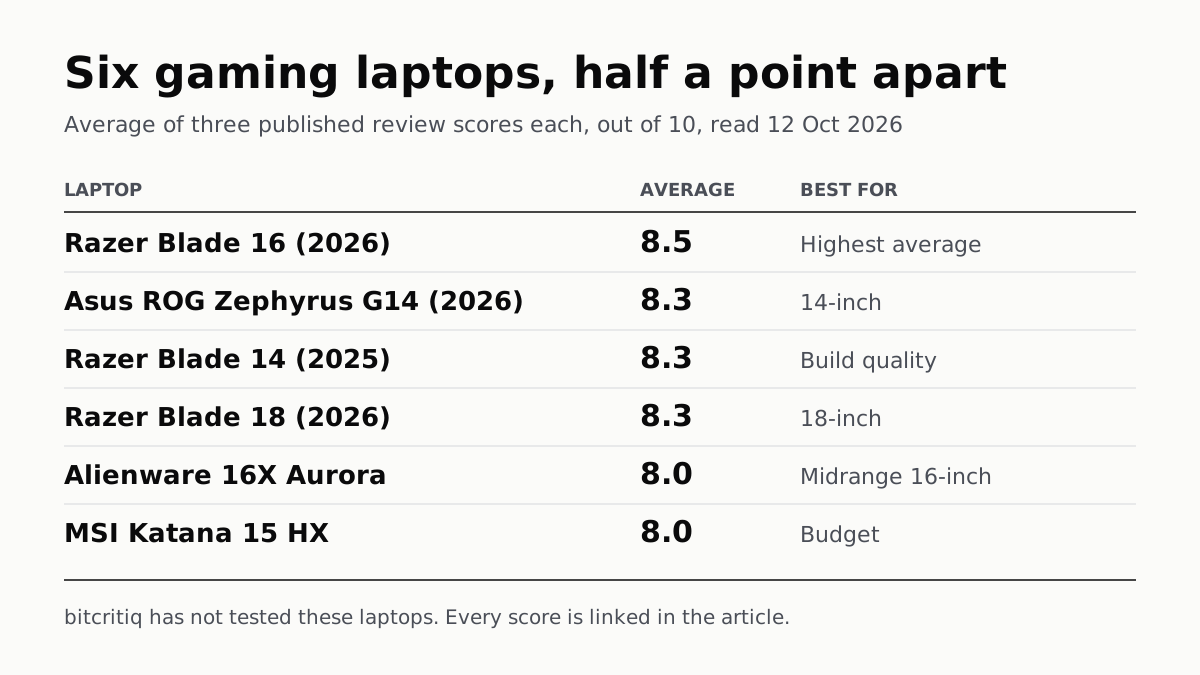
Razer Blade 16 Tops Gaming Laptop Reviews, by Half a Point
Eighteen review scores from eight outlets, all read on 12 October. Six laptops land within half a point, so pick by size and price.
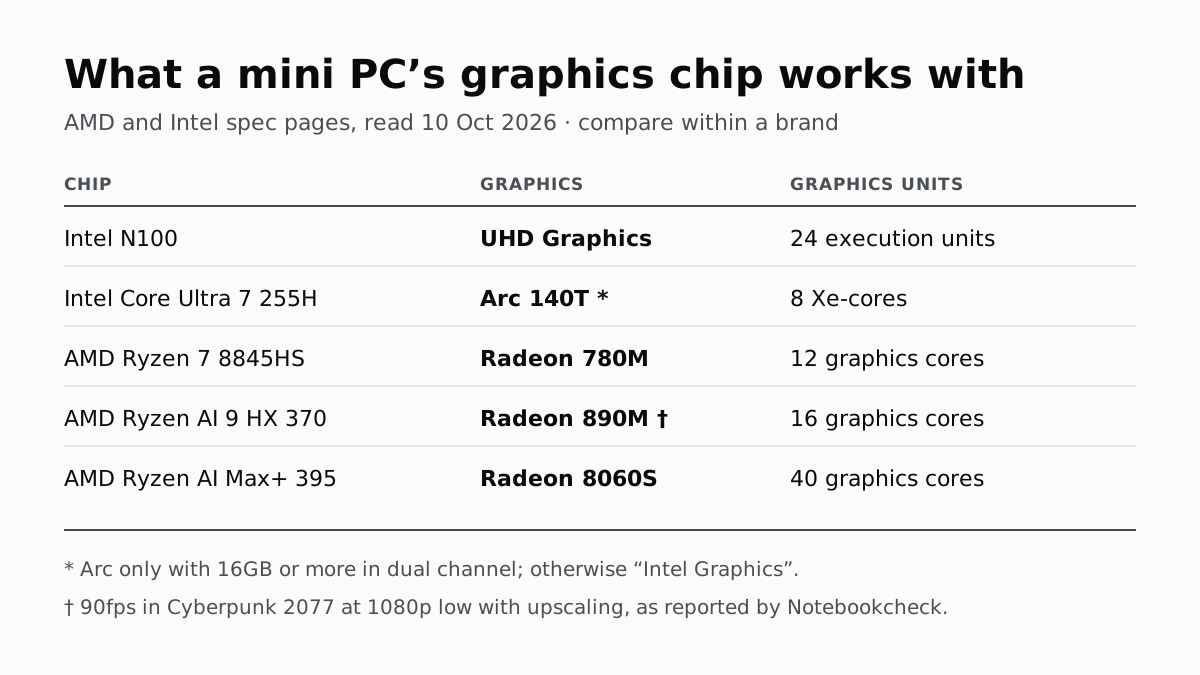
A Mini PC Can Game, but Its Graphics Chip Sets the Ceiling
Balatro's minimum is integrated graphics; Cyberpunk 2077's is a GTX 1060. A Radeon 890M ran Cyberpunk at 1080p low in one reported test.
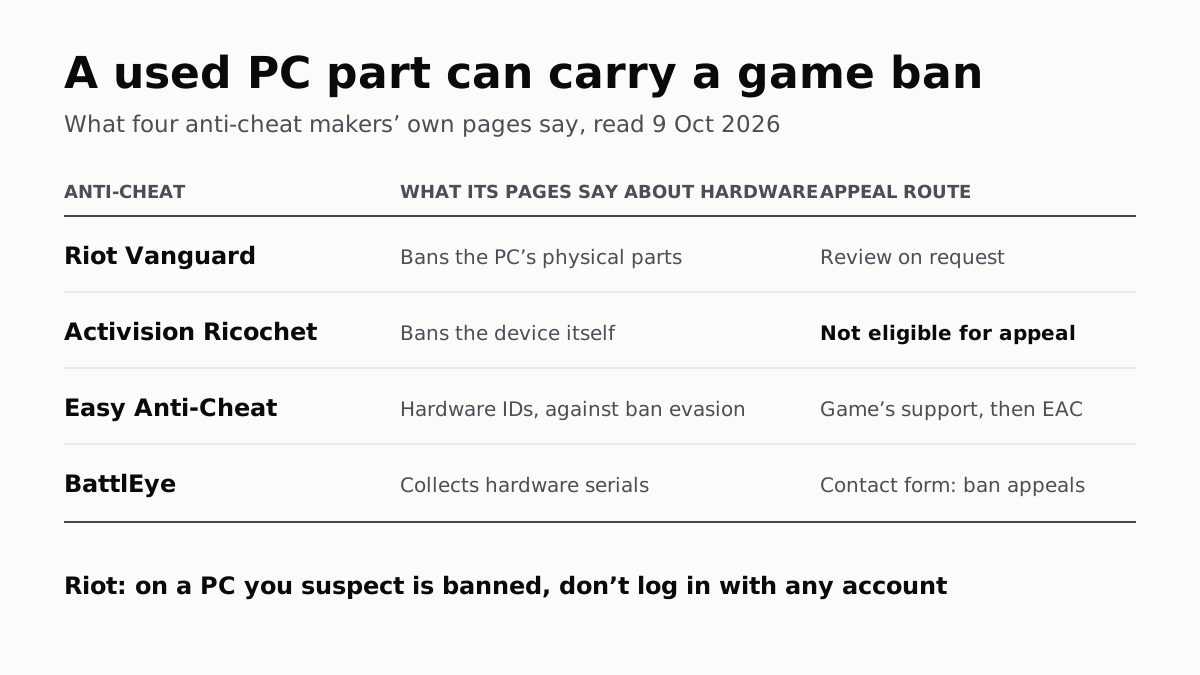
A Used PC or CPU Can Carry Its Last Owner’s Game Ban
Riot and Activision ban hardware, not only accounts. Riot will re-check one on request; Activision rules out an appeal.
The Same RTX 5070 Laptop GPU Runs at 90W or 115W
Nvidia publishes a power range for each laptop GPU and the maker picks a point in it. The spec sheet, or Nvidia Control Panel, shows which.