Robot Vacuums Self-Empty From $430 and Wash Mops From $600
Lidar mapping at $250, cameras from $1,000: 14 robots on Roborock, iRobot and eufy’s US stores, where sales cut the cheap end deepest.
If you buy through our links, we may earn a commission. It never affects our verdicts or scores — how that works. As an Amazon Associate I earn from qualifying purchases.
Update, 12 October 2026. Roborock’s US store no longer lists the dockless Q7 M5: its product page returns “404 Not Found”, and a store search finds only the Q7 M5+ and a refurbished M5+. The $299.99 below is what it listed at on 8 October, while sold out. Every other price here is as read that day.
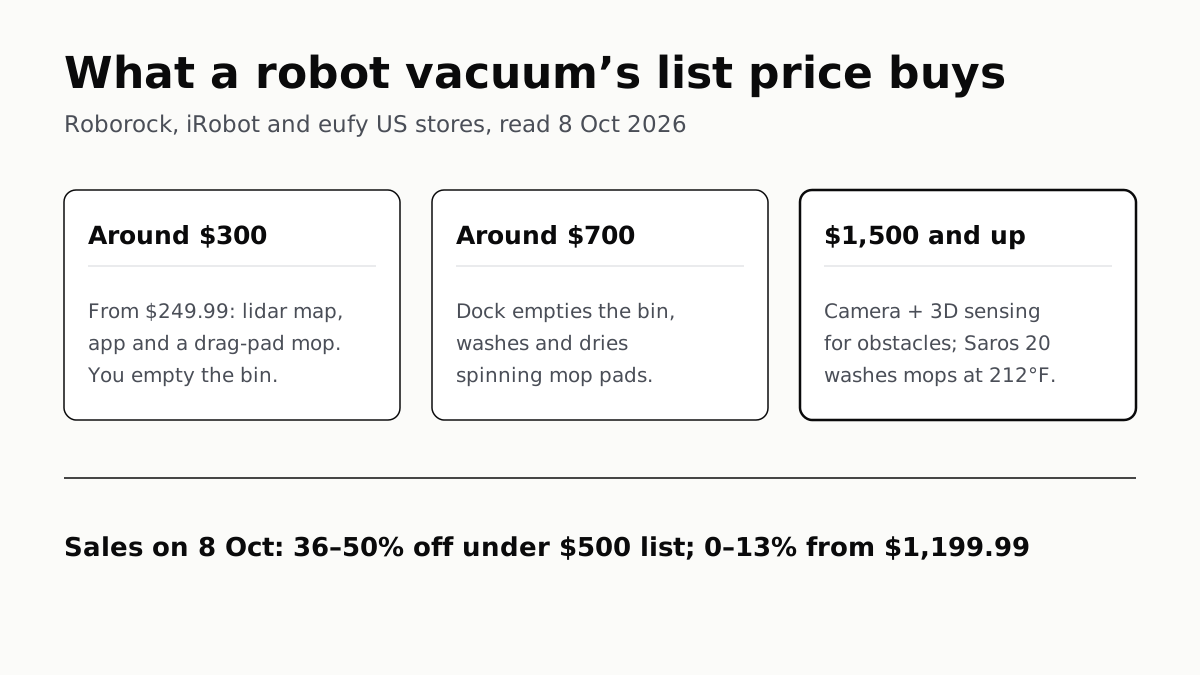
On the makers’ own list prices, about $300 buys a robot that maps your home by lidar and drags a damp pad; about $700 buys a dock that empties the robot and washes its mop; $1,500 buys camera-and-3D obstacle sensing and the hottest mop washing we found. In the 14 robots we priced on Roborock, iRobot and eufy’s US stores on 8 October 2026, self-emptying first appears at $429.99 and a mop that lifts off rugs at $499.99.
Sales bend those bands. Robots listed under $500 were 36% to 50% off on their makers’ stores that day; the three listed at $1,199.99 or more were 0% to 13% off.
What each feature first costs
| Feature | Lowest list price we found | Model |
|---|---|---|
| Lidar mapping and an app | $249.99 | Roborock Q7 L5 |
| Self-emptying dock | $429.99 | Roborock Q7 M5+ |
| Mop that lifts for rugs, and an obstacle sensor | $499.99 | Roborock Q10 X5+ |
| Dock that washes and heat-dries mop pads | $599.99 | iRobot Roomba Plus 415 Combo |
| Hot-water pad washing (167°F) | $699.99 | iRobot Roomba Plus 515 Combo |
| Roller mop | $799.99 | eufy Omni C28 |
| RGB camera for obstacles | $999.99 | eufy Omni E25 |
| 212°F mop washing and 1.77 in sill climbing | $1,599.99 | Roborock Saros 20 (affiliate link to Amazon, opens in a new tab) |
The “first appears at” reading is ours, from three makers’ ranges. Another maker could put any of these features lower, and a sale moves all of them.
The 14 robots, by list price
| Robot | List (sale on 8 Oct) | Navigation and obstacles | Dock | Mop |
|---|---|---|---|---|
| Roborock Q7 L5 | $249.99 ($139.99) | Lidar | Charges only | Drag pad, 3 water levels |
| eufy RoboVac 11S Max | $279.99 ($139.99 with code) | No Wi-Fi; infrared remote, anti-collision sensors | Charges only | None |
| Roborock Q7 M5+ | $429.99 ($249.99) | Lidar | Empties bin | Drag pad |
| iRobot Roomba 105 Vac | $449.99 ($279.99) | Lidar | Empties bin | None |
| Roborock Q10 X5+ | $499.99 ($319.99) | Lidar, structured light | Empties bin | Drag pad, lifts |
| iRobot Roomba Plus 415 Combo | $599.99 ($499.99) | Lidar | Empties; washes, heat-dries pads | Spinning pads, lift |
| iRobot Roomba Plus 515 Combo | $699.99 ($599.99) | Lidar; steers round shoes, bowls | Empties; hot-washes pads | Spinning pads, lift 10 mm |
| eufy Omni C20 (affiliate link to Amazon, opens in a new tab) | $699.99 ($339.99 on eufy’s listing) | Infrared + point laser | Empties, washes, air-dries, refills | Spinning pads, lift 10.4 mm |
| Roborock Qrevo 2 Pro | $799.99 ($549.99) | Lidar, structured light | Empties, washes | Spinning pads, detach |
| eufy Omni C28 | $799.99 ($499.99 on eufy’s listing) | LDS + laser line | — | Roller, lift 10.8 mm |
| eufy Omni E25 | $999.99 ($599.99 on eufy’s listing) | RGB camera + LED | — | Roller, lift 10.8 mm |
| iRobot Roomba Max 875 Combo (affiliate link to Amazon, opens in a new tab) | $1,199.99 (no reduction) | Lidar + camera AI | Empties, washes, dries | Roller, lifts and shields |
| Roborock Saros 20 (affiliate link to Amazon, opens in a new tab) | $1,599.99 ($1,479.99) | 3D time-of-flight + RGB camera | Empties, 212°F wash, 131°F dry, refills | Spinning pads, detach |
| eufy Omni S2 | $1,599.99 ($1,399.99 with code) | RGB camera + LED + 3D TOF | — | Roller, lift 10.5 mm |
All from the makers’ own pages, read on 8 October 2026; — means we did not read that model’s dock details. Prices change daily, and none of this is a ranking: we have not used these robots.
Around $300: mapping, and you do the rest
Roborock’s Q7 L5 lists at $249.99 and navigates by lidar, keeps up to three floor maps, and carries a mop module with three water levels. Its dock only charges it, so you empty the bin and rinse the pad. The dockless Roborock Q7 M5 listed at $299.99 on 8 October and showed as sold out in both colours; by 12 October Roborock’s store no longer listed it.
The same money can buy far less. eufy’s RoboVac 11S Max lists at $279.99, and eufy’s own comparison marks it as not Wi-Fi connected. It is driven by an infrared remote and relies on anti-collision and drop sensors, with no mapping named on its page. Two robots $30 apart on list price, and one maps your rooms while the other takes orders from a remote.
$430 to $500: the dock starts emptying the robot
Self-emptying is the first thing a dock adds. Roborock’s Q7 M5+ lists at $429.99 with a 2.7-litre bag Roborock rates for up to seven weeks; iRobot’s Roomba 105 Vac lists at $449.99 with a dock it rates for up to 75 days.
iRobot’s prices isolate what the dock costs. The Roomba 105 Combo robot lists at $319.99 on its own and $469.99 with the AutoEmpty dock, so the dock adds $150 to the same robot, on our arithmetic.
At $499.99, Roborock’s Q10 X5+ adds two things the Q7 models do not list: a mop that lifts when a carpet sensor finds a rug, and structured-light obstacle avoidance. It is still a drag pad that you wash yourself. How the robot mop types differ explains why a lifting or detaching mop is the feature to check first if you have rugs.
Around $700: the dock washes the mop
From $599.99 list, the dock takes over the mop. iRobot’s Roomba Plus 415 Combo dock empties the robot, rewets its two spinning pads, and washes and heat-dries them after every clean. At $699.99 the Plus 515 Combo adds hot washing at 167°F, refills its clean water and empties its dirty water, and its page says it steers around shoes, pet bowls and toys.
eufy’s Omni C20 (affiliate link to Amazon, opens in a new tab) also lists at $699.99 and does similar work: it empties into a 3.1-litre bag, washes the mop, dries it with room-temperature air and refills its own water. Its pads lift 10.4 mm for rugs. Roborock’s Qrevo 2 Pro, at $799.99, takes its spinning mops off entirely for high-pile carpet.
Around $1,000: cameras and rollers
eufy’s comparison table shows obstacle sensing stepping up with price within one range. The $699.99 Omni C20 uses infrared and a point laser, the $799.99 C28 a laser line, the $999.99 E25 an RGB camera, and the $1,599.99 S2 a camera with 3D time-of-flight sensing. The C28, E25 and S2 also switch from spinning pads to a roller mop.
iRobot’s Roomba Max 875 Combo (affiliate link to Amazon, opens in a new tab), at $1,199.99, pairs lidar with what iRobot calls PrecisionVision AI to avoid obstacles. Its roller spins at 300 rpm with 18 N of downward pressure and 140°F water, and lifts while lowering a shield when it detects carpet.
$1,500 and up: climbing, and hotter water
Roborock’s Saros 20 lists at $1,599.99. Its dock washes the mops in water up to 212°F, dries them with 131°F air, adds detergent and refills itself. It spots obstacles with 3D time-of-flight sensors and an RGB camera, and Roborock says it recognises more than 300 types.
The other thing the top band buys is climbing. Roborock rates the Saros 20 for single door sills up to 1.77 in and stacked ones up to 3.46 in. Further down, the Q7 M5+ is rated for 2 cm and eufy’s C20 for 18 mm; eufy’s S2 is rated for 35 mm.
What the sale price does to all this
On 8 October, the cheap end was where the discounts were. The Q7 M5+ sold for $249.99, a self-emptying lidar robot at the price of the bottom band. The Q10 X5+ was $319.99 and the Roomba Plus 415 Combo, a mop-washing robot, $499.99. The Max 875 Combo was not reduced at all.
A discount is a percentage of a number the seller chose, which is why a dated list price is the figure to judge a deal against. These list prices are dated 8 October 2026; check the sale price against them on the day you buy.
What this cannot tell you
Everything above is what the makers say each robot has, not how well it does it. A camera that recognises obstacles still has to recognise yours, and a dock that washes a mop still needs its tanks filled and emptied. For how these robots perform, the robot vacuum reviews, averaged across outlets, cover the Saros 20 and three others; for what happens after the first month, owner reports such as those for the Q7 M5 say more than any spec sheet.
Questions people ask
How much does a robot vacuum cost?
On the makers’ own US list prices on 8 October 2026, robots we read ran from $249.99 for Roborock’s Q7 L5, which maps by lidar, to $1,599.99 for Roborock’s Saros 20 and eufy’s Omni S2. Self-emptying started at $429.99 and mop-washing docks at $599.99 list. Sale prices that day were often far lower.
Is a self-emptying robot vacuum worth the extra cost?
iRobot’s own prices put a number on the dock: the Roomba 105 Combo robot lists at $319.99 alone and $469.99 with its AutoEmpty dock, so $150. iRobot says that dock holds up to 75 days of dirt on the 105 Vac. Whether that is worth $150 depends on how often you would otherwise empty a bin.
What is the cheapest robot vacuum that washes its own mop?
Of the robots we read, iRobot’s Roomba Plus 415 Combo at $599.99 list, $499.99 on sale on 8 October 2026; its dock washes and heat-dries the pads. eufy’s Omni C20 lists at $699.99, and eufy’s robot vacuum listing showed it at $339.99 that day.
Do cheap robot vacuums have lidar?
Some do. Roborock’s $249.99 Q7 L5 navigates by lidar and keeps up to three maps. eufy’s $279.99 RoboVac 11S Max has no Wi-Fi at all by eufy’s own comparison; it is driven by an infrared remote and relies on anti-collision and drop sensors.
Are robot vacuum list prices real?
They are the makers’ own reference prices, and on 8 October 2026 the cheap end sold well below them: robots listed under $500 were 36% to 50% off on their makers’ stores, while the three listed at $1,199.99 or more were 0% to 13% off.
What does a $1,500 robot vacuum do that a $500 one does not?
Comparing Roborock’s Saros 20 ($1,599.99) with its Q10 X5+ ($499.99): spinning mops washed at up to 212°F and dried with warm air instead of a drag pad, a camera with 3D sensors instead of structured light, mops that detach for carpet, and a chassis Roborock rates for 1.77 in door sills.
How we researched this
No one at bitcritiq has handled this product. Everything here comes from published sources, listed below.
- What this cannot tell you
- These are makers’ list prices and feature claims, mostly from their own tests; we have not used any of these robots, so nothing here says which cleans better. Fourteen robots from three makers is a sample: Ecovacs, Dreame, Shark and others were not priced, and one of them could put a feature lower than we found. List prices are the makers’ own reference figures and several were well above what the same stores charged that day. iRobot’s Plus 515 page gives its pad-washing temperature as 167°F in two places and 140°F in a third. We did not read the dock details of eufy’s C28, E25 or S2.
How we chose this, and what we did
- Why this subject
- Search Console shows ‘robot vacuum price comparison’ reaching our robot vacuum shortlist at an average position of 7.3, and that page is an average of outlet review scores with no prices, so it cannot say what each price band buys. This sets list prices against features instead. Models were chosen to cover each maker’s range from its cheapest current robot to its flagship, using robots that were listed on the maker’s own US store on 8 October 2026.
- How we looked at it
- Every price and feature is from the makers’ own US stores, read through a browser on 8 October 2026: Roborock’s product pages for the Q7 L5, Q7 M5+, Q10 X5+, Qrevo 2 Pro and Saros 20 (and its store catalogue for the Q7 M5); iRobot’s Roomba shop page and the product pages for the Roomba 105 Vac, Plus 415 Combo, Plus 515 Combo and Max 875 Combo; eufy’s robot vacuum listing and the product pages for the 11S Max, Omni C20 and Omni S2, where the C20 page carries eufy’s own comparison table of the C20, C28, E25 and S2. List price means the struck-through or ‘reduced from’ figure where a sale was running, otherwise the price shown. Two absence statements rest on controls: the Q7 L5 and Q7 M5+ key-feature lists name lidar and anti-tangle brushes but no mop lift or obstacle avoidance, where the Q10 X5+ list, in the same place on the same store, names ‘Auto Lifting Mopping System’ and ‘Reactive Tech Obstacle Avoidance’; and the 11S Max page names its drop-sensing, anti-collision sensors, BoostIQ and infrared remote but no mapping, where eufy’s C20 page names ‘multi-level mapping’. The ‘first appears at’ grouping, the price bands and every percentage are our arithmetic.
What this rests on
6 claims, all official. Nothing here was measured by bitcritiq — see how we test for why. Open a claim to read the source it came from.
Roborock’s Q7 L5 lists at $249.99 with lidar navigation, multi-level mapping and a mop module with three water levels, and comes with a charging dock rather than an emptying one.Official
Roborock Q7 L5 page, 8 October 2026: price shown “$139.99 $249.99”; key features “PreciSense LiDAR Navigation”, “Three Levels of Water Flow”; “Multi-Level Mapping supports up to 3 maps”; in the box “Charging Dock (1)”.
Roborock’s Q10 X5+ lists at $499.99 with an auto-empty dock, a mop that lifts on carpet, and structured-light obstacle avoidance.Official
Roborock Q10 X5+ page: “$319.99 $499.99”; key features “Auto Lifting Mopping System”, “Reactive Tech Obstacle Avoidance”, “Auto-Empty Dock”; “Powered by structured light, the robot is ready to detect and navigaate around obstacles”; “A built-in carpet sensor … automatically lifting or lowering the mop as needed.”
iRobot’s Roomba Plus 415 Combo lists at $599.99, and its dock empties the robot and washes and heat-dries its spinning mop pads.Official
iRobot Plus 415 Combo page: “$499.99 Price reduced from $599.99”; “The self‑maintaining dock automatically empties debris, rewets the mop pads, and washes and heat‑dries mop pads after every clean”; key feature “DualClean™ Mop Pads with auto-pad lift”.
eufy’s own comparison table moves from infrared and point-laser obstacle sensing at $699.99 to an RGB camera at $999.99 and a camera with 3D time-of-flight sensing at $1,599.99.Official
eufy Omni C20 page, ‘Products Comparison’: Omni C20 $699.99 “Obstacle Avoidance: Infrared + Point laser”; Omni C28 $799.99 “LDS + Laser line”; Omni E25 $999.99 “RGB Camera + LED”; Omni S2 $1,599.99 “RGB Camera + LED + 3D TOF”.
Roborock’s Saros 20 lists at $1,599.99; its dock washes the mops in water up to 212°F and dries them with 131°F air, and it uses 3D time-of-flight sensors and an RGB camera to avoid obstacles.Official
Roborock Saros 20 page: “$1,479.99 $1,599.99”; FAQ: “212 °F hot-water mop washing, 131 °F warm-air drying, automatic detergent dispensing, auto-emptying, automatic water refilling”; “Advanced 3D sensors and an RGB camera spot obstacles in real time”.
On 8 October 2026 the five robots listed under $500 were 36% to 50% below list on their makers’ stores, and the three listed at $1,199.99 or more were 0% to 13% below.Official
Prices shown on the makers’ stores, our arithmetic: Q7 L5 $139.99 of $249.99; 11S Max $139.99 with eufy’s on-page code, of $279.99; Q7 M5+ $249.99 of $429.99; Roomba 105 Vac $279.99 of $449.99; Q10 X5+ $319.99 of $499.99. Roomba Max 875 Combo $1,199.99, no reduction; Saros 20 $1,479.99 of $1,599.99; Omni S2 $1,399.99 with eufy’s code, of $1,599.99.
Sources 16
- Roborock Q7 L5 Robot Vacuum and Mop — Roborock USOfficialaccessed Oct 8, 2026
- Roborock Q7 M5+ Robot Vacuum and Mop with Auto-Empty Dock — Roborock USOfficialaccessed Oct 8, 2026
- Roborock Q10 X5+ Robot Vacuum and Mop with Auto-Empty Dock — Roborock USOfficialaccessed Oct 8, 2026
- Roborock Qrevo 2 Pro Robot Vacuum with Auto Mop Removal — Roborock USOfficialaccessed Oct 8, 2026
Show 12 more · 12 official or standards
- Roborock Saros 20 — Roborock USOfficialaccessed Oct 8, 2026
- Roborock Q7 M5 Robot Vacuum and Mop — Roborock USOfficialaccessed Oct 8, 2026
- Search results for “Q7 M5” — Roborock US storeOfficialaccessed Oct 12, 2026
- Roomba Robots — iRobot USOfficialaccessed Oct 8, 2026
- Roomba 105 Vac Robot + AutoEmpty Dock — iRobot USOfficialaccessed Oct 8, 2026
- Roomba Plus 415 Combo robot + AutoWash dock — iRobot USOfficialaccessed Oct 8, 2026
- Roomba Plus 515 Combo robot + AutoWash dock — iRobot USOfficialaccessed Oct 8, 2026
- Roomba Max 875 Combo robot + AutoWash dock — iRobot USOfficialaccessed Oct 8, 2026
- Robot Vacuums — eufy USOfficialaccessed Oct 8, 2026
- eufy RoboVac 11S MAX — eufy USOfficialaccessed Oct 8, 2026
- eufy Robot Vacuum Omni C20, with eufy’s comparison of the C20, C28, E25 and S2 — eufy USOfficialaccessed Oct 8, 2026
- eufy Robot Vacuum Omni S2 — eufy USOfficialaccessed Oct 8, 2026
Pass it on
Know someone weighing this up? Send them the answer.
bitcritiq.com/vpq8The link is permanent: it opens this article for good, even if the title changes.
No email, no account
Follow bitcritiq
Every new article, in whatever reader you already use.
Subscribe by RSSAll the ways to follow
Using Chrome on Android? Open the browser menu and tap Follow. New articles then turn up in the Following tab in Discover.
read next
Ecobee and Honeywell Need a C-Wire; Nest Often Doesn’t
Each maker has a fix for homes without the wire, and each sends you to its own compatibility checker before you buy.
Apple Home Needs an iPhone; Google and Alexa Run on Both
All three add Matter and Thread devices. They differ in which hub you need, which assistant answers and what camera video history costs.
Extender for One Dead Room, Mesh for a Whole House
An extender repeats your router from one plug; mesh runs several nodes as one network. How the nodes link sets the speed.
Four Router Makers Set an Update Term; Asus, Linksys Don’t
eero and Google guarantee five years at minimum; Netgear and TP-Link stop about three years after a model leaves sale.