Samsung’s US Store Lists 33 Odyssey Monitors, 13 OLED
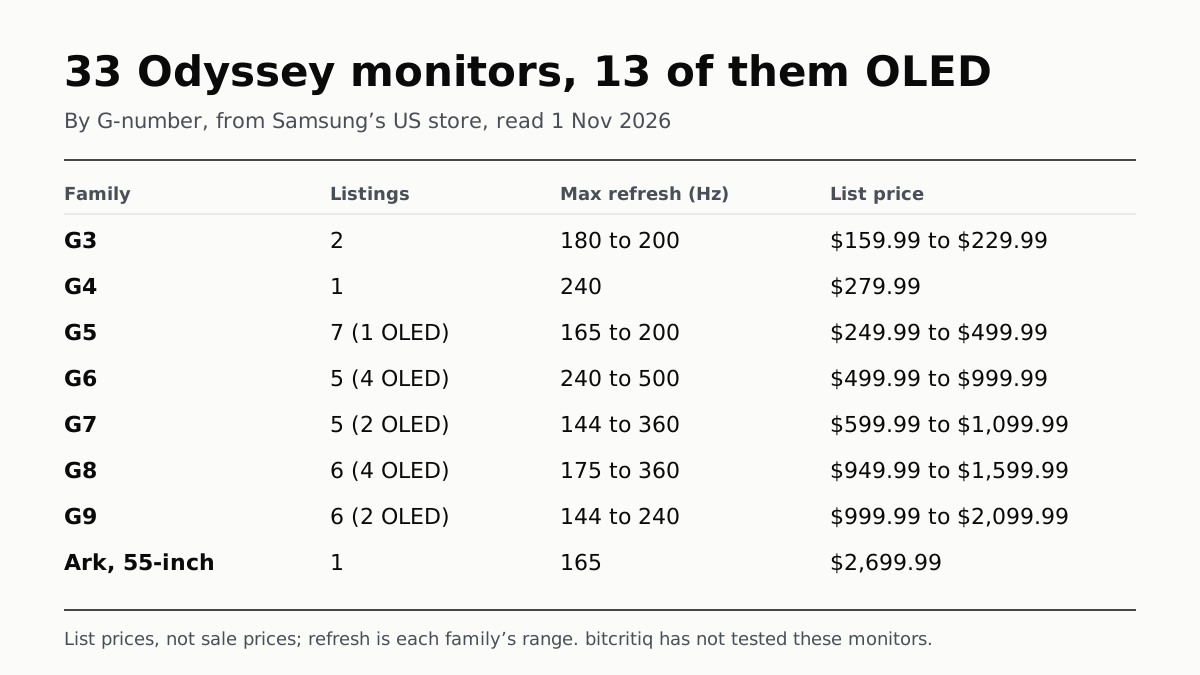
The G-number runs from G3 to G9, OLED models say so in the name, and refresh rates reach 500 Hz. List prices read 1 November 2026.
If you buy through our links, we may earn a commission. It never affects our verdicts or scores — how that works. As an Amazon Associate I earn from qualifying purchases.
Samsung’s US store listed 33 Odyssey gaming monitors on 1 November 2026, grouped by a G-number from G3 to G9, plus the 55-inch Odyssey Ark. 13 of the 33 are OLED and say so in the name; the rest are IPS or VA LCDs, and every G-number from G5 up sells both kinds.
Every figure here comes from Samsung’s own US pages, read on 1 November 2026: the gaming-monitors page’s listing cards and, for 13 listings, the product page’s spec table. We have not used these monitors, and this page does not rank them.
How to read an Odyssey name
Samsung’s gaming page does not say what the G-number stands for. What the listings do show is a pattern you can check yourself:
- The G-number is the family. List prices rose with it overall, from $159.99 for the cheapest G3 to $2,099.99 for the 57-inch G9, though the bands overlap: the top G6 lists above the cheapest G8.
- OLED is in the name. Each of the 13 OLED listings reads “Odyssey OLED”, and its model code has an S before the last letter (G60SF (affiliate link to Amazon, opens in a new tab), G85SD). The 6K G80HS (affiliate link to Amazon, opens in a new tab) is the one to watch: it ends in S but is an IPS panel.
- Five listings were labelled 2026 in their names: the two G80SH sizes, the G80HS, the G80HF and the G73SH.
Two monitors with the same G-number can still differ sharply. The G6 family runs from a 350 Hz IPS panel to a 500 Hz OLED, and the cheapest and dearest G6 list prices are $500 apart. When comparing prices across retailers, the full code matters more than the G-number; our piece on Black Friday model numbers explains why.
G3, G4 and G5: 1080p and 1440p
| Listing | Size (in) | Panel | Resolution | Max refresh (Hz) | Shape | List price | Shown 1 Nov |
|---|---|---|---|---|---|---|---|
| Odyssey G3 G30H | 24 (also 27) | IPS | FHD | 200 | — | $159.99 | $139.99 |
| Odyssey G3 G30D | 27 (also 24, 32) | — | FHD | 180 | — | $229.99 | $129.99 |
| Odyssey G4 G40B | 25 | IPS | FHD | 240 | — | $279.99 | — |
| Odyssey G5 G53F | 27 | — | QHD | 200 | — | $249.99 | — |
| Odyssey G5 G50F | 27 (also 32) | IPS | QHD | 180 | — | $279.99 | $169.99 |
| Odyssey G5 G55H | 32 (also 27) | — | QHD | 180 | Curved | $289.99 | $219.99 |
| Odyssey G5 G55C | 27 (also 32) | — | QHD | 165 | Curved | $299.99 | $229.99 |
| Odyssey G5 G50D | 27 (also 32) | IPS | QHD | 180 | — | $349.99 | — |
| Odyssey G5 G55T | 34 | — | QHD | 165 | Curved | $399.99 | $249.99 |
| Odyssey OLED G5 G50SF | 27 | OLED | QHD | 180 | — | $499.99 | — |
A dash in the price column means Samsung showed no sale price. Prices are for the size in the listing’s title.
G6 and G7: where OLED and 4K start
| Listing | Size (in) | Panel | Resolution | Max refresh (Hz) | Shape | List price | Shown 1 Nov |
|---|---|---|---|---|---|---|---|
| Odyssey G6 G60F | 27 | IPS | QHD | 350 | — | $499.99 | — |
| Odyssey OLED G6 G61SH | 27 | OLED | QHD | 240 | — | $599.99 | $429.99 |
| Odyssey OLED G6 G61SD | 27 | OLED | QHD | 240 | — | $799.99 | $629.99 |
| Odyssey OLED G6 G60SD | 27 | OLED | QHD | 360 | — | $899.99 | — |
| Odyssey OLED G6 G60SF | 27 | OLED | QHD | 500 | Flat | $999.99 | $699.99 |
| Odyssey G7 G70F | 27 | IPS | 4K, dual mode | 360 (dual mode) | — | $599.99 | $449.99 |
| Odyssey G7 G70D | 27 (also 32) | IPS | 4K | 144 | Flat | $699.99 | — |
| Odyssey G7 G75F | 37 (also 40) | — | 4K | 165 | Curved | $899.99 | $699.99 |
| Odyssey OLED G7 G70SH | 27 | OLED | 4K | 165 | — | $999.99 | $749.99 |
| Odyssey OLED G7 G73SH | 32 | OLED | 4K | 165 (330 at FHD) | Flat | $1,099.99 | $699.99 |
Every G6 listing is a 27-inch QHD screen; the family splits on panel and refresh rate, from 240 Hz to 500 Hz. The G7 is where 4K appears, on IPS and OLED panels and on the curved 37-inch G75F. A faster panel does not cure every kind of hitch, though: why games stutter on a fast PC covers the stalls that happen while a game builds shaders, whatever the refresh rate.
G8: OLED, 5K and 6K
| Listing | Size (in) | Panel | Resolution | Max refresh (Hz) | Shape | List price | Shown 1 Nov |
|---|---|---|---|---|---|---|---|
| Odyssey G8 G80HF (2026) | 27 | IPS | 5K (5120 × 2880) | 180 (360 at QHD) | Flat | $949.99 | $599.99 |
| Odyssey OLED G8 G80SH (2026) | 27 | OLED | 4K | 240 | Flat | $1,099.99 | — |
| Odyssey OLED G8 G85SD | 34 | OLED | UWQHD (3440 × 1440) | 175 | Curved | $1,199.99 | — |
| Odyssey OLED G8 G80SH (2026) | 32 | OLED | 4K | 240 | Flat | $1,299.99 | $1,099.99 |
| Odyssey OLED G8 G81SF | 27 (also 32) | OLED | 4K | 240 | — | $1,299.99 | $999.99 |
| Odyssey G8 G80HS (2026) | 32 | IPS | 6K (6144 × 3456) | 165 (330 at 3K) | Flat | $1,599.99 | $1,349.99 |
The two IPS G8s use what Samsung calls Dual Mode: the G80HF runs 5K at up to 180 Hz or QHD at up to 360 Hz, and the G80HS runs 6K at up to 165 Hz or 3K at up to 330 Hz.
G9 and the Ark: super-ultrawide and beyond
| Listing | Size (in) | Panel | Resolution | Max refresh (Hz) | Shape | List price | Shown 1 Nov |
|---|---|---|---|---|---|---|---|
| Odyssey G9 G91F | 49 | VA | DQHD (5120 × 1440) | 144 | Curved | $999.99 | $699.99 |
| Odyssey OLED G9 G91SD | 49 | OLED | DQHD (5120 × 1440) | 144 | Curved | $1,299.99 | $899.99 |
| Odyssey G9 G95C | 49 | — | DQHD (5120 × 1440) | 240 | Curved | $1,299.99 | — |
| Odyssey 3D G9 G90XF | 27 | — | 4K, glasses-free 3D | 165 | — | $1,399.99 | $999.99 |
| Odyssey OLED G9 G95SD | 49 | OLED | DQHD (5120 × 1440) | 240 | Curved | $1,899.99 | — |
| Odyssey Neo G9 | 57 | VA, Mini-LED | Dual 4K (7680 × 2160) | 240 | Curved | $2,099.99 | — |
| Odyssey Ark 2nd Gen. | 55 | VA, Quantum Mini-LED | 4K | 165 | Curved | $2,699.99 | $2,299.99 |
Five of the six G9 listings are 49-inch or 57-inch curved ultrawides; the exception is the 27-inch 3D model. The Ark has no G-number, and Samsung calls it a “Gaming Screen” rather than a monitor.
Who each family suits, by the spec sheet
- G3 and G4: 1080p screens from 24 to 32 inches at 180 to 240 Hz, the lowest list prices on the page.
- G5: 27-inch to 34-inch QHD, including three curved models and one OLED at 180 Hz.
- G6: 27-inch QHD only, for refresh rates of 240 Hz and up.
- G7 and G8: mostly 4K and above, with the 5K and 6K IPS models in the G8 family; the 34-inch OLED G8 is an ultrawide at 3440 × 1440.
- G9: the 49-inch and 57-inch curved ultrawides, plus the 27-inch glasses-free 3D model.
Samsung sells TVs under a separate naming scheme; our Samsung TV series explainer sets that one out.
Questions people ask
What is the difference between Samsung Odyssey G5, G6, G7, G8 and G9?
Samsung does not define the G-number on its gaming page. On its US store on 1 November 2026, list prices rose with it overall, from G3 at $159.99 to the G9 Neo at $2,099.99, and every G9 listing is 49 or 57 inches apart from the 27-inch 3D model. Each G-number from G5 up includes OLED and non-OLED models.
How do I tell if a Samsung Odyssey monitor is OLED?
Samsung puts OLED in the listing name, as in Odyssey OLED G6 G60SF, and in the 13 OLED listings we read the model code has an S before its last letter. The 6K G80HS is the exception to watch: it ends in S but is an IPS panel.
Which Samsung Odyssey monitor has the highest refresh rate?
The 27-inch Odyssey OLED G6 G60SF, at 500 Hz at QHD, per Samsung’s US product page on 1 November 2026. The 27-inch G8 G80HF and the IPS G70F reach 360 Hz at a lower resolution in dual mode.
Which Samsung Odyssey monitors are curved?
Eleven listings on 1 November 2026: the five 49-inch and 57-inch G9 models, the 34-inch OLED G8 G85SD, the 37-inch G7 G75F, three G5 models (G55T, G55C, G55H) and the 55-inch Ark. The 2026 G8 and G7 models we opened are flat.
What is the Samsung Odyssey G80HS?
A 32-inch 6K IPS gaming monitor marked 2026 on Samsung’s US store. Samsung lists 6144 by 3456 at up to 165 Hz, or 3072 by 1728 at up to 330 Hz in its dual mode.
Is the Odyssey Ark a monitor?
Samsung files it on its gaming-monitors page but calls it a “Gaming Screen”. The 2nd-generation Ark is a 55-inch curved 4K VA panel with Quantum Mini-LED backlighting at up to 165 Hz, and it carries no G-number.
How we researched this
No one at bitcritiq has handled this product. Everything here comes from published sources, listed below.
- What this cannot tell you
- Samsung’s US store ran sales on most listings on 1 November; prices move weekly through Black Friday, and the card shows one size’s price on multi-size listings. We did not open every product page, so panel type is blank where neither card nor product page we read stated it, and shape is blank where Samsung did not state it on what we read. Samsung’s Curved filter returned 8 listings and left out three whose own cards say Curved (G85SD, G75F, G55H). The 24-inch G30H’s URL calls it “odyssey-oled-g3”, while its card says IPS; we use the card. Six listings showed “Notify me” instead of a buy button. We have not used any of these monitors, and this page does not rank them.
How we chose this, and what we did
- Why this subject
- Search Console shows our computing lineup explainers and gaming pages collecting impressions for best-laptop and gaming searches. Samsung’s Odyssey range has more listings than any other lineup we have covered, in seven G-numbers plus the Ark, with OLED and non-OLED models sharing a G-number. No bitcritiq post covers Samsung’s monitors: a grep for “Odyssey” across our posts returned nothing.
- How we looked at it
- Read on 1 November 2026 in the research browser. Samsung’s US gaming-monitors page (samsung.com/us/monitors/gaming/) said “36 Results”; we expanded it with its View more button and counted 36 cards, of which 3 are bundles of two monitors, leaving 33 monitor listings. The 27-inch and 32-inch G80SH appear as two separate listings, so the 33 listings cover 32 model names. We counted the 13 OLED listings by the word OLED in each listing name, and the G-number groups by the G-number in each name (the G70F listing omits “G7” from its title; its URL names it Odyssey G7). Resolution and refresh rate come from each card’s spec line; for the 13 listings whose card omits a figure or that we wanted to confirm, we opened Samsung’s product page and read its spec table (Flat / Curved, Panel Type, Resolution, Frame Rate). List price is the struck-through “Save Price” figure where the card showed one, and otherwise the price shown, for the size named in the listing title. Shape: 11 listings are described as curved by their card, product page, URL or Samsung’s own Curved filter; 7 we confirmed as flat on the product page. Absence check on the G-number: Samsung’s gaming page FAQ explains refresh rate and curved versus flat but gives no meaning for the G-number, while it does define refresh rate and response time.
What this rests on
6 claims, all official. Nothing here was measured by bitcritiq — see how we test for why. Open a claim to read the source it came from.
Samsung’s US gaming-monitors page listed 36 results on 1 November 2026: 33 monitor listings and 3 two-monitor bundles.Official
samsung.com/us/monitors/gaming/, 1 November 2026: “36 Results”; bundle cards include “40 Inch Odyssey G7 G75H 34 Inch Odyssey G8 G85SD Gaming Mo...”, “27 Inch Odyssey G7 G70D 27 Inch G5 G50D Gaming Monitor Bun...” and “49 Inch Odyssey G9 G95C 27 Inch Odyssey G5 G50D Gaming Mon...”.
13 of the 33 monitor listings carry OLED in their names.Official
Listing names include “27 Inch Odyssey OLED G6 G60SF”, “34 Inch Odyssey OLED G8 G85SD”, “49 Inch Odyssey OLED G9 G95SD” and ten more with “Odyssey OLED”; count in research.method.
The highest refresh rate on the page is 500 Hz, on the 27-inch Odyssey OLED G6 G60SF.Official
Card: “27 Inch Odyssey OLED G6 G60SF QHD | 500Hz | G-Sync Compatible”; product page: “Frame Rate Max 500Hz”, “Panel Type OLED”, “Flat / Curved Flat”.
Samsung lists the 32-inch Odyssey G8 G80HS as a 6K IPS panel running 165 Hz at 6K or 330 Hz at 3K.Official
Product page: “Panel Type IPS … 6K (6144 x 3456 ↔ DLG 3072 x 1728) … Frame Rate Max 6K 165 Hz / 3K 330 Hz … Flat / Curved Flat”.
The 57-inch Odyssey Neo G9 is a 7,680 × 2,160 VA panel at up to 240 Hz.Official
Product page: “Panel Type VA … 7,680 x 2,160 … Frame Rate Max 240Hz”; card: “Dual 4K | HDR 1000 | 240Hz | Mini-LED”.
The 27-inch Odyssey G8 G80HF is a 5K IPS panel at up to 180 Hz, or 360 Hz at QHD.Official
Product page: “Panel Type IPS … 5K (5120 x 2880 ↔ DLG 2560 x 1440) … Frame Rate Max 5K 180 Hz / QHD 360 Hz … Flat / Curved Flat”.
Sources 13
- Gaming Monitors | Samsung Odyssey — Samsung USOfficialaccessed Nov 1, 2026
- 32 Inch Odyssey G8 G80HS 6K Gaming Monitor — Samsung USOfficialaccessed Nov 1, 2026
- 27 Inch Odyssey G8 G80HF 5K Gaming Monitor — Samsung USOfficialaccessed Nov 1, 2026
- 27 Inch Odyssey OLED G8 G80SH 4K Gaming Monitor — Samsung USOfficialaccessed Nov 1, 2026
Show 9 more · 9 official or standards
- 32 Inch Odyssey OLED G8 G80SH 4K Gaming Monitor — Samsung USOfficialaccessed Nov 1, 2026
- 32 Inch Odyssey OLED G7 G73SH 4K Gaming Monitor — Samsung USOfficialaccessed Nov 1, 2026
- 27 Inch Odyssey OLED G6 G60SF — Samsung USOfficialaccessed Nov 1, 2026
- 27 Inch Odyssey G7 G70D — Samsung USOfficialaccessed Nov 1, 2026
- 34 Inch Odyssey OLED G8 G85SD — Samsung USOfficialaccessed Nov 1, 2026
- 49 Inch Odyssey OLED G9 G95SD — Samsung USOfficialaccessed Nov 1, 2026
- 49 Inch Odyssey G9 G91F — Samsung USOfficialaccessed Nov 1, 2026
- 57 Inch Odyssey Neo G9 — Samsung USOfficialaccessed Nov 1, 2026
- 55 Inch Odyssey Ark 2nd Gen. — Samsung USOfficialaccessed Nov 1, 2026
Pass it on
Know someone weighing this up? Send them the answer.
bitcritiq.com/hvw7The link is permanent: it opens this article for good, even if the title changes.
No email, no account
Follow bitcritiq
Every new article, in whatever reader you already use.
Subscribe by RSSAll the ways to follow
Using Chrome on Android? Open the browser menu and tap Follow. New articles then turn up in the Following tab in Discover.
read next
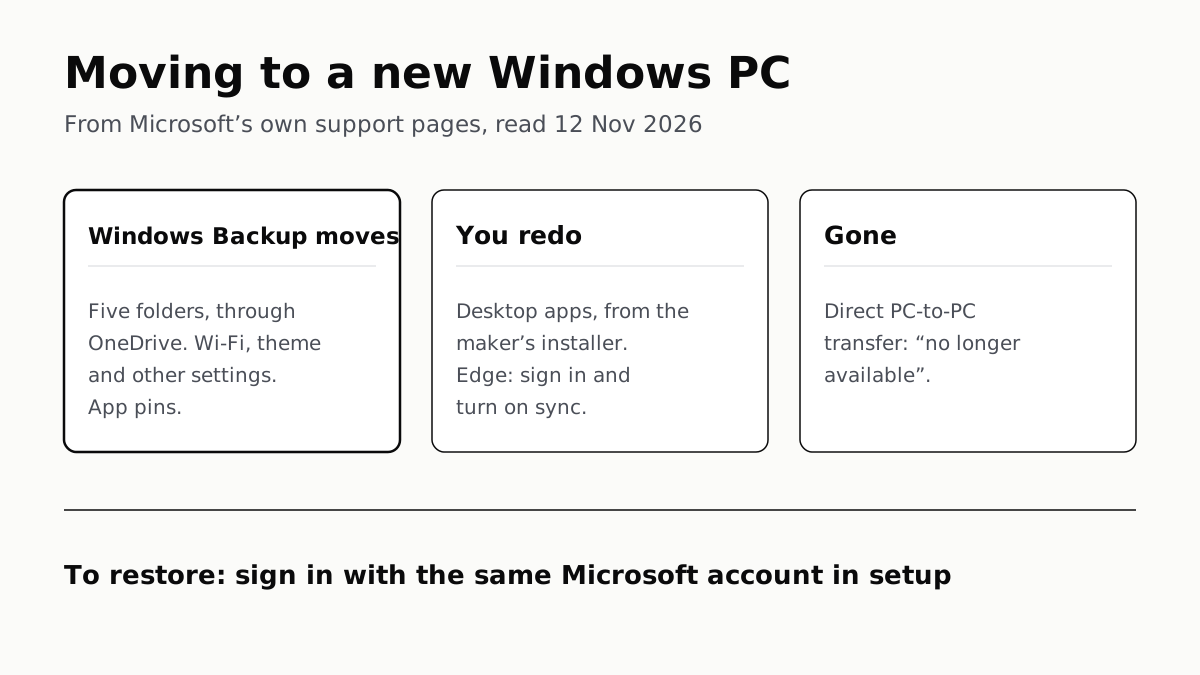
Windows Backup Moves Files and Settings, Not Desktop Apps
Sign in with the same Microsoft account during setup to restore. Files travel through OneDrive, whose free tier is 5 GB.
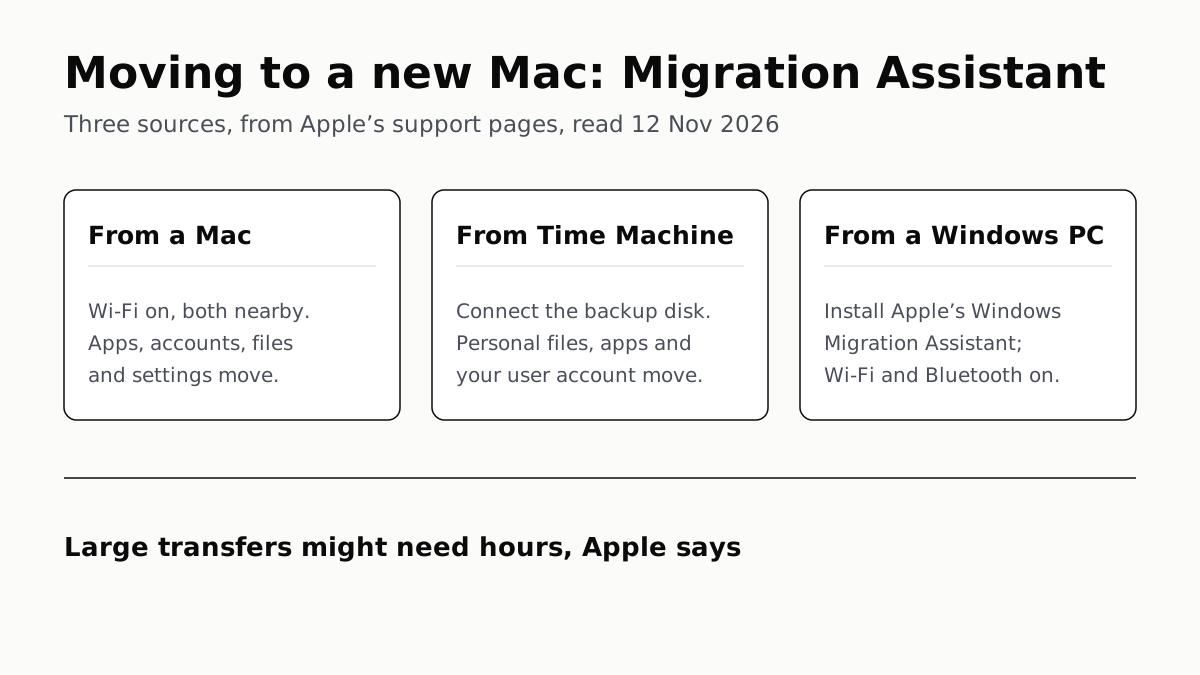
Migration Assistant Moves Your Old Mac or PC to a New Mac
It comes with your Mac. A PC needs Apple’s Windows Migration Assistant, and Apple warns large transfers might need hours.
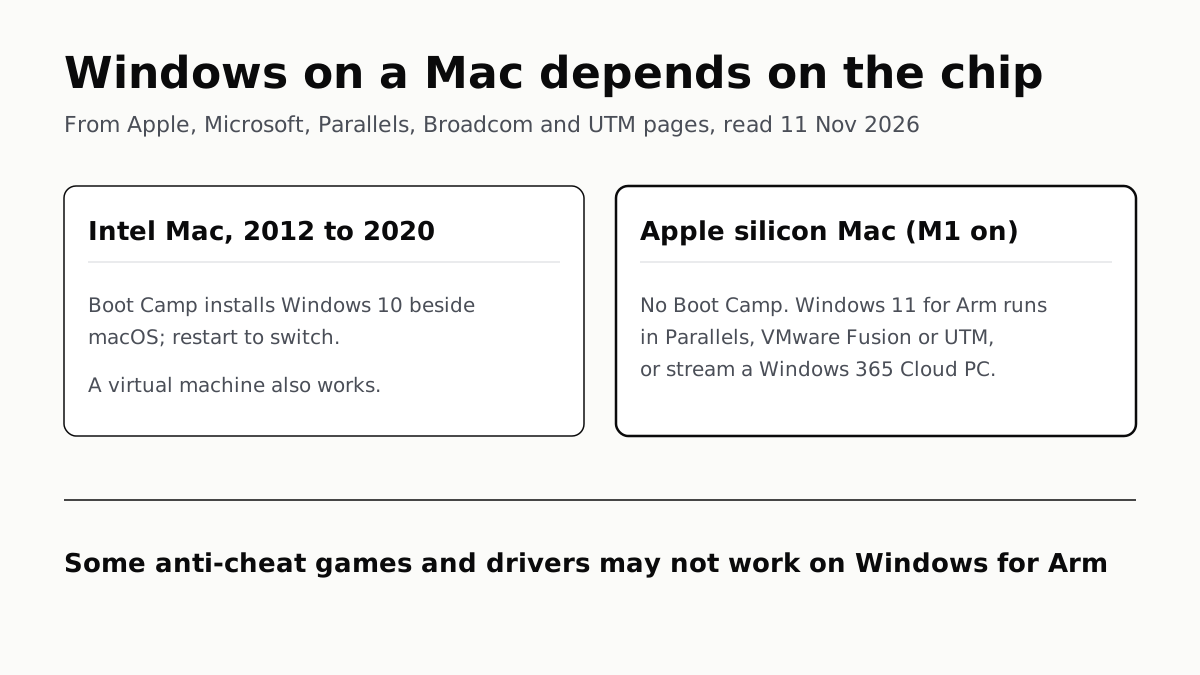
A Mac Can Run Windows, but Apple Silicon Means No Boot Camp
Microsoft authorizes Parallels on M1 to M3; Fusion and UTM are free. All run Windows 11 for Arm, where some games may not work.
Windows 11 Pro Adds BitLocker, Remote Desktop and VMs
Home can encrypt the drive on supported laptops. Pro adds a Remote Desktop host, Hyper-V, Windows Sandbox and domain join.