Carrier Dead-Zone Venture Sets No Date, Phone List or Price
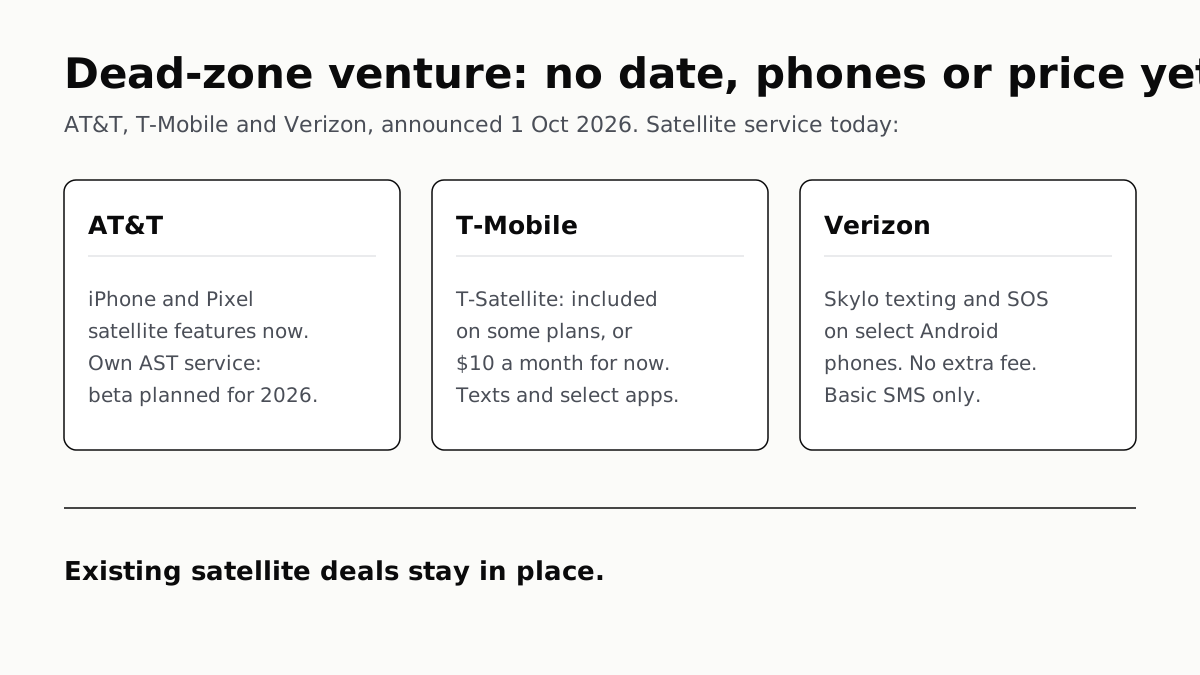
Existing satellite texting carries on: T-Satellite is $10 a month for now unless included; Verizon’s is free on some Androids.
If you buy through our links, we may earn a commission. It never affects our verdicts or scores — how that works. As an Amazon Associate I earn from qualifying purchases.
Not yet. The joint venture AT&T, T-Mobile and Verizon signed on 1 October 2026 has published no launch date, no list of phones, no plans and no price, so your phone works in a dead zone exactly as it did before. What reaches a dead zone today is each carrier’s own satellite service, and the venture leaves those deals in place.
What the three carriers announced
The three carriers put out one release, word for word the same on all three newsrooms. It says they “have entered into a joint venture agreement focused on expanding coverage in underserved areas across the U.S.”, names Paul Roth as interim CEO while a permanent one is found, and says a board with a member from each carrier will run it. That firms up a plan from 14 May, when the deal was an “agreement in principle” still subject to definitive agreements.
The idea is to pool the carriers’ spectrum and make it easier for satellite companies to reach ordinary phones. The stated goal is large: the venture “will nearly eliminate dead zones in the U.S. currently without mobile service”, with better direct-to-device satellite access “as a first step”.
Read it as an intention, not a schedule. The release introduces its customer benefits with what the venture “will aim to provide”, and attaches no date to any of them.
What has not been published
| Question | What the carriers have said |
|---|---|
| When does it start? | No date |
| Which phones? | No list. The aim is “industrywide device compatibility”, worked out with operating system and phone makers |
| Which plans? | Not stated |
| Does it cost extra? | No price |
| Which satellite company? | None named; the release calls it “technology-neutral” and wants more providers to compete |
| Does my current satellite service change? | No: “Existing carrier-satellite agreements will remain in place” |
The release does give operating detail, such as the interim CEO and the board, so the missing four are absent rather than out of scope. We found no website for the venture and no FCC filing cited in either release.
What works in a dead zone today
Each carrier already offers something, and they differ more than the joint announcement suggests.
| Carrier | Service now | Phones | Cost |
|---|---|---|---|
| T-Mobile | T-Satellite: texts, picture messages, location sharing and select apps such as WhatsApp voice chat | “Most smartphones from the last 4 years” | Included with Experience Beyond 2.0 and Better Value; otherwise $10 a month |
| Verizon | Satellite texting and SOS through Skylo | Listed Galaxy S25, Z Fold7, Z Flip7 (affiliate link to Amazon, opens in a new tab), Pixel 9 and Pixel 10 (affiliate link to Amazon, opens in a new tab) models | No extra fee |
| AT&T | iPhone and Pixel satellite messaging and emergency features | iPhone and Pixel; AT&T says over half its customers have access | Not an AT&T charge |
T-Mobile’s service does more than Verizon’s, adding select apps to texting. T-Satellite is sold to customers of other carriers too, at $10 a month, which T-Mobile’s FAQ calls a limited-time price, $5 off. It connects automatically when there is no other signal, outdoors with a view of the sky, and T-Mobile says it reaches “the over 500,000 miles of the U.S. that aren’t covered by any wireless company’s cell towers”. It also works in Canada, New Zealand and Japan, which helps on a hike but does not replace a day pass or travel eSIM for data abroad. Anyone with an eligible phone can use T-Mobile’s text-to-911 by satellite free, even without a T-Mobile account.
Verizon offers less but charges nothing for it. Satellite messages go through Skylo on the listed Galaxy and Pixel models, with Google Messages as the default texting app. Verizon supports basic two-way text only: no MMS, RCS or attachments, and no Wireless Emergency Alerts over Skylo. iPhone owners are pointed to Apple’s own satellite features.
AT&T has no satellite service of its own on sale that we could find. Its satellite page sends customers to the iPhone and Pixel features, and its own service with AST SpaceMobile, which it says will handle voice, data and text on ordinary phones, was last given a timeline in December 2025: a beta for select customers in the first half of 2026, “with commercial launch to follow”. We could not confirm from AT&T’s pages whether that beta has begun.
What to do
If dead zones are a real problem for you now, the venture is not the fix yet. Your options are the services in the table, and which one you can use depends on your phone as well as your carrier: check the T-Satellite device list or Verizon’s model list before paying for anything. Plan names and inclusions change often, and as with what “unlimited” data includes, each carrier sets its own terms.
Expect limits either way. T-Mobile and Verizon both require you to be outside with a line of sight to the satellite, and T-Mobile warns that satellite service, including text to 911, “may be delayed, limited, or unavailable”.
Questions people ask
Will the AT&T, T-Mobile and Verizon joint venture fix dead zones?
That is its stated aim: the carriers say it will “nearly eliminate dead zones in the U.S.” But the 1 October announcement gives no date, phones, plans or price, so nothing changes on your phone yet.
Do I have to pay extra for the carriers’ satellite venture?
Not stated yet. The carriers have published no price for anything the venture will offer. What exists today is priced by each carrier: T-Satellite is included on some T-Mobile plans or $10 a month, and Verizon charges no extra fee on select Android phones.
Which phones will work with the dead-zone joint venture?
No list has been published. The carriers say they want “industrywide device compatibility” and will work with operating system and phone makers, but name no models.
Can I use T-Satellite if I’m on Verizon or AT&T?
Yes. T-Mobile sells T-Satellite to non-customers for $10 a month, a price it calls limited-time. Separately, anyone with an eligible phone can use T-Mobile’s free text-to-911 by satellite, without a T-Mobile account.
Does Verizon have satellite texting?
Yes, through Skylo on listed Galaxy S25, Z Fold7, Z Flip7, Pixel 9 and Pixel 10 models, at no extra fee. It is basic two-way text only: no MMS, RCS or attachments. Verizon points iPhone owners to Apple’s own satellite features.
Does AT&T have satellite texting?
Through the phone, not AT&T: AT&T says over half its customers can already use satellite messaging and emergency features on iPhone and Pixel. Its own service with AST SpaceMobile was due as a beta for select customers in the first half of 2026.
How we researched this
No one at bitcritiq has handled this product. Everything here comes from published sources, listed below.
- What this cannot tell you
- We found no website for the venture itself and no FCC filing referenced in either release, and the venture has no published name. We did not use outlet reporting. AT&T's newest first-party statement we found on its own AST SpaceMobile service is a plan for a beta in the first half of 2026; we could not confirm from AT&T's pages whether that beta has started. We have not used any of these satellite services.
How we chose this, and what we did
- Why this subject
- On 1 October 2026 AT&T, T-Mobile and Verizon said they had signed the joint venture they first announced in May, aimed at dead zones and satellite coverage. The reader's question is practical: will my phone work in a dead zone because of this, which phones, on which plans, when, and at what cost.
- How we looked at it
- The 1 October release was read on all three carriers' own newsrooms (about.att.com, t-mobile.com/news, verizon.com/about/news) and is word-for-word the same on each; the 14 May release was read on about.att.com. Absence of a date, price, plan or device list: the 1 October release names the interim CEO (“Paul Roth will serve as interim CEO”) and the board, and says “Existing carrier-satellite agreements will remain in place”, but gives no launch date, price, plan or phone. Current services come from each carrier's own pages, read 10 October 2026: T-Mobile's T-Satellite page and its FAQ, Verizon's Satellite SOS and messaging FAQs, and AT&T's Satellite Solutions page and its 29 December 2025 satellite blog.
What this rests on
6 claims, all official. Nothing here was measured by bitcritiq — see how we test for why. Open a claim to read the source it came from.
AT&T, T-Mobile and Verizon have entered into a joint venture agreement, with Paul Roth as interim CEO and a board drawn from all three.Official
1 October 2026 release, identical on all three newsrooms: “AT&T, T-Mobile, and Verizon have entered into a joint venture agreement focused on expanding coverage in underserved areas across the U.S.” and “Paul Roth will serve as interim CEO of the JV while an active search is underway for a permanent CEO.”
The venture aims to nearly eliminate US dead zones, starting with better direct-to-device satellite access, and leaves each carrier's existing satellite agreements in place.Official
1 October release: “Will nearly eliminate dead zones in the U.S. currently without mobile service”; “as a first step, direct-to-device (D2D) access will improve”; “Existing carrier-satellite agreements will remain in place and the JV partners can continue connectivity efforts independently.”
The release gives no launch date, price, plan or list of phones.Official
Read in full on about.att.com, t-mobile.com and verizon.com on 10 October 2026. Control: the same release names the interim CEO and the board structure, so it does give operating detail, but none of these four.
T-Satellite is included with Experience Beyond 2.0 and Better Value, and costs $10 a month on other plans, including other carriers', at a price T-Mobile calls limited-time.Official
T-Mobile T-Satellite FAQ: “Experience Beyond 2.0 & Better Value customers: No action needed—T-Satellite is included in your plan at no extra cost. For all other T-Mobile customers: Add T-Satellite for a limited time at $10/month (a savings of $5/mo.)… Not a T-Mobile customer? Get T-Satellite for $10/mo.” and “Most smartphones from the last 4 years work with T-Satellite.”
Verizon's satellite texting and SOS run through Skylo on listed Galaxy and Pixel models, at no extra fee, and support basic two-way text only.Official
Verizon Satellite SOS and messaging FAQs: “Verizon partners with Skylo to provide satellite services for select Android smartphones”; “No, there is no extra fee to use Satellite SOS and messaging with Skylo”; “Only 2-way basic text messaging is supported.”
AT&T points customers to iPhone and Pixel satellite features today, and planned a beta of its own AST SpaceMobile service in the first half of 2026.Official
AT&T Satellite Solutions: “Over half of AT&T customers already have access to peer-to-peer messaging and emergency satellite services. For more information on availability and how to use, visit here for iPhone and here for Pixel.” AT&T blog, 29 December 2025: “we plan to offer a select number of AT&T customers and public safety on FirstNet beta satellite service in the first half of next year, with commercial launch to follow.”
Sources 8
- AT&T, T-Mobile, and Verizon Launch Joint Venture That Helps End Dead Zones; Name Paul Roth Interim CEO — AT&T Newsroom, 1 October 2026Officialaccessed Oct 10, 2026
- AT&T, T-Mobile and Verizon Launch Joint Venture That Helps End Dead Zones — T-Mobile Newsroom, 1 October 2026Officialaccessed Oct 10, 2026
- AT&T, T-Mobile and Verizon launch joint venture that helps end dead zones — About Verizon, 1 October 2026Officialaccessed Oct 10, 2026
- AT&T, T-Mobile, and Verizon Plan to Launch New Joint Venture that Helps End Dead Zones — AT&T Newsroom, 14 May 2026Officialaccessed Oct 10, 2026
Show 4 more · 4 official or standards
- T-Satellite — T-MobileOfficialaccessed Oct 10, 2026
- Satellite SOS and messaging FAQs — Verizon SupportOfficialaccessed Oct 10, 2026
- AT&T Satellite Solutions — AT&TOfficialaccessed Oct 10, 2026
- The Sky’s No Limit: AT&T’s Satellite Successes and What’s Next — AT&T Blog, 29 December 2025Officialaccessed Oct 10, 2026
Pass it on
Know someone weighing this up? Send them the answer.
bitcritiq.com/b6s4The link is permanent: it opens this article for good, even if the title changes.
No email, no account
Follow bitcritiq
Every new article, in whatever reader you already use.
Subscribe by RSSAll the ways to follow
Using Chrome on Android? Open the browser menu and tap Follow. New articles then turn up in the Following tab in Discover.
read next
Chargers Rated 100–240V Need Only a Plug Adapter Abroad
Apple, Samsung and Google rate their chargers, and the MacBook Air, for 100–240V. A hair dryer built for 110–120V is a different case.
Send Your AirTag Link to United, Delta, American, JetBlue
Find My’s Share Item Location makes a seven-day link a bag agent can open. Apple says more than 50 airlines accept it.
Family Link Works From an iPhone. Screen Time Needs Apple
Neither app supervises the other maker’s phones. App limits, downtime, web filters and more, side by side, with iOS 27’s changes.
WhatsApp Chats Can Cross Between iPhone and Android
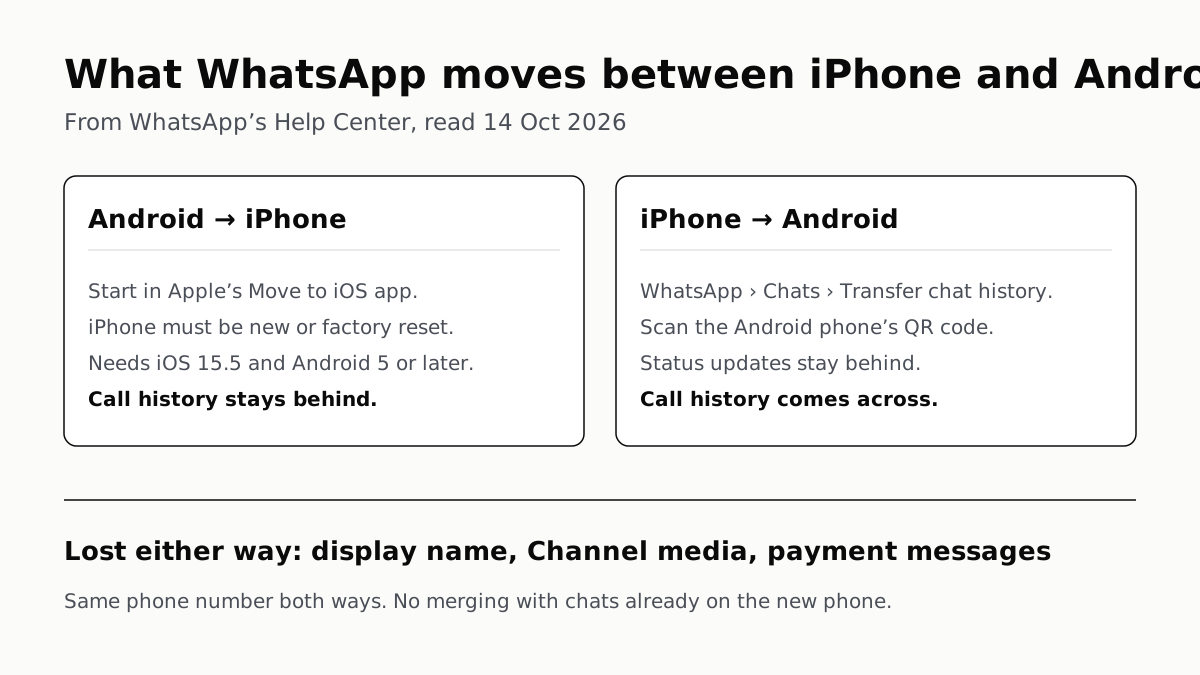
Messages, media and settings move both ways. Display names, Channel media and payment messages don’t, and call logs reach Android alone.