On ‘Unlimited’ Phone Plans, the Limit Is Speed, Not Data
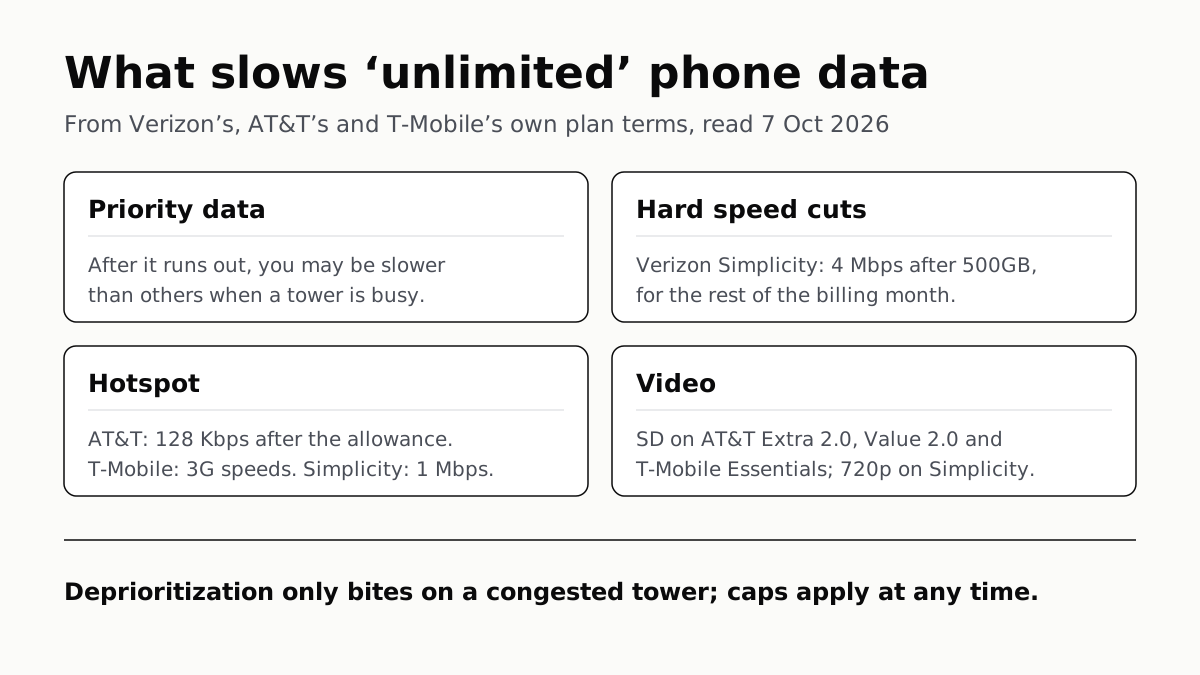
Slowdowns come from four places — busy-tower priority, hard speed cuts, hotspot caps and video resolution — and each plan sets its own.
If you buy through our links, we may earn a commission. It never affects our verdicts or scores — how that works. As an Amazon Associate I earn from qualifying purchases.
On a US phone plan, “unlimited” means you are not cut off and not charged for overage; it does not mean your speed stays the same however much you use. The carriers’ own terms add up to four separate limits: a priority allowance, sometimes a hard speed cut, a hotspot cap and a video resolution cap.
Verizon’s own definition is the narrow one: an unlimited plan lets you “use as much cellular data as you need without worrying about overage charges”. Speed is a separate promise, and each plan sets it in the fine print.
The four limits, plan by plan
| Carrier · plan | Priority data | After that | Hotspot | Video |
|---|---|---|---|---|
| Verizon · Simplicity | Not stated | 4 Mbps after 500GB a month | 10GB, then 1 Mbps | 720p |
| AT&T · Elite 2.0 | Won’t slow based on usage | — | 250GB, then 128 Kbps | 4K UHD |
| AT&T · Premium 2.0 | Won’t slow based on usage | — | 100GB, then 128 Kbps | 4K UHD |
| AT&T · Extra 2.0 | 100GB | May slow if the network is busy | 50GB, then 128 Kbps | SD |
| AT&T · Value 2.0 | 5GB | May slow if the network is busy | 3GB, then 128 Kbps | SD |
| T-Mobile · Experience Beyond 2.0 | Unlimited | — | 250GB, then 3G speeds | SD; up to 4K if activated |
| T-Mobile · Experience More 2.0 | Unlimited | — | 60GB, then 3G speeds | SD; up to 4K if activated |
| T-Mobile · Essentials 2.0 | 50GB | Further reduction | 3G speeds | SD |
| Visible · Visible | Not stated | Slower than other traffic at busy times | Unlimited at up to 5 Mbps | 480p |
| Visible · Visible+ | Unlimited | — | Unlimited at up to 10 Mbps | 1080p on 5G UW, 720p elsewhere |
All figures are from each carrier’s own plan pages and terms, read 7 October 2026 and linked below. “Not stated” means the plan’s own description does not give one. Prices are left out on purpose.
Priority data and deprioritization
Premium data, or high-speed data in AT&T’s wording, is how much you can use each month before your traffic drops to the back of the queue on a busy tower. T-Mobile’s plans page gives the plainest definition: data “at the start of your bill cycle where you are prioritized higher than customers who are heavy data users”. Once it is used, “you are prioritized lower than other customers and you may notice lower speeds in times and places with network congestion.”
The condition is congestion. Verizon says deprioritized speeds return to normal “once the demand on the site lessens, or if you connect to a different site not experiencing high demand.” AT&T says the effect can “start and stop over a very short time period (often measured in fractions of a second)”. On an uncrowded tower, a deprioritized line can run at full speed; at a stadium event or at peak times, the examples AT&T gives, it is slower than the lines ahead of it.
T-Mobile’s Essentials 2.0 shows the allowance is not always top priority. Its plan card offers “50GB of premium data”, while the footnote says Essentials customers “may notice speeds lower than other customers and further reduction if using >50GB/month., due to data prioritization.”
AT&T says that for plans with a usage threshold it alerts customers when they reach 75% of it, though its network-practices page still gives retired plans as its examples.
Hard speed cuts are a different thing
A throttle is a fixed cap that applies whether or not the tower is busy. Verizon’s Simplicity plan, the one on its unlimited-plans page, cuts speeds to 4 Mbps after 500GB in a billing cycle for the rest of that cycle. Its plan description, unlike Verizon’s older Unlimited Welcome on the same page, does not mention congestion priority.
Verizon also has a network-wide rule for any mobile line: above the top 0.5% of users’ average (1.2 TB as of June 2026), it “may reduce data speeds to your device to 4 Mbps” for the rest of the month.
Hotspot has its own allowance
Using your phone as a hotspot draws from a separate, usually smaller bucket. After it runs out, AT&T slows hotspot to a maximum of 128 Kbps, Verizon Simplicity to 1 Mbps, and T-Mobile to “max 3G speeds”. T-Mobile markets Experience Beyond 2.0 as “Unlimited mobile hotspot included”; its terms make that 250GB of high-speed hotspot data, then unlimited at 3G speeds.
T-Mobile adds that on-phone data “is prioritized over tethering usage” and that for customers using more than 50GB a month, “primary data usage must be on smartphone or tablet”. Visible takes the other approach: no hotspot allowance, but a speed ceiling of 5 Mbps on its base plan.
All of these limits assume a signal. Where there is none, the question is satellite coverage, and what AT&T, T-Mobile and Verizon’s dead-zone venture has announced sets out what each carrier offers today.
Video resolution is capped separately
Carriers detect streaming video and hold it to a set speed. AT&T’s default is standard definition, which it describes as “480p/DVD quality” and limits to 2 Mbps on a 5G device and plan. T-Mobile streams video “at up to 2.5 Mbps (SD)” unless a plan that allows 4K has it switched on. Verizon’s network page says it aims for 480p or 720p to phones depending on the plan; Simplicity gets 720p, and a $10-a-month Premium Video Streaming add-on raises it to up to 4K.
This is one reason a speed test can look fine while video stays soft: the number a speed test measures is not the one a stream gets. AT&T notes that it may also count two tethered devices watching the same source as one video stream.
How to read a plan before you switch
The FCC requires a broadband label for each mobile plan, listing data allowances and linking to the carrier’s network-management practices. T-Mobile embeds them in its plans page. If you are weighing a carrier’s prepaid plan against its postpaid one, what prepaid gives up on the same carrier sets the terms side by side. For any plan, look for four numbers: priority data, what happens after it, the hotspot allowance and its fallback speed, and the video resolution.
If you do switch, the difference between an eSIM and a physical SIM covers the SIM side of the move.
Questions people ask
Is unlimited data really unlimited?
You are not cut off and not charged overage, which is what carriers mean by it. What can change is speed: after a set amount you may be slowed on a busy tower, some plans cut speed outright after a threshold, and hotspot and video have their own caps.
What is premium data on a phone plan?
The amount of data each month during which you keep normal priority on the network. T-Mobile defines it as data at the start of your bill cycle where you are prioritized above heavy users; after it, you may notice lower speeds where the network is congested.
What does deprioritization mean?
Your data waits behind other customers’ when a cell site is congested. Verizon and AT&T both say speeds return to normal when demand at the site eases or you move to a site that is not busy. On a quiet tower it has little or no effect.
Is deprioritization the same as throttling?
No. Deprioritization depends on congestion. A throttle is a fixed cap that applies regardless, such as Verizon Simplicity’s 4 Mbps after 500GB in a month, or AT&T’s 128 Kbps hotspot speed once the hotspot allowance is used.
Why is my hotspot slow on an unlimited plan?
Most plans give hotspot its own, smaller allowance. After it, AT&T slows hotspot to 128 Kbps, T-Mobile to 3G speeds and Verizon Simplicity to 1 Mbps. T-Mobile also prioritizes on-phone data over tethering.
Why does video look blurry on my unlimited plan?
Many plans cap video resolution. AT&T Extra 2.0 and Value 2.0 and T-Mobile Essentials stream in SD, which AT&T describes as 480p. T-Mobile’s Experience plans stay in SD until you activate 4K, and Verizon Simplicity streams at 720p.
How we researched this
No one at bitcritiq has handled this product. Everything here comes from published sources, listed below.
- What this cannot tell you
- Carriers’ own terms, not measurements: we have not tested how often or how far any plan slows in practice, which depends on the tower, the hour and the area. Verizon’s still-supported myPlan plans and other carriers’ older plans are left out except where noted. AT&T’s network-practices page still uses retired plan names (Unlimited Starter SL, Unlimited Extra EL) as its examples, so its 75% usage-alert rule is reported as AT&T states it, without confirming it applies unchanged to the 2.0 plans. Where a page does not state a figure, the table says “not stated”. AT&T’s plans page also carries a general line, “AT&T may temporarily slow data speeds if the network is busy”, beside all four plans; the table follows the per-plan wording, which says Elite 2.0 and Premium 2.0 “won’t slow down based on usage”. Prices are left out except Verizon’s $10 video add-on, read from Verizon’s own page.
How we chose this, and what we did
- Why this subject
- Google Trends puts “best phone plans”, “phone plans” and “best phone service” among the top mobile queries this month, and nothing on bitcritiq explained the terms those plans are sold in. This is not a plan recommendation: it explains what the words mean and reports what each carrier’s own pages state about its current unlimited plans.
- How we looked at it
- Read on 7 October 2026 through a browser: Verizon’s Simplicity plan page, Simplicity FAQs, Important Plan Information, Network Management page and Premium Video Streaming page; AT&T’s unlimited plans page, its Unlimited Your Way support article (last updated 15 April 2026) and its broadband Network Practices disclosure; T-Mobile’s plans page, including the full plan terms and broadband labels embedded in it; Visible’s plans page and footnotes; and the FCC’s Broadband Consumer Labels page. Figures and plan names are copied as each page states them. The statement that Simplicity’s description has no congestion-priority clause is checked against a control on the same Verizon page: the Unlimited Welcome description there does carry one (“During times of congestion, smartphone and mobile hotspot data … may be temporarily slower than other traffic”).
What this rests on
6 claims, all official. Nothing here was measured by bitcritiq — see how we test for why. Open a claim to read the source it came from.
On Verizon’s Simplicity plan, speeds drop to 4 Mbps after 500GB in a billing cycle, hotspot drops to 1 Mbps after 10GB, and video streams at 720p.Official
Verizon, Important Plan Information: “Simplicity plan: … After 500GB of data during a monthly billing cycle, speeds reduced to 4 Mbps for remainder of that cycle. After exceeding 10GB/mo of Mobile Hotspot data, speeds reduced to 1 Mbps … 720p HD Video streaming available inside the 5G and 4G LTE coverage areas.”
AT&T Extra 2.0 and Value 2.0 can be slowed on a busy network after 100GB and 5GB respectively; hotspot on all four 2.0 plans slows to 128 Kbps after its allowance.Official
AT&T Unlimited Your Way: “For AT&T Extra 2.0: After 100GB of data use, AT&T may temporarily slow data speeds if the network is busy. For AT&T Value 2.0: After 5GB …” and “Hotspot speeds slow to a maximum of 128Kbps … after: 250GB for Elite 2.0, 100GB for Premium 2.0, 50GB … for Extra 2.0, 3GB … for Value 2.0.”
Premium data is the amount at the start of a bill cycle during which a customer is prioritized above heavy users; after it, speeds may drop where the network is congested.Official
T-Mobile plans page: “Most unlimited plans give you an amount of data at the start of your bill cycle where you are prioritized higher than customers who are heavy data users. This data is called Premium Data. Once you have used that data, you are prioritized lower than other customers and you may notice lower speeds in times and places with network congestion.”
Deprioritized speeds apply only while the cell site is congested and recover when it is not.Official
Verizon Network Management: “Once the demand on the site lessens, or if you connect to a different site not experiencing high demand, your speed will return to normal.” AT&T Network Practices: “After the congestion at the cell site abates, or if the customer’s session migrates to an uncongested cell site, speeds and latency are not affected by that congestion.”
T-Mobile’s Experience Beyond 2.0 and Experience More 2.0 include 250GB and 60GB of high-speed hotspot data, then 3G speeds, and stream video in SD unless 4K is activated.Official
T-Mobile plan terms: “Tethering: 250GB high-speed data then unlimited on our network at max 3G speeds” (Experience Beyond 2.0); “Tethering: 60GB high-speed data then unlimited on our network at max 3G speeds” (Experience More 2.0); “activate up to 4K UHD streaming on capable device, or video typically streams in SD.”
Visible’s base plan can be slower than other traffic at busy times and caps hotspot speed rather than hotspot data.Official
Visible plans page: “In times of traffic, your data may be temporarily slower than other traffic” and “Mobile hotspot with unlimited data at speeds ups to 15 Mbps (Visible+ Pro), 10 Mbps (Visible+), or 5 Mbps (Visible Plan).”
Sources 11
- Simplicity Plan — VerizonOfficialaccessed Oct 7, 2026
- Verizon Simplicity Plan FAQs — Verizon SupportOfficialaccessed Oct 7, 2026
- Important Plan Information — Verizon SupportOfficialaccessed Oct 7, 2026
- Network Management Information — About VerizonOfficialaccessed Oct 7, 2026
Show 7 more · 7 official or standards
- Premium Video Streaming — VerizonOfficialaccessed Oct 7, 2026
- Unlimited Data Cell Phone Plans & Hotspot Data — AT&TOfficialaccessed Oct 7, 2026
- Explore AT&T Unlimited Your Way — AT&T Support (updated 15 April 2026)Officialaccessed Oct 7, 2026
- Network Practices — AT&T Broadband InformationOfficialaccessed Oct 7, 2026
- Compare our best unlimited cell phone plans — T-Mobile (plan terms and broadband labels)Officialaccessed Oct 7, 2026
- Plans — VisibleOfficialaccessed Oct 7, 2026
- Broadband Consumer Labels — FCCOfficialStandards / .govaccessed Oct 7, 2026
Pass it on
Know someone weighing this up? Send them the answer.
bitcritiq.com/g4wsThe link is permanent: it opens this article for good, even if the title changes.
No email, no account
Follow bitcritiq
Every new article, in whatever reader you already use.
Subscribe by RSSAll the ways to follow
Using Chrome on Android? Open the browser menu and tap Follow. New articles then turn up in the Following tab in Discover.
read next
Chargers Rated 100–240V Need Only a Plug Adapter Abroad
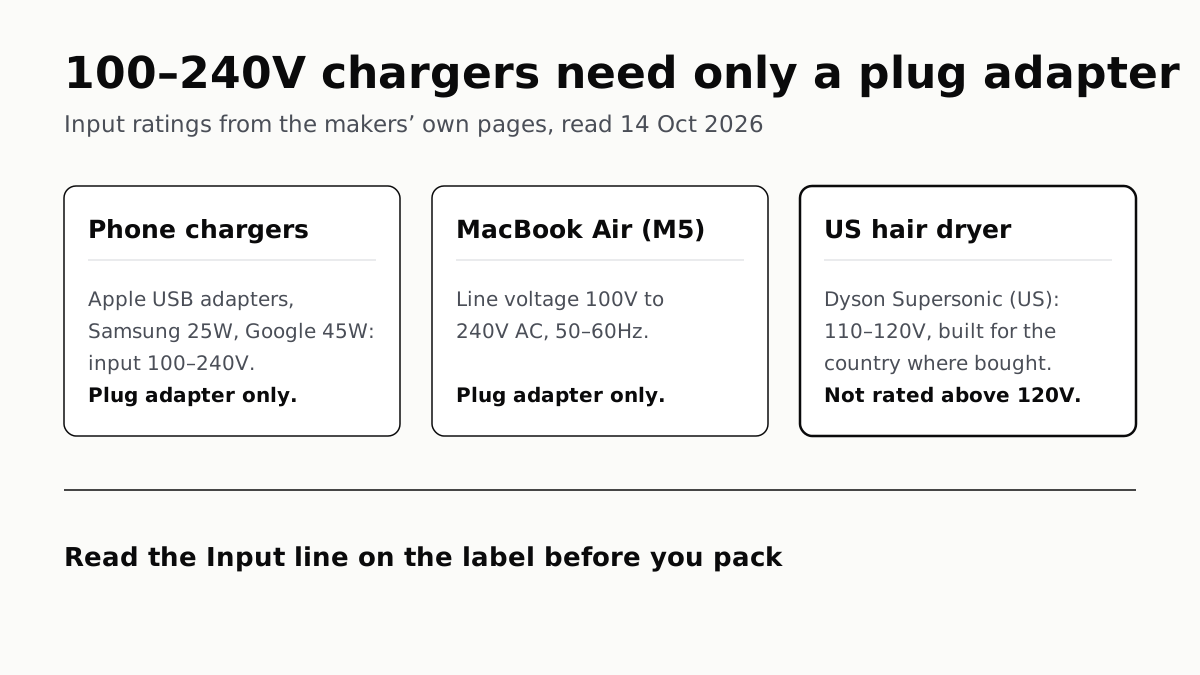
Apple, Samsung and Google rate their chargers, and the MacBook Air, for 100–240V. A hair dryer built for 110–120V is a different case.
Send Your AirTag Link to United, Delta, American, JetBlue
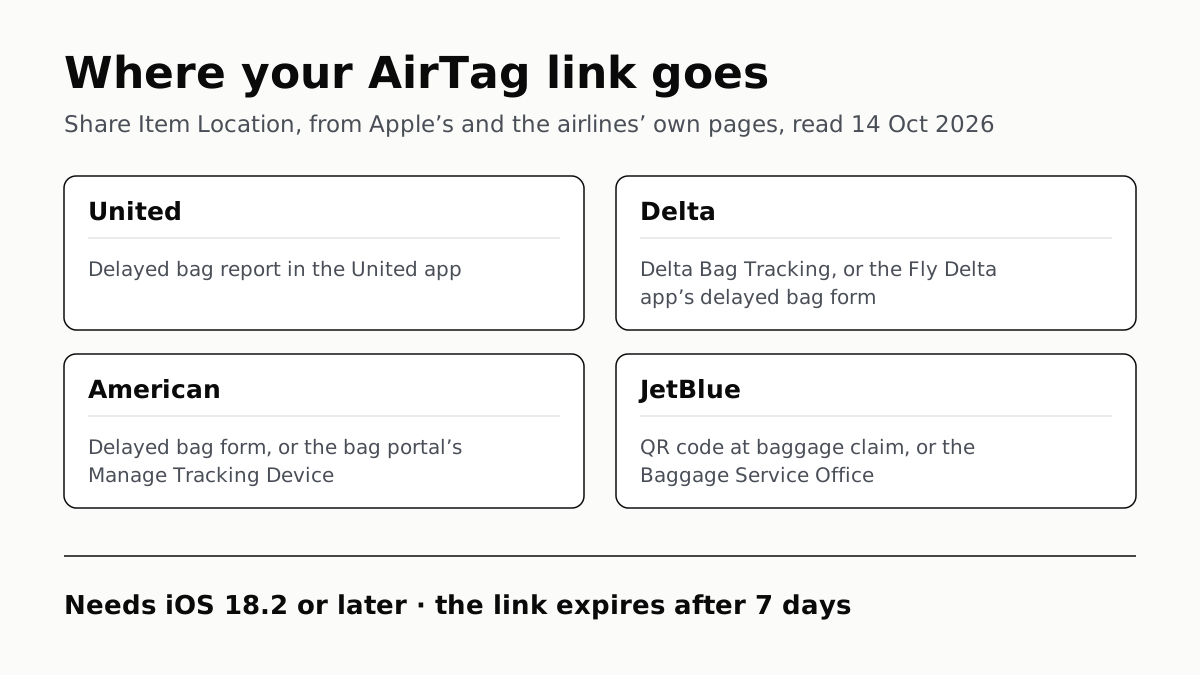
Find My’s Share Item Location makes a seven-day link a bag agent can open. Apple says more than 50 airlines accept it.
Family Link Works From an iPhone. Screen Time Needs Apple
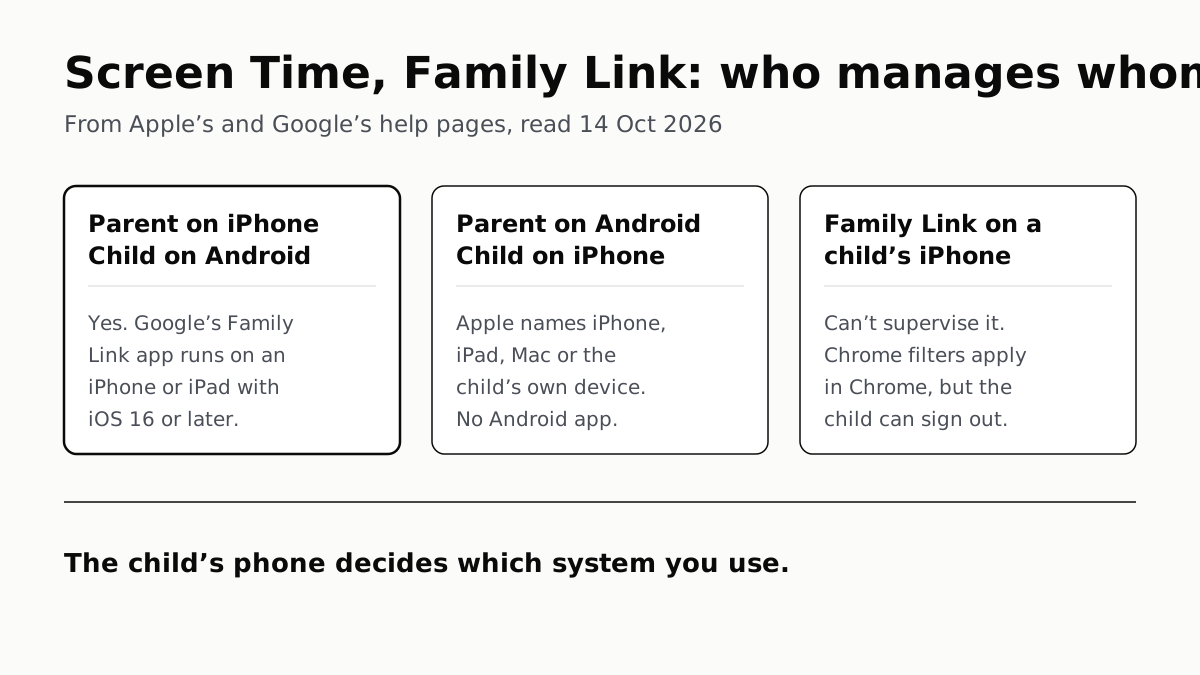
Neither app supervises the other maker’s phones. App limits, downtime, web filters and more, side by side, with iOS 27’s changes.
WhatsApp Chats Can Cross Between iPhone and Android
Messages, media and settings move both ways. Display names, Channel media and payment messages don’t, and call logs reach Android alone.