US Carrier Day Passes Abroad Cost $10 to $12 a Day
T-Mobile’s Experience plans include some data abroad; a travel eSIM alongside your home line needs an unlocked phone.
If you buy through our links, we may earn a commission. It never affects our verdicts or scores — how that works. As an Amazon Associate I earn from qualifying purchases.
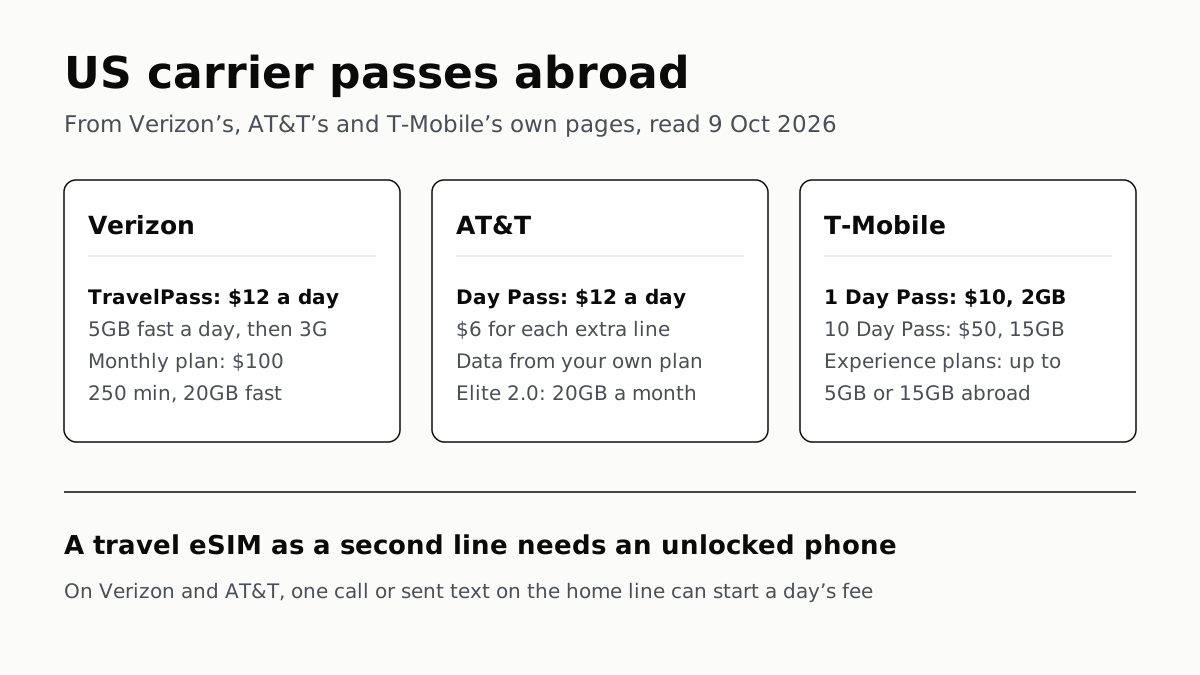
Verizon’s TravelPass and AT&T’s International Day Pass each cost $12 for every day you use your phone abroad, and T-Mobile’s cheapest pass is $10 for one day with 2GB, though its Experience plans already include 5GB or 15GB of high-speed data abroad. A travel eSIM, added as a second line on an unlocked phone, is the alternative when your trip is long, you need more data than the pass gives, or your plan includes nothing abroad.
All prices below are from each carrier’s own pages, read on 9 October 2026, and exclude taxes and fees.
What each carrier charges per day
| Carrier · product | Price | Data, and speed after | Who can get it |
|---|---|---|---|
| Verizon TravelPass | $12 per line per day; $6 in Mexico and Canada | Unlimited talk and text; 5GB high-speed a day, then 3G speeds. Another 2GB for $10 | A qualifying plan and a “world device”. Added automatically on Unlimited Plus and Unlimited Welcome |
| Verizon International Monthly Plan | $100 per line per month | 250 minutes, unlimited texts; 20GB high-speed, then 3G | Add-on; Verizon pitches it at trips of 9 days or more |
| AT&T International Day Pass | $12 a day; $6 for each extra line used the same day; $20 a day on cruise ships | Unlimited talk and text; data from your own plan’s allowance, with speed varying by destination | Unlimited plans |
| T-Mobile International Pass | $10 for 1 day (2GB); $50 for 10 days (15GB); $75 for 30 days (30GB) | Free calls, hotspot allowed; after the pass data, your plan’s roaming data, or 128Kbps if it has none | A qualifying plan; one pass at a time |
Both day passes cover 210+ countries and destinations; T-Mobile’s covers 215+. Verizon says it charges “only … on the days you make or receive a call, send texts or use data” abroad, so a pass left on your line costs nothing at home. AT&T says the same.
What some plans already include
| Plan | Included abroad |
|---|---|
| T-Mobile Experience Beyond | Up to 15GB high-speed data in 215+ countries, then 256kbps; unlimited texting; calls $0.50 a minute |
| T-Mobile Experience More | Up to 5GB high-speed, then 256kbps; unlimited texting; calls $0.50 a minute |
| T-Mobile Essentials | Unlimited texting and calls at $0.50 a minute; no high-speed data without a pass |
| AT&T Elite 2.0 | Unlimited international talk and text, and 20GB of data a month, in 210+ destinations |
| AT&T Premium 2.0 | Talk, text and high-speed data in 20 Latin American countries |
| Verizon Simplicity | Mexico and Canada included. A $30-a-month For Travelers bundle adds 3 TravelPass days a month |
| Verizon Unlimited Ultimate | International data, talk and text included, per Verizon; TravelPass cannot be added |
On T-Mobile’s Experience plans, the first question is whether 5GB or 15GB covers your trip; if it does, no pass is needed. AT&T says all its unlimited plans include the US, Canada and Mexico, and Verizon says roaming there is included with Simplicity and Unlimited plans. For how those same plans slow down at home, see what “unlimited” data actually limits.
When a travel eSIM makes more sense
The day pass bills by the day, so it gets expensive as the trip gets longer. Ten days on TravelPass or AT&T’s Day Pass is $120 for one line; Verizon’s own monthly plan is $100, and Verizon suggests it from 9 days. T-Mobile’s 10 Day Pass is $50.
A travel eSIM is a prepaid plan from a carrier in the country you visit, or from a worldwide provider. Apple says worldwide providers cover “over 190 countries or regions”, and that local carriers sell prepaid plans online before you leave or at airport kiosks on arrival, sometimes asking for a passport. Prices vary by seller, country and data amount; we have not priced any.
It tends to fit when:
- the trip is long enough that daily charges add up past your carrier’s monthly option;
- you need more high-speed data than the pass includes (5GB a day on TravelPass, 2GB on T-Mobile’s one-day pass);
- your plan includes nothing abroad and you mostly need data, not your US number;
- your destination is outside your carrier’s pass countries.
It needs an unlocked phone. If yours is still locked, you are left with your carrier’s own options.
How a second eSIM works
On iPhone. Dual SIM works on iPhone XS, XS Max, XR and later; iPhone 13 and later can run two eSIMs. Apple’s Dual SIM page lists “Add a local data plan when you travel outside of the country or region” as a use, and says “your iPhone can use one cellular data network at a time.”
- Install the travel eSIM before you leave, on Wi-Fi. With iOS 26 or later you may be asked whether it is for home or travel.
- On arrival, tap Turn On Travel eSIM if prompted, and choose Travel eSIM and Current eSIM to keep your number. Apple says the travel eSIM is then used for data.
- Otherwise set it by hand: Settings › Cellular › Cellular Data, then pick the travel line.
- Leave Allow Cellular Data Switching off. Apple says turning it on lets the iPhone use data from both plans.
Choose Travel eSIM Only instead and Apple says FaceTime and iMessage keep working on your home number. With iOS 26, the iPhone switches the travel eSIM off and your home SIM back on when you return, depending on your country or region.
On a Pixel. Google’s help says Pixel 3a and later can run a card and an eSIM; two eSIMs at once need a Pixel 7 or later and a carrier that allows it, and US Pixel 10 models other than the 10 Pro Fold take eSIM only.
- Settings › Network & internet › SIMs › Add SIM, then set up the eSIM.
- Under Your primary SIMs, set Mobile data to the travel eSIM and leave Calls and Texts on your home SIM.
- Leave Automatic data switching off. On Pixel 8 and earlier, Google says that during a call all data goes through the SIM making the call.
The phone keeps both numbers live, but the home line is still roaming. Apple warns you “might still incur roaming fees from your home eSIM”, and Verizon says that with two numbers, “charges apply per the international plan associated with each line.”
On Verizon and AT&T, one call answered or one text sent on your home number can start a $12 day. Verizon’s trigger list is “make or answer a phone call, send a text or use data”; AT&T’s is to “use data, send a text, or make or accept a phone call”. Neither lists receiving a text. Verizon adds that background data, such as app refreshes and email sync, can start a session once data roaming is on, which is a reason to keep data roaming off on the home line.
Is your phone unlocked?
Apple’s condition is plain: “your iPhone cannot be locked to a carrier.” On iPhone, Settings › General › About shows “No SIM Restrictions” next to Carrier Lock when it is unlocked. Each carrier’s own policy for postpaid phones it sold:
| Carrier | When a postpaid phone unlocks |
|---|---|
| Verizon | Automatically, when bought at full retail price or once the financing balance is paid in full. Prepaid: after 365 days of paid service |
| AT&T | Bought more than 60 days ago, paid in full, not reported lost or stolen, and the account not past due. Prepaid: twelve months of service |
| T-Mobile | Active for at least 40 days on the line and paid in full; T-Mobile unlocks it remotely within two business days. Prepaid: 365 days, or more than $100 in refills |
Verizon’s pages disagree with each other. Its unlocking policy, effective 18 February 2026, ties the unlock to paying the phone off, while its Dual SIM FAQ still describes “a 60-day SIM lock” before another carrier’s service can go on the second SIM. If you are paying off a Verizon phone, ask Verizon before relying on a travel eSIM.
For what changes between the two kinds of SIM beyond travel, see how an eSIM differs from a physical SIM.
Questions people ask
How much is Verizon TravelPass per day?
$12 per line per day in most of its 210+ countries and destinations, and $6 in Mexico and Canada, plus taxes and fees. Mexico and Canada are included at no extra cost on Simplicity and Unlimited plans. You get 5GB of high-speed data a day, then 3G speeds.
How much is the AT&T International Day Pass?
$12 a day on land, plus $6 for each additional line used on the same calendar day, and $20 a day on a cruise. It gives unlimited talk and text and uses your unlimited plan’s own data allowance. AT&T Elite 2.0 already includes 20GB a month in 210+ destinations.
Does T-Mobile charge for international data?
Not on Experience plans, up to an allowance: Experience Beyond includes up to 15GB of high-speed data in 215+ countries and destinations and Experience More up to 5GB, then 256kbps. Calls are $0.50 a minute unless you buy an International Pass, from $10 for one day with 2GB.
Can I keep my number and use a travel eSIM?
Yes, on a dual SIM phone. Keep your home line on for calls and texts and set the travel eSIM as the data line. Apple warns your home line may still incur roaming fees, and on Verizon and AT&T a call or a sent text on it can start a day’s pass charge.
Does my phone need to be unlocked for a travel eSIM?
Yes, for an eSIM from another carrier. Apple says your iPhone cannot be locked to a carrier. On iPhone, Settings › General › About shows “No SIM Restrictions” next to Carrier Lock when it is unlocked. Each carrier sets its own unlock rules.
Do I get charged for TravelPass if I don’t use my phone?
No. Verizon and AT&T charge only on days you use the phone in a covered country, so you can leave the pass on. But background data counts: Verizon says app refreshes, email sync and updates can start a session once data roaming is on.
How we researched this
No one at bitcritiq has handled this product. Everything here comes from published sources, listed below.
- What this cannot tell you
- Carriers’ and makers’ documentation, not a test abroad. We did not read any third-party eSIM seller’s pricing, so no seller is named or priced, and the cost comparison here is with a carrier’s own passes, not with any particular eSIM. T-Mobile’s pages say “up to” 15GB or 5GB of high-speed data abroad without stating the period on the pages we read. Verizon’s pages say Unlimited Ultimate includes international data, talk and text but we did not find the allowance stated. AT&T’s Day Pass page says data comes from your domestic plan and that speed varies by destination; it gives no daily cap. Verizon contradicts itself on unlocking (see the article). Android is covered through Google’s Pixel help only. Pay-as-you-go roaming rates were not read and are not quoted.
How we chose this, and what we did
- Why this subject
- Google Trends showed “travel” up 500% across four of our mobile and AI pulls in the week to 4 October (ops/trends/2026-10-04-digest.md), alongside “best phone plans” and “phone plans” among the top mobile queries, with holiday travel ahead. Our eSIM explainer covers what an eSIM is and mentions travel in one paragraph; our unlimited-data piece covers domestic limits. Neither says what the three big US carriers charge abroad, or how a travel eSIM sits beside a home number.
- How we looked at it
- Read through a browser on 9 October 2026, all first-party: Verizon’s TravelPass page, TravelPass FAQs, International Monthly Plan page and Simplicity plan page (including the For Travelers bundle terms), its device unlocking policy (effective 18 February 2026) and Dual SIM FAQs; AT&T’s International Day Pass page and FAQ, its unlimited plans page and its device unlock page; T-Mobile’s international roaming page, International Pass page and FAQs, plans page and device unlock policy; Apple Support 118227 (travel eSIM) and 109317 (Dual SIM), both published 17 September 2026; and Google’s Pixel help on dual SIMs. Prices are copied exactly as each page shows them. The statement that neither Verizon nor AT&T lists receiving a text as a trigger is checked against a control: both pages list sending a text in the same sentence.
What this rests on
6 claims, all official. Nothing here was measured by bitcritiq — see how we test for why. Open a claim to read the source it came from.
Verizon TravelPass costs $12 per line per day ($6 in Mexico and Canada), with 5GB of high-speed data a day and then 3G speeds.Official
Verizon TravelPass page: “$12 /line per day. Plus taxes and fees. $6/line in Canada and Mexico.” and “*After 5GB of high speed data, then unlimited data at 3G speeds for the remainder of the TravelPass session.” Read 9 October 2026.
AT&T International Day Pass costs $12 a day on land, $6 for each additional line used the same day, and uses the data allowance of your domestic plan.Official
AT&T Day Pass page: “unlimited* talk, text, and high-speed data for $12/day. $6 for each additional line used on the same calendar day.” and “Terms and data allowance from your domestic plan … apply.” Read 9 October 2026.
T-Mobile’s 1 Day International Pass is $10 for 2GB; Experience Beyond includes up to 15GB of high-speed data abroad and Experience More up to 5GB, then 256kbps.Official
T-Mobile International Pass page: “$10 for 2GB of high-speed data and free calls for up to 24 hours.” International plans FAQ: “Up to 15GB … Experience Beyond/Go5G Next … After using 15GB of high-speed data, roaming data is unlimited up to 256kbps. Up to 5GB … Experience More/Go5G Plus/ Magenta MAX.” Read 9 October 2026.
On Verizon and AT&T, a day’s charge starts the first time you make or answer a call, send a text or use data in a covered country.Official
Verizon: “A 24-hour TravelPass session starts automatically when you use your device in a TravelPass country (e.g., make or answer a phone call, send a text or use data).” AT&T: “The first time you use data, send a text, or make or accept a phone call in an included destination … your 24-hour International Day Pass begins.”
Using a travel eSIM from another carrier requires the iPhone to be unlocked; with both lines on, the travel eSIM carries data and the home line can still incur roaming fees.Official
Apple Support 118227: “To use your iPhone with another carrier when traveling internationally, your iPhone cannot be locked to a carrier.” and “If you choose to use both lines, your travel eSIM will be used for data. You might still incur roaming fees from your home eSIM.”
Verizon’s unlocking policy and its Dual SIM FAQ describe different locks for phones bought from Verizon.Official
Device Unlocking Policies (effective 18 February 2026): “Devices will be unlocked automatically when purchased at full retail price or if the device financing agreement balance is paid in full.” Dual SIM FAQs: “there’s a 60-day SIM lock … you must wait 60 days before activating another carrier’s service on the second SIM.” Both read 9 October 2026.
Sources 16
- TravelPass — VerizonOfficialaccessed Oct 9, 2026
- TravelPass FAQs — Verizon SupportOfficialaccessed Oct 9, 2026
- International Monthly Plan — VerizonOfficialaccessed Oct 9, 2026
- Simplicity Plan — Verizon (For Travelers bundle terms)Officialaccessed Oct 9, 2026
Show 12 more · 12 official or standards
- Device Unlocking Policies — Verizon (effective 18 February 2026)Officialaccessed Oct 9, 2026
- Dual SIM: using 2 numbers on 1 phone FAQs — VerizonOfficialaccessed Oct 9, 2026
- AT&T International Day Pass — AT&TOfficialaccessed Oct 9, 2026
- Unlimited Data Cell Phone Plans & Hotspot Data — AT&TOfficialaccessed Oct 9, 2026
- Unlock an AT&T device — AT&TOfficialaccessed Oct 9, 2026
- International plans — T-MobileOfficialaccessed Oct 9, 2026
- International Pass — T-MobileOfficialaccessed Oct 9, 2026
- Cell phone plans — T-MobileOfficialaccessed Oct 9, 2026
- Device Unlock Policy — T-MobileOfficialaccessed Oct 9, 2026
- Use eSIM while traveling internationally with your iPhone — Apple Support 118227 (published 17 September 2026)Officialaccessed Oct 9, 2026
- Using Dual SIM with an eSIM — Apple Support 109317 (published 17 September 2026)Officialaccessed Oct 9, 2026
- How to use dual SIMs on your Google Pixel phone — Pixel Phone HelpOfficialaccessed Oct 9, 2026
Pass it on
Know someone weighing this up? Send them the answer.
bitcritiq.com/vr9nThe link is permanent: it opens this article for good, even if the title changes.
No email, no account
Follow bitcritiq
Every new article, in whatever reader you already use.
Subscribe by RSSAll the ways to follow
Using Chrome on Android? Open the browser menu and tap Follow. New articles then turn up in the Following tab in Discover.
read next
Chargers Rated 100–240V Need Only a Plug Adapter Abroad
Apple, Samsung and Google rate their chargers, and the MacBook Air, for 100–240V. A hair dryer built for 110–120V is a different case.
Send Your AirTag Link to United, Delta, American, JetBlue
Find My’s Share Item Location makes a seven-day link a bag agent can open. Apple says more than 50 airlines accept it.
Family Link Works From an iPhone. Screen Time Needs Apple
Neither app supervises the other maker’s phones. App limits, downtime, web filters and more, side by side, with iOS 27’s changes.
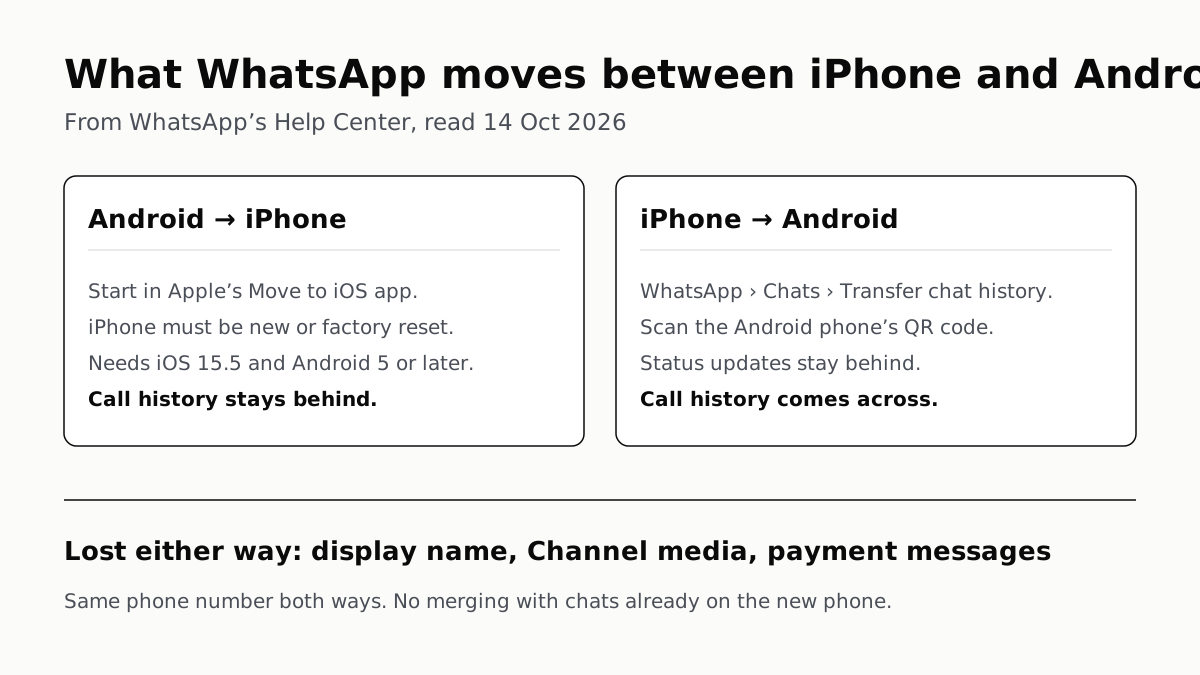
WhatsApp Chats Can Cross Between iPhone and Android
Messages, media and settings move both ways. Display names, Channel media and payment messages don’t, and call logs reach Android alone.