Open Weight Is Not Open Source
Meta's licence needs Meta's permission above 700 million users, and makes you print "Built with Llama" on the product.
If you buy through our links, we may earn a commission. It never affects our verdicts or scores — how that works. As an Amazon Associate I earn from qualifying purchases.
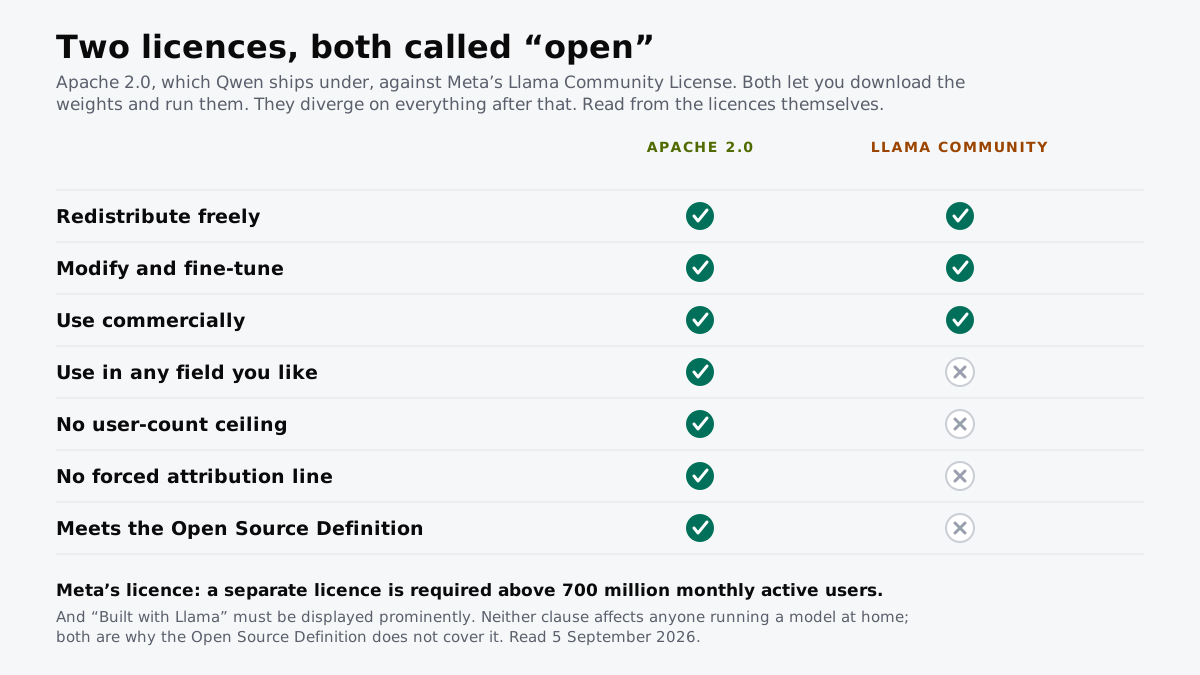
Two of the most downloaded model families are licensed on completely different terms, and only one of them is open source. Meta’s licence requires a separate licence from Meta above 700 million monthly active users, and requires you to print “Built with Llama” on the product.
Neither clause touches anyone running a model on their own computer. Both matter enormously the moment you build something with it.
What each licence lets you do
| Apache 2.0 | Llama Community | |
|---|---|---|
| Redistribute freely | yes | yes |
| Modify and fine-tune | yes | yes |
| Use commercially | yes | yes |
| Use in any field you like | yes | no |
| No user-count ceiling | yes | no |
| No forced attribution line | yes | no |
| Meets the Open Source Definition | yes | no |
Drawn from the licence texts themselves. Qwen3-32B’s model card states Apache 2.0; the Llama clauses are quoted from Meta’s own agreement.
Why the last row follows from the ones above it
“Open source” is not a vibe, it is a published definition with ten criteria, and two of them decide this.
Criterion 6 states: “The license must not restrict anyone from making use of the program in a specific field of endeavor.” An acceptable use policy that forbids certain applications is precisely such a restriction, however reasonable the forbidden applications are.
A user-count ceiling has the same effect from the other direction: the licence you have stops being the licence you have at a certain scale.
None of that makes the terms unreasonable. It makes the label wrong, and the label is what people rely on when they choose what to build on.
Who this actually bites
Not you, if you are running a model at home. All three restrictions attach to distribution and to products, not to private use on your own machine. Download it, run it, use the output.
It bites when you ship something. The attribution line is a design requirement someone will discover late. The acceptable use policy is a compliance question. The 700 million user threshold is, for almost everyone, theoretical, and is best understood as the clause that exists so a handful of very large companies have to come and ask.
What to actually do
- Read the licence file that came with the weights, not an article about the family. Terms differ between versions of the same model.
- If you are only running it locally, stop worrying. None of this reaches you, and the practical question is whether it fits on your card.
- If you are building a product, choose the licence before the benchmark. Swapping models late because of a clause is more expensive than picking a slightly weaker model that is Apache-licensed.
- Treat “open source” in a model announcement as marketing until checked. The definition is public and takes a minute to check against.
How we researched this
No one at bitcritiq has handled this product. Everything here comes from published sources, listed below.
- What this cannot tell you
- This is a description of licence terms, not legal advice, and a lawyer reading your specific product will reach a more useful answer than a general article can. It covers two licences among many: several model families ship under terms different from both, and licences change between model versions, so the one attached to the file you downloaded is the one that governs it. Nothing here is a judgement about model quality, which is unrelated to how a model is licensed.
How we chose this, and what we did
- Why this subject
- The models people download to run at home are described everywhere as open source, and several of the most popular are not. The difference is written into the licence files that ship with them, is short enough to read, and decides what you are allowed to build. It matters more now that running a capable model locally is an ordinary thing to do rather than a research exercise.
- How we looked at it
- Every clause is quoted from the licence text itself: Meta's Llama Community License, the Apache License 2.0 as applied on a published model card, and the Open Source Initiative's Open Source Definition. Nothing is taken from commentary about those documents. Where a model family is named, the licence is the one stated on that model's own card.
What this rests on
6 claims, all official. Nothing here was measured by bitcritiq — see how we test for why. Open a claim to read the source it came from.
Meta's Llama licence requires a separate licence from Meta above 700 million monthly active users.Official
The Llama 3.3 Community License states that if monthly active users is greater than 700 million, you must request a license from Meta.
The same licence requires the phrase "Built with Llama" to be displayed prominently.Official
Section 1.b.i requires you to prominently display "Built with Llama" on a related website, user interface, blogpost, about page or product documentation.
It also incorporates an Acceptable Use Policy by reference, which restricts what the model may be used for.Official
Section 1.b.iv states that use of the Llama Materials must comply with applicable laws and adhere to the Acceptable Use Policy, which is incorporated into the agreement.
The Open Source Definition forbids restricting use in a specific field of endeavour, which an acceptable use policy does.Official
Criterion 6 of the Open Source Definition states: "The license must not restrict anyone from making use of the program in a specific field of endeavor."
Some widely used model families do ship under an OSI-approved licence.Official
The Qwen3-32B model card states the model is released under the Apache 2.0 license, which is OSI-approved and imposes none of the three restrictions above.
None of these restrictions affect a person running a model on their own machine.Official
The user threshold, the attribution requirement and the acceptable use policy all attach to distribution and to products built on the model, not to private local use.
Sources 4
- Llama 3.3 Community License Agreement — MetaOfficialaccessed Sep 5, 2026
- The Open Source Definition — Open Source InitiativeOfficialaccessed Sep 5, 2026
- Qwen3-32B model card — Hugging FaceOfficialaccessed Sep 5, 2026
- What Fits on the Graphics Card You Already Own — bitcritiqaccessed Sep 5, 2026
No email, no account
Follow bitcritiq
Every new article, in whatever reader you already use.
Subscribe by RSSAll the ways to follow
Using Chrome on Android? Open the browser menu and tap Follow. New articles then turn up in the Following tab in Discover.