Qwen 3.6 Needs About 24GB to Run Fully on a GPU
The 27B is 17GB at four bits. The default download is the 35B at 24GB, and Qwen asks for 128K of context on top.
If you buy through our links, we may earn a commission. It never affects our verdicts or scores — how that works. As an Amazon Associate I earn from qualifying purchases.
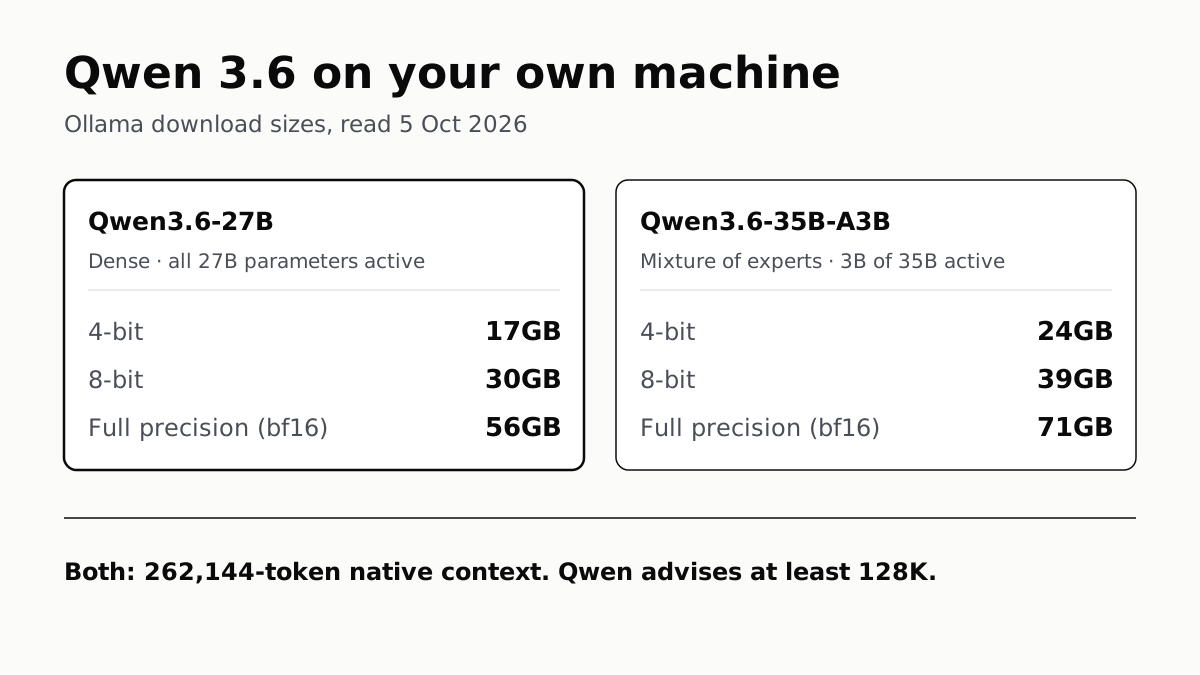
To run Qwen 3.6 entirely in fast memory you need about 24GB for it: a 24GB graphics card, or a Mac with 32GB or more. The smaller model, Qwen3.6-27B, is a 17GB download at four bits in Ollama, and context comes on top of that; with less, the 35B-A3B can split between a smaller card and system RAM, more slowly.
The catch most people hit first is that ollama run qwen3.6 does not fetch that one. Ollama’s default tag shares its digest with qwen3.6:35b, a 23–24GB download.
Two models, and the bigger one is the default
Alibaba’s Qwen team released two open-weight Qwen 3.6 models in April 2026: the 35B-A3B on 14 April and the 27B a week later. Both read images as well as text, and both have a native context of 262,144 tokens.
| Qwen3.6-27B | Qwen3.6-35B-A3B | |
|---|---|---|
| Design | Dense | Mixture of experts |
| Parameters, total / active per token | 27B / 27B | 35B / 3B |
| Native context | 262,144 tokens | 262,144 tokens |
Ollama, 4-bit (q4_K_M) |
17GB | 24GB |
Ollama, 8-bit (q8_0) |
30GB | 39GB |
Ollama, full precision (bf16) |
56GB | 71GB |
| Hardware class at 4-bit, our reading | 24GB GPU, or a Mac with 32GB+ | 32GB+ GPU, a Mac with 48GB+, or a smaller GPU with experts in system RAM |
Sizes are Ollama’s, from its tags page on 5 October 2026. The last row is our arithmetic, not anyone’s specification: the file has to fit, then context and the operating system need room beyond it. Ollama lists no smaller Qwen 3.6 than these two, so it has no 8B-class Qwen 3.6 for a 12GB card.
“A3B” means less work, not less memory
The 35B-A3B is a mixture-of-experts model. Qwen’s card lists 256 experts, of which 8 routed and 1 shared are used for each token — about 3 billion parameters doing the work at any moment.
All 35 billion still have to be loaded. That is why its four-bit file is 24GB against the dense model’s 17GB, and why “only 3B active” does not make it the small one.
What it changes is where the weights can live. llama.cpp has a dedicated option, --cpu-moe, to “keep all Mixture of Experts (MoE) weights in the CPU”, and --n-cpu-moe to do it for some layers only. A dense model has no equivalent split, because every weight is used for every token. Our reading, unmeasured: a 12GB or 16GB card plus enough system RAM to hold the rest is a workable home for the 35B-A3B, and a slow one for the 27B. What happens when a model spills to system RAM covers how to see that split with ollama ps.
If the 27B fits, it is the stronger coding model by Qwen’s own numbers: 77.2 on SWE-bench Verified against 73.4 for the 35B-A3B, from Qwen’s model card and its own test setup.
Qwen asks for 128K of context. Ollama starts you far lower
Both model cards say the same thing: “we advise maintaining a context length of at least 128K tokens to preserve thinking capabilities.” Qwen’s own suggestion for an out-of-memory error is to reduce the window — and then it asks you not to go below 128K.
Ollama’s defaults, set by how much VRAM it finds:
- Under 24 GiB — 4k context
- 24–48 GiB — 32k
- 48 GiB or more — 256k
So on most home machines, Qwen 3.6 starts with a small fraction of the context its makers recommend. Raising it costs memory, and Ollama’s documentation says so directly. Our piece on why context, not the model, is the wall for local coding is the longer version of this argument, and it applies here with more force, because Qwen’s figure is roughly twice the 64,000 tokens Ollama recommends for coding tools.
One detail softens it. Qwen’s cards publish the layout: in the 27B, 16 of 64 layers use full attention and the rest use Gated DeltaNet, a linear-attention design; in the 35B-A3B it is 10 of 40. Our reading is that only those full-attention layers keep a cache that grows with every token, so long context should cost less memory here than in a model where every layer does. Neither Qwen nor Ollama publishes the figure, and we have not measured it.
On a Mac
Ollama publishes MLX builds for Apple silicon: 19GB for the 27B and 24GB for the 35B-A3B. A Mac’s GPU draws on unified memory, so the whole machine’s memory is the pool, as covered in what 512GB of unified memory changes. By our arithmetic, a 32GB Mac holds the 27B with about 13GB left for macOS, apps and context; the 35B-A3B on 32GB leaves 8GB, which is why we put it at 48GB.
What to buy, by what you have
- 16GB of VRAM or less: neither model fits on the card. Try the 35B-A3B with experts in system RAM, and have 32GB or more of system RAM so the 24GB file has somewhere to go.
- 24GB card: pull
qwen3.6:27b, not the default, then raise the context deliberately and checkollama psreads 100% GPU. - 32GB+ card or a 48GB+ Mac: either model fits at four bits with room to raise context toward Qwen’s 128K.
- 64GB+: the 8-bit builds (30GB and 39GB) become practical. The rule of thumb for what fits on a card you already own works the same way for any size.
Both models carry the Apache 2.0 licence on their model cards — commercial use included, without the use restrictions in some licences that are open-weight but not open source.
Questions people ask
Can I run Qwen 3.6 on a 16GB GPU?
Not entirely on the card. The smallest four-bit build Ollama lists is the 27B at 17GB, more than 16GB before any context. It can still run with part of the model in system RAM, more slowly. Of the two, the 35B-A3B is the one built for that split.
How much VRAM does Qwen 3.6 27B need?
Ollama’s four-bit build is 17GB and the 8-bit build 30GB. Context comes on top, so in our reading a 24GB card is the smallest that holds the four-bit model with room to work.
Which Qwen 3.6 should I download, 27B or 35B-A3B?
The 27B if it fits your memory: it is 7GB smaller at four bits and scores higher on Qwen’s own coding-agent benchmarks. The 35B-A3B if it will not: only 3 billion of its parameters work per token, and llama.cpp can keep its experts in system RAM.
Can a Mac run Qwen 3.6?
Yes. Ollama publishes MLX builds for Apple silicon at 19GB (27B) and 24GB (35B-A3B). In our reading, 32GB of unified memory suits the 27B, and the 35B-A3B wants 48GB to leave room for macOS and context.
What context length should I use for Qwen 3.6?
Qwen advises at least 128K tokens to keep its thinking mode working well. Ollama gives far less by default below 48 GiB of VRAM — 4k under 24 GiB — so set it yourself, and expect memory use to rise when you do.
Is Qwen 3.6 free for commercial use?
Both open models carry the Apache 2.0 licence on their model cards, which allows commercial use, modification and redistribution, with no user-count ceiling of the kind some open-weight licences set.
How we researched this
No one at bitcritiq has handled this product. Everything here comes from published sources, listed below.
- What this cannot tell you
- bitcritiq has run neither model and measured no speeds. The memory a given context length adds on top of the weights is not published for either model, so we describe its direction, not its size. Download sizes are Ollama's; other quantisations from other publishers will differ. Ollama lists some tags as a range (18–19GB, 23–24GB) without explaining it; the tag page shows separate MLX and llama.cpp builds, which is the likely reason.
How we chose this, and what we did
- Why this subject
- “qwen 3.6” has been a Breakout search in five consecutive weekly Google Trends pulls, alongside “best local llm for coding 2026”. The people searching it are mostly asking one thing before they download 20GB: will it run on what I have, or what do I need to buy. Our general VRAM pieces answer that for models in the abstract; Qwen 3.6 has two specifics they do not cover — the default download is the larger model, and its maker asks for far more context than local tools give by default.
- How we looked at it
- Parameters, architecture, context length and licence are from Qwen's own model cards on Hugging Face and its two release posts on qwen.ai (14 and 21 April 2026). Download sizes are from Ollama's qwen3.6 tags page, which lists every tag with its size and digest. Context defaults are from Ollama's documentation, and the option for placing expert weights in system RAM from llama.cpp's server documentation. All read through a browser on 5 October 2026. The hardware column is our arithmetic from those published sizes, labelled as such.
What this rests on
6 claims, all official. Nothing here was measured by bitcritiq — see how we test for why. Open a claim to read the source it came from.
Qwen3.6-27B is a dense 27-billion-parameter model; Qwen3.6-35B-A3B has 35 billion parameters with 3 billion activated.Official
Qwen's model cards: “Number of Parameters: 27B” and “Number of Parameters: 35B in total and 3B activated”.
Ollama lists the four-bit builds at 17GB (27B) and 24GB (35B-A3B), the 8-bit builds at 30GB and 39GB, and bf16 at 56GB and 71GB.Official
Ollama's qwen3.6 tags page: qwen3.6:27b-q4_K_M 17GB, 27b-q8_0 30GB, 27b-bf16 56GB; 35b-a3b-q4_K_M 24GB, 35b-a3b-q8_0 39GB, 35b-a3b-bf16 71GB.
Ollama's default qwen3.6 tag is the 35B model.Official
Ollama's tags page lists qwen3.6:latest and qwen3.6:35b with the same digest, 8a43277aac50, and the same 23GB–24GB size.
Qwen advises a context length of at least 128K tokens.Official
Both model cards: “If you encounter out-of-memory (OOM) errors, consider reducing the context window. However, because Qwen3.6 leverages extended context for complex tasks, we advise maintaining a context length of at least 128K tokens to preserve thinking capabilities.”
Ollama defaults to 4k context below 24 GiB of VRAM, 32k from 24 to 48 GiB, and 256k at 48 GiB or more.Official
Ollama's context-length documentation: “< 24 GiB VRAM: 4k context; 24-48 GiB VRAM: 32k context; >= 48 GiB VRAM: 256k context”.
Both models are released under the Apache 2.0 licence.Official
Both Hugging Face model cards show “License: apache-2.0”, and Ollama's 27B tag ships the Apache License Version 2.0 text.
Sources 7
- Qwen/Qwen3.6-27B — model card, Hugging FaceOfficialaccessed Oct 5, 2026
- Qwen/Qwen3.6-35B-A3B — model card, Hugging FaceOfficialaccessed Oct 5, 2026
- Qwen3.6-35B-A3B: Agentic Coding Power, Now Open to All — Qwen blog, 14 April 2026Officialaccessed Oct 5, 2026
- Qwen3.6-27B: Flagship-Level Coding in a 27B Dense Model — Qwen blog, 21 April 2026Officialaccessed Oct 5, 2026
Show 3 more · 3 official or standards
- qwen3.6 tags — Ollama model libraryOfficialaccessed Oct 5, 2026
- Context length — Ollama documentationOfficialaccessed Oct 5, 2026
- llama.cpp server README — ggml-org/llama.cppOfficialaccessed Oct 5, 2026
Pass it on
Know someone weighing this up? Send them the answer.
bitcritiq.com/hz22The link is permanent: it opens this article for good, even if the title changes.
No email, no account
Follow bitcritiq
Every new article, in whatever reader you already use.
Subscribe by RSSAll the ways to follow
Using Chrome on Android? Open the browser menu and tap Follow. New articles then turn up in the Following tab in Discover.
read next
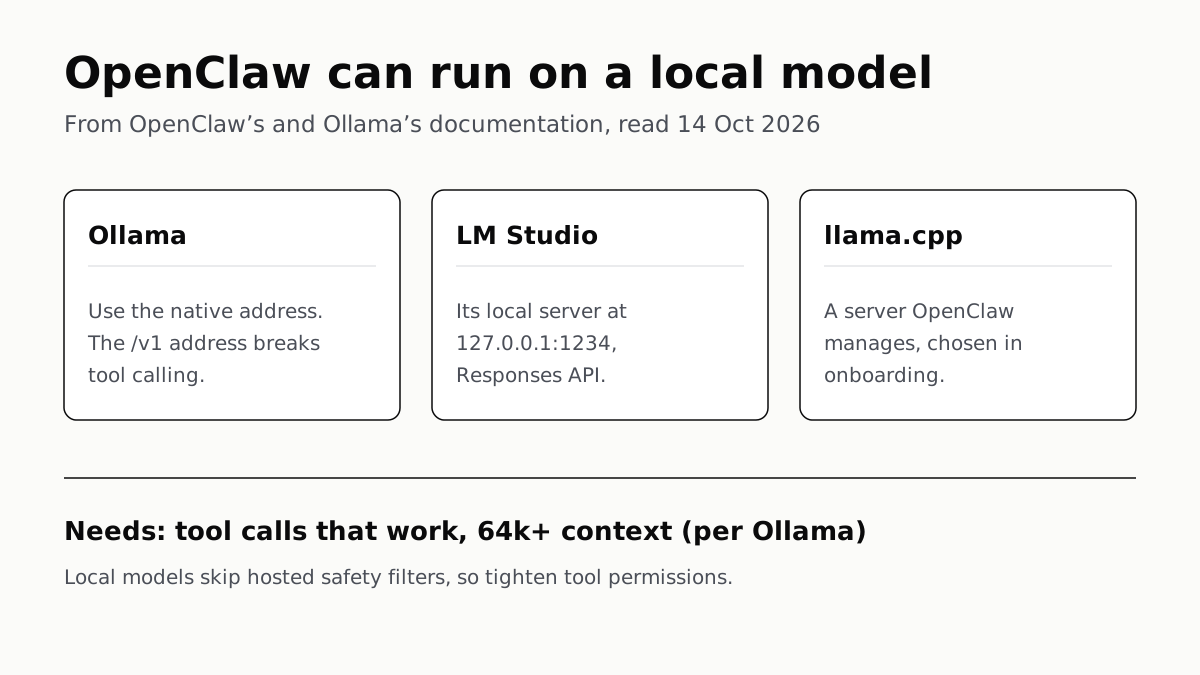
OpenClaw Runs on a Local LLM via Ollama or LM Studio
OpenClaw's docs also cover llama.cpp, vLLM and any OpenAI-compatible server. Ollama advises 64k context; small models are easier to hijack.
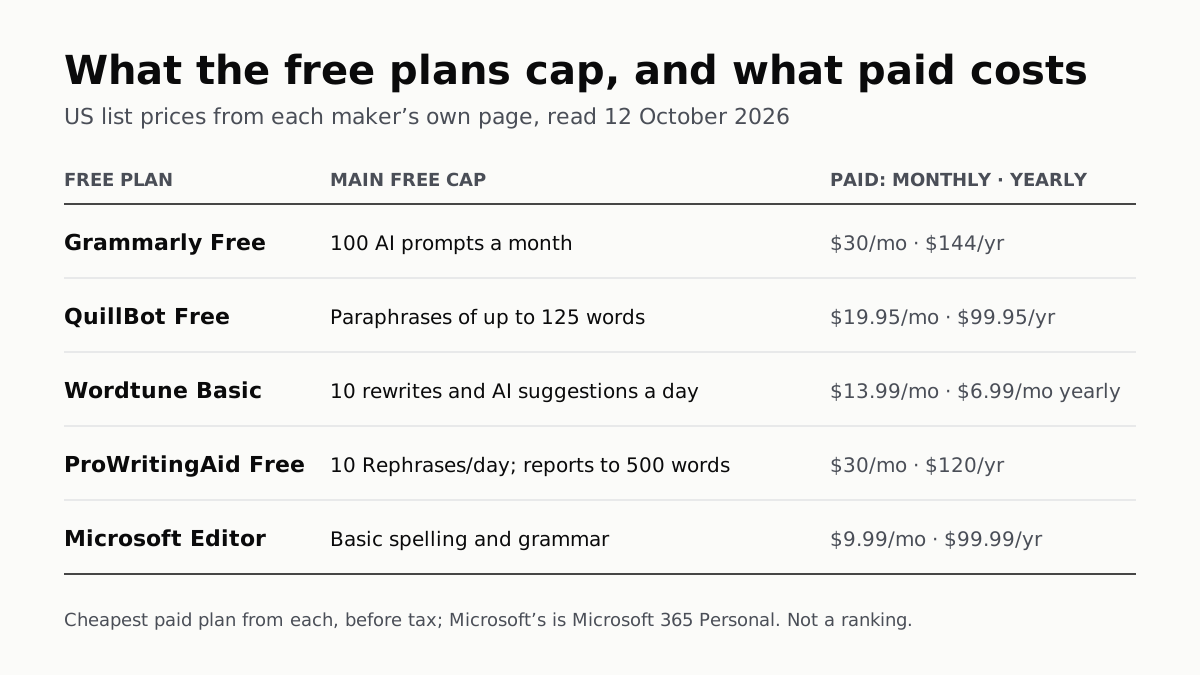
Free AI Writing Tools Ration Rewrites in Different Units
Grammarly gives 100 AI prompts a month, Wordtune 10 rewrites a day, QuillBot 125 words a paraphrase. Yearly billing halves most prices.
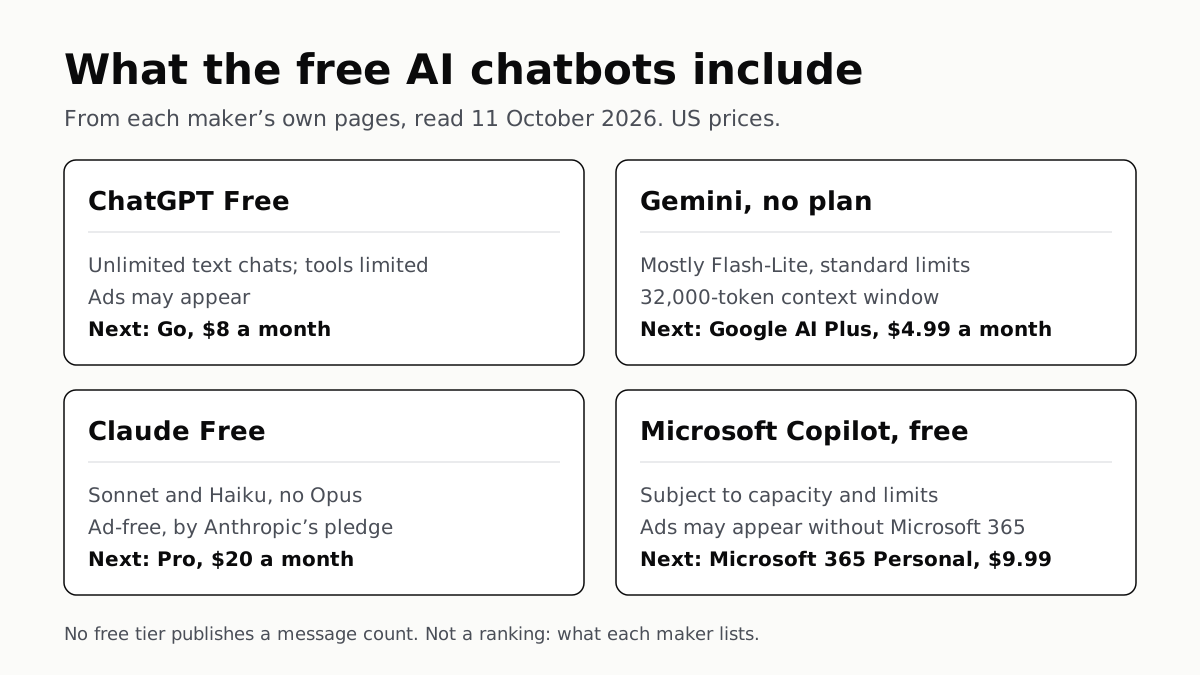
Of Four Free AI Chatbots, Only ChatGPT Lists Unlimited Chat
ChatGPT’s free tier carries ads, as Copilot’s may; Gemini’s leans on Flash-Lite and Claude’s leaves out Opus.
Google’s Offline AI Note-Taker Runs Only on a Mac
Transcription and AI run on the Mac itself, with no phone version. Google says your audio, notes and files never leave the computer.