TCL’s TV Series: What QM, X, RM and the K/L Letters Mean
From TCL’s US spec pages: backlight, dimming zones, brightness, refresh rate, sizes and list price for each of its 13 series.
If you buy through our links, we may earn a commission. It never affects our verdicts or scores — how that works. As an Amazon Associate I earn from qualifying purchases.
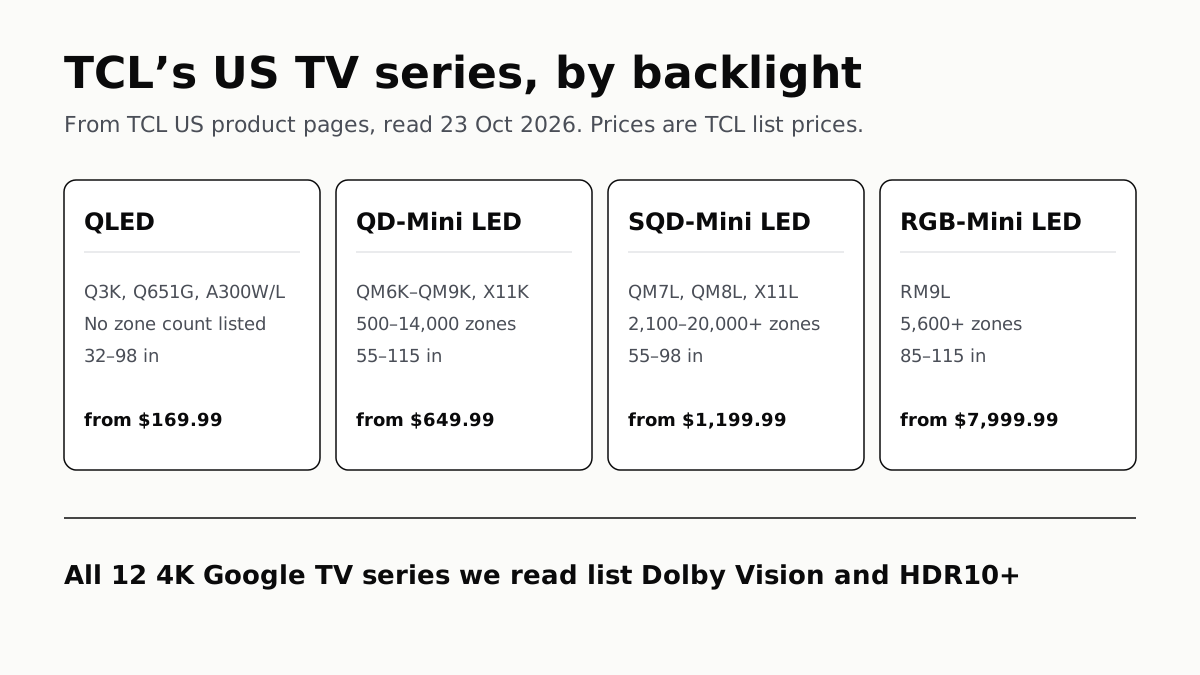
TCL’s US TVs split by backlight first: QLED sets with no zone count, QD-Mini LED (the K-generation Mini LED sets), and the newer SQD-Mini LED and RGB-Mini LED (the L-generation ones). Within a range, the number after QM rises with dimming zones and brightness on TCL’s own spec sheets, and X marks TCL’s flagship.
TCL’s TV menu lists 13 Google TV series, and it still sells both Mini LED generations side by side, so a QM7K and a QM7L are different backlights, not two sizes of one set. Each of the 12 4K Google TV series pages we read lists both Dolby Vision and HDR10+.
What the letters and numbers mean
We found no key to the names on TCL’s pages, but the pattern reads from them:
| Part of the name | What it marks on TCL’s pages | Examples |
|---|---|---|
| QM | TCL’s Q Class sets with a Mini LED backlight (the QM8L spec sheet heads itself “TCL Q Class (QM8L)”) | QM6K, QM7L, QM8L, QM9K |
| X | The flagship: the X11L page heads its table “Flagship Specifications” | X11K, X11L |
| RM | RGB-Mini LED | RM9L |
| Q without M | QLED with no Mini LED backlight | Q3K, Q651G |
| A300 | Design sets: NXTVISION with a flush wall mount (A300W) and the picture-frame Designer Series (A300L) | A300W, A300L |
| Number | The step within a range: higher means more zones and brightness on TCL’s sheets | QM6K → QM9K |
| Final K or L | The generation: the K Mini LED sets are QD-Mini LED; the L Mini LED sets carry the SQD and RGB backlights TCL introduced for 2026 | QM7K vs QM7L |
The series side by side
From TCL’s US store, read 23 October 2026. Zones and brightness are TCL’s “up to” figures. List is TCL’s regular price for the smallest size; sale is what TCL’s store charged that day for the same size.
| Series | Backlight, as TCL lists it | Dimming zones | Brightness, TCL’s label | Refresh | Sizes | List, smallest size | TCL sale, 23 Oct |
|---|---|---|---|---|---|---|---|
| Q3K | QLED, direct LED, 1080p | not listed | not listed | not listed | 32–43 in | $169.99 | $139.99 |
| Q651G | QLED | not listed | not listed | 120Hz, VRR to 144Hz | 43–98 in | $299.99 | $239.99 |
| A300W | QLED, edge-lit | not listed | not listed | 120Hz, VRR to 144Hz | 55–85 in | $1,299.99 | $699.99 |
| A300L | QLED, edge-lit | “N/A” | “N/A” | 144Hz | 55–75 in | $999.99 | $899.99 |
| QM6K | QD-Mini LED | 500 | “High HDR Brightness” | 144Hz | 55–98 in | $649.99 | $549.99 |
| QM7K | QD-Mini LED | 2,800 | HDR 3,000 | 144Hz | 55–115 in | $1,199.99 | $749.99 |
| QM8K | QD-Mini LED | 3,800 | HDR 5,000 | 144Hz | 65–98 in | $2,499.99 | unavailable |
| QM9K | QD-Mini LED | 6,000 | HDR 6,500 | 144Hz | 65–98 in | $2,999.99 | $999.99 |
| X11K | QD-Mini LED | 14,000 | HDR 6,500 nits | 144Hz | 85–98 in | $9,999.99 | $2,999.99 |
| QM7L | SQD-Mini LED | 2,100+ | 3,000 peak nits | 144Hz | 55–98 in | $1,199.99 | $799.99 |
| QM8L | SQD-Mini LED | 4,000 | 6,000 peak nits | 144Hz | 65–98 in | $2,499.99 | $1,199.99 |
| X11L | SQD-Mini LED | 20,000+ | 10,000 nits | 144Hz | 75–98 in | $5,999.99 | $2,999.99 |
| RM9L | RGB-Mini LED | 5,600+ (16,000+ colour zones) | 9,000 peak nits | 144Hz | 85–115 in | $7,999.99 | $5,999.99 |
Every set in the table runs Google TV. The 55-inch QM7K and every QM8K size were marked unavailable on 23 October; the table keeps their list prices. TCL’s store carried a Halloween sale banner that day, so the sale column will move.
QLED: no zone count on the sheet
The Q3K is the 1080p entry set, 32 to 43 inches, with a direct LED backlight and two HDMI inputs. The Q651G is TCL’s 4K QLED from 43 to 98 inches. The A300W and A300L are design sets: the A300W mounts flush to the wall, the A300L is the 2026 picture-frame Designer Series, and both list edge-lit backlights. None of these four pages lists a dimming-zone count; the A300L table has the row and fills it with “N/A”.
QD-Mini LED: the K range
TCL’s own comparison chart on the QM7K page lines the four QM sets up by zones: up to 500 on the QM6K, 2,800 on the QM7K, 3,800 on the QM8K and 6,000 on the QM9K, with brightness rising alongside. The QM6K also drops from Audio by Bang & Olufsen to an Onkyo 2.1 speaker system, and lists Game Accelerator 240 where the QM8K and QM9K list 288. The X11K, at 85 and 98 inches, lists up to 14,000 zones. TCL’s QM6K appears in our explainer on how Mini LED and OLED make light, which covers what a zone does and where halo comes from.
SQD-Mini LED and RGB-Mini LED: the L range
TCL describes SQD-Mini LED as a blue Mini LED backlight shining through a denser “Super Quantum Dot” layer and an Ultra Color Filter, aimed at 100% of the BT.2020 colour range. RGB-Mini LED instead replaces the white backlight with red, green and blue LEDs; the RM9L is TCL’s set.
Between the two QM sets, the QM8L lists nearly twice the zones and double the peak brightness of the QM7L, a WHVA 2.0 Ultra panel where the QM7L has HVA 2.0 Pro, and the TSR AI Pro processor. On the QM7L only HDMI 1 and 2 run at 4K 144Hz; inputs 3 and 4 stop at 4K 60Hz, which matters to anyone connecting two consoles and a PC at 120Hz or above. The QM8L lists all four at 4K 144Hz. The X11L (affiliate link to Amazon, opens in a new tab) tops the range at up to 20,000+ zones and 10,000 nits, from 75 inches.
Two generations, one ladder that does not line up
A higher model number does not mean more zones across the two generations. The QM9K, from the K range, lists more than the SQD-based QM8L, 6,000 against 4,000, and on 23 October TCL’s store had the 65-inch QM9K on sale below the 65-inch QM8L. The two ranges also label brightness differently, “HDR 6500 Brightness” on one and “Up to 6000 Peak Nits” on the other, so those figures are not a like-for-like measurement. What the L sets add, on TCL’s account, is the SQD colour layer.
HDR, OS and gaming
Each 4K Google TV series page we read names both Dolby Vision and HDR10+. That separates TCL from Samsung’s 2026 range, where none of the 11 spec pages we searched lists Dolby Vision, and from Sony’s Bravia range, where none of the ten spec tables we read lists HDR10+; our HDR10+ and Dolby Vision explainer covers which services use which. Each Mini LED series lists 144Hz native, and the Q651G and A300W list 120Hz with VRR up to 144Hz.
TCL also sells Fire TV versions outside the Google TV menu, among them the QM64L, a QD-Mini LED Q Series listing 144Hz and local dimming without a zone count, unavailable in every size on 23 October. For how these compare with sets from other makers on outlets’ review scores, see our shortlist of the best-reviewed TVs. TCL’s soundbars, from the 2.0 S45H to the 7.1.4 Q85H, are set out in our TCL soundbar explainer.
Questions people ask
What is the difference between TCL QM7L and QM8L?
Both are 2026 SQD-Mini LED sets at 144Hz. TCL lists the QM8L at up to 4,000 dimming zones and 6,000 peak nits against the QM7L’s 2,100+ and 3,000, a WHVA 2.0 Ultra panel, the TSR AI Pro chip, and four 4K 144Hz HDMI inputs where the QM7L has two. The QM8L starts at 65 inches, the QM7L at 55.
What does SQD-Mini LED mean on a TCL TV?
Super Quantum Dot Mini LED. TCL says it keeps a blue Mini LED backlight but passes the light through a denser quantum dot layer and an Ultra Color Filter, aiming at 100% of the BT.2020 colour range. The QM7L, QM8L and X11L use it.
What is the difference between TCL QM6K and QM7K?
Dimming and sound, on TCL’s own chart. The QM6K lists up to 500 zones, “High HDR Brightness” and an Onkyo 2.1 speaker system; the QM7K lists up to 2,800 zones, HDR 3,000 brightness and Audio by Bang & Olufsen. Both list 144Hz, Google TV and Dolby Vision.
Which has more dimming zones, the TCL QM9K or the QM8L?
The QM9K, on TCL’s pages: up to 6,000 zones against the QM8L’s 4,000. The QM9K is from TCL’s QD-Mini LED K range; the QM8L carries the SQD-Mini LED that TCL introduced for 2026. A higher model number does not mean more zones across the two generations.
Do TCL TVs support Dolby Vision and HDR10+?
The 4K ones we checked do. All 12 TCL 4K Google TV series pages we read, from the Q651G QLED to the RM9L, name both Dolby Vision and HDR10+. The 11 Samsung 2026 spec pages we searched list HDR10+ and not Dolby Vision, so this is one place the brands differ.
What is TCL RGB Mini LED?
A backlight made of red, green and blue LEDs instead of white or blue ones. TCL’s RGB set is the RM9L, which it lists at up to 5,600+ dimming zones, 16,000+ colour zones and 9,000 peak nits, in 85 to 115 inches.
How we researched this
No one at bitcritiq has handled this product. Everything here comes from published sources, listed below.
- What this cannot tell you
- TCL’s zone and brightness figures are “up to” numbers in TCL’s own wording, and the two generations label brightness differently (“HDR 6500 Brightness” on the QM9K, “6000 Peak Nits” on the QM8L), so they are not a like-for-like measurement. We did not find an HDMI count on the RM9L page or a refresh rate on the Q3K page, so the table leaves those blank. TCL does not say on these pages what the K and L suffixes stand for; we describe what each generation carries. TCL’s sale prices change often in the run-up to Black Friday, and several sizes were marked unavailable. Fire TV versions (QM64L, F7D, F8D) and the 1080p Q3L sit outside the Google TV menu and are only mentioned. We have not used any of these TVs; nothing here is a review or a score.
How we chose this, and what we did
- Why this subject
- Search Console shows bitcritiq’s best-TVs page drawing searches for “best tv 2026”, “best new tvs” and “best new televisions”, and Black Friday falls on 27 November. We have laid out Samsung’s and LG’s series side by side; TCL sells two generations of Mini LED sets at once under similar names (QM7K and QM7L, X11K and X11L), and none of our pages explains which is which.
- How we looked at it
- Read TCL’s US store (us.tcl.com) on 23 October 2026: the TV menu on its home page, which lists 13 Google TV series under SQD-Mini LED, QD-Mini LED, RGB-Mini LED and QLED, and the product page for each of them, plus the Fire TV QM64L page and TCL’s blog post introducing SQD-Mini LED (27 January 2026). Specs come from each page’s specification table where it has one (QM7L, QM8L, RM9L, A300W, A300L, Q651G, QM64L), from its “Flagship Specifications” or feature panel otherwise (X11L, QM6K, QM7K, QM8K, QM9K, X11K), and from the spec comparison chart on the QM7K page for the four QM K-series sets. The QM7L and QM8L tables were read for every size. Prices are from the store’s own product data for every size: list is the “regular” (compare-at) price, sale is what TCL charged that day. The Dolby Vision check covered the 12 4K Google TV series; each page names Dolby Vision and HDR10+ in the same HDR line. The QLED absence of a zone count was checked against the A300L table, which has a “Dimming Zones” row reading “N/A”; the A300W and Q651G pages have no dimming row at all.
What this rests on
6 claims, all official. Nothing here was measured by bitcritiq — see how we test for why. Open a claim to read the source it came from.
TCL’s SQD-Mini LED uses a blue Mini LED backlight and a denser “Super Quantum Dot” layer, not red, green and blue LEDs.Official
TCL blog, 27 January 2026: “SQD stands for “Super” Quantum Dot… How SQD-Mini LED Works: Uses blue Mini LED backlights, not RGB. Light passes through a new Super Quantum Dot layer and Ultra Color Filter…”
RGB-Mini LED replaces the white LED backlight with red, green and blue LEDs; TCL’s RGB set is the RM9L.Official
TCL blog: “RGB Mini LED replaces the traditional white LED backlight with individual red, green, and blue LEDs… our RGB TV (known as the RM9L and showcased at CES2026)”. RM9L spec table: “Backlight Type: RGB-Mini LED”.
TCL lists the QM7L at up to 2,100+ dimming zones and 3,000 peak nits, and the QM8L at up to 4,000 zones and 6,000 peak nits.Official
QM7L spec table, every size: “Dimming Zones: Up to 2100+ Discrete Dimming Zones”; “Peak Brightness (nits): Up to 3000 Peak Nits”. QM8L: “Up to 4000 Discrete Dimming Zones”; “Up to 6000 Peak Nits”.
The QM7L runs two of its HDMI inputs at 4K 144Hz and two at 4K 60Hz; the QM8L lists four HDMI 2.1 inputs at 4K 144Hz.Official
QM7L spec table: “(HDMI 1-2: 4K@144Hz) | (HDMI 3-4: 4K@60…”. QM8L spec table: “4x HDMI 2.1 (4K@144HZ) HDMI1 with eARC”.
TCL’s own comparison chart ranks the four QM K-series sets by dimming zones: QM9K up to LD6000, QM8K LD3800, QM7K LD2800, QM6K LD500.Official
QM7K page, Spec Comparison: “Local Dimming Zones: Up to LD6000 Precise Dimming | Up to LD3800 Precise Dimming | Up to LD2800 Precise Dimming | Up to LD500 Precise Dimming”; “Brightness: Up to HDR 6500 | Up to HDR 5000 | Up to HDR 3000 | High HDR Brightness”.
Each of the 12 4K Google TV series pages we read lists both Dolby Vision and HDR10+.Official
For example QM8L: “Dolby Vision IQ / HDR10 / HDR 10+ / HLG”; RM9L: “HDR10 / HDR 10+ / HLG / Dolby Vision gaming / Dolby Vision IQ”; Q651G: “HDR PRO+ (Dolby Vision, HDR10+, HDR10, HLG)”; A300W: “HDR ULTRA (Dolby Vision IQ, HDR10+, HDR10, HLG)”.
Sources 16
- TCL USA — TVs, Sound Bars, Phones, Appliances (home page and TV menu)Officialaccessed Oct 23, 2026
- QM7L Series SQD-Mini LED 4K UHD HDR Smart TV with Google TV — TCL USAOfficialaccessed Oct 23, 2026
- QM8L Series SQD-Mini LED 4K UHD HDR Smart TV with Google TV — TCL USAOfficialaccessed Oct 23, 2026
- X11L Series 4K UHD HDR SQD-Mini LED Smart TV with Google TV — TCL USAOfficialaccessed Oct 23, 2026
Show 12 more · 12 official or standards
- RM9L Series 4K UHD HDR RGB-Mini LED Smart TV with Google TV — TCL USAOfficialaccessed Oct 23, 2026
- QM6K Series QD-Mini LED QLED 4K UHD Smart TV with Google TV — TCL USAOfficialaccessed Oct 23, 2026
- QM7K Series QD-Mini LED QLED 4K UHD Smart TV with Google TV — TCL USA (and spec comparison chart)Officialaccessed Oct 23, 2026
- QM8K Series QD-Mini LED QLED 4K UHD Smart TV with Google TV — TCL USAOfficialaccessed Oct 23, 2026
- QM9K Series QD-Mini LED QLED 4K UHD Smart TV with Google TV — TCL USAOfficialaccessed Oct 23, 2026
- X11K Series 4K UHD HDR QD-Mini LED Smart TV with Google TV — TCL USAOfficialaccessed Oct 23, 2026
- Class NXTVISION 4K QLED Smart TV with Flush Wall Mount (A300W) — TCL USAOfficialaccessed Oct 23, 2026
- A300L Designer Series Picture Frame TV QLED 4K, 2026 Version — TCL USAOfficialaccessed Oct 23, 2026
- Q Class 4K UHD HDR QLED Smart TV with Google TV (Q651G) — TCL USAOfficialaccessed Oct 23, 2026
- Q3K Series 1080P FHD QLED Smart TV with Google TV — TCL USAOfficialaccessed Oct 23, 2026
- TCL Q Series 4K UHD HDR QD-Mini LED Smart TV with Fire TV (QM64L) — TCL USAOfficialaccessed Oct 23, 2026
- TCL SQD-Mini LED TVs: Ultimate Color, Contrast & Brightness with X11L — TCL USA blog, 27 January 2026Officialaccessed Oct 23, 2026
Pass it on
Know someone weighing this up? Send them the answer.
bitcritiq.com/jh9mThe link is permanent: it opens this article for good, even if the title changes.
No email, no account
Follow bitcritiq
Every new article, in whatever reader you already use.
Subscribe by RSSAll the ways to follow
Using Chrome on Android? Open the browser menu and tap Follow. New articles then turn up in the Following tab in Discover.
read next
To Use One TV Remote, Turn On HDMI-CEC at Both Ends
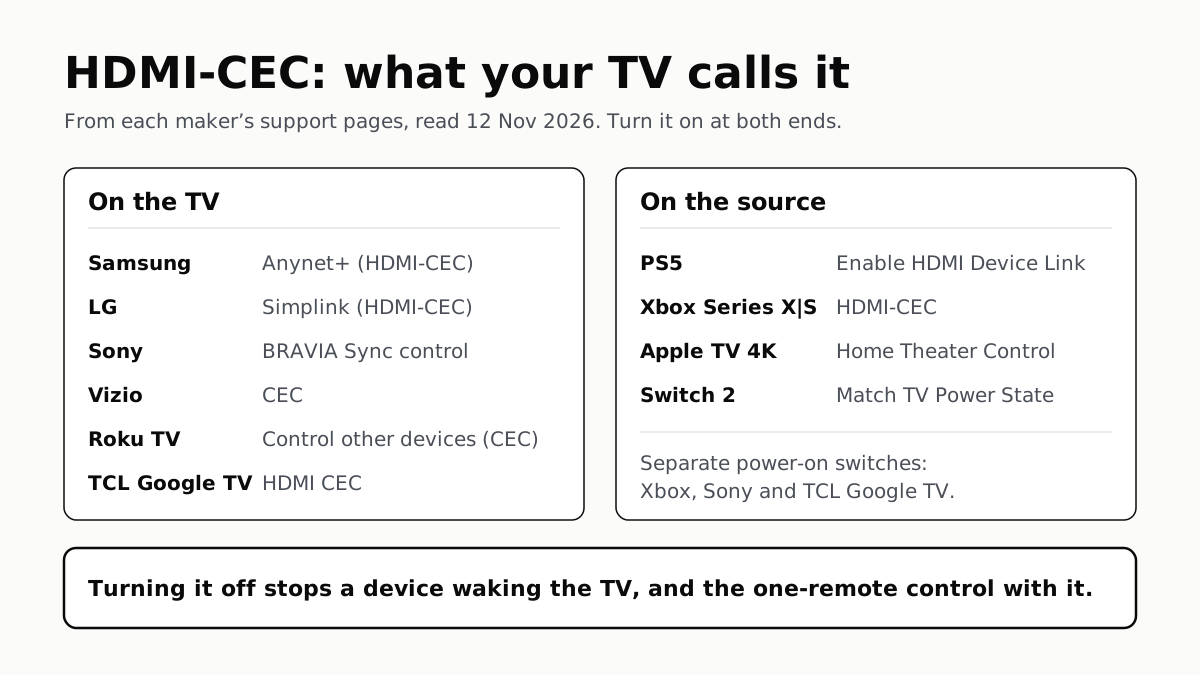
Samsung calls it Anynet+, LG Simplink, Sony BRAVIA Sync, Vizio CEC. Consoles, Apple TV and Switch 2 have their own switch.
7 TV Makers Build AirPlay Into Some Sets, No Apple TV Needed
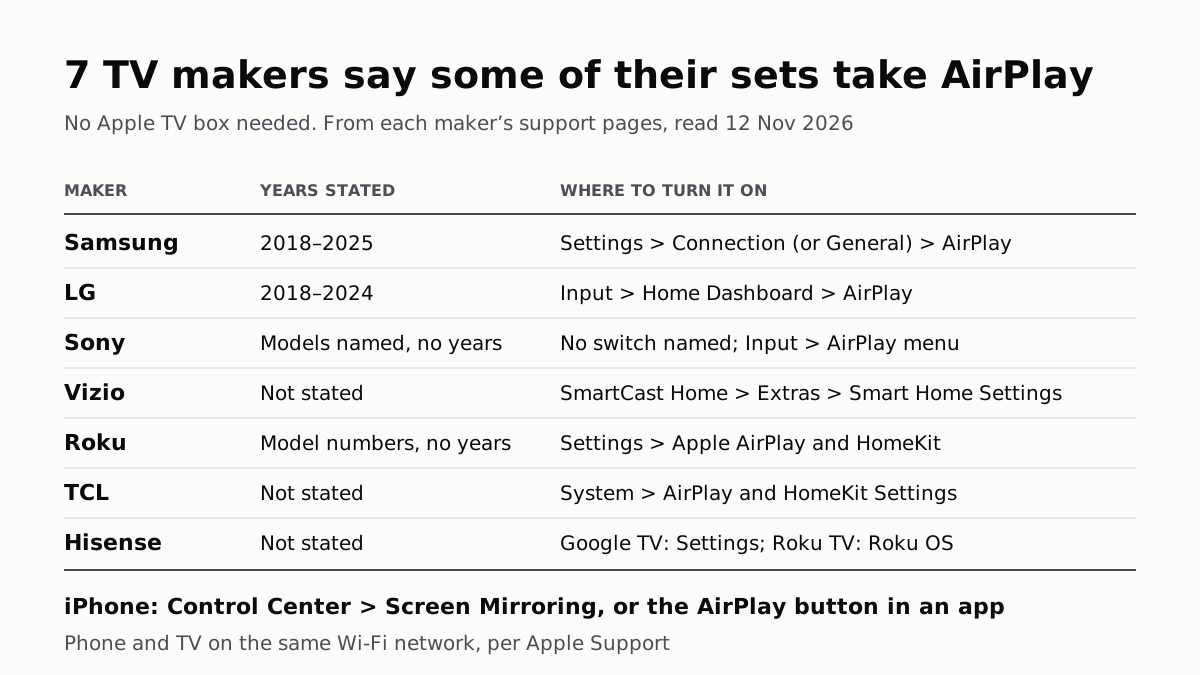
Samsung lists 2018–2025 sets and LG 2018–2024. Switch AirPlay on in the TV’s settings, then use Screen Mirroring in Control Center.
Soap Opera Effect: Set the TV’s Motion Setting to Off
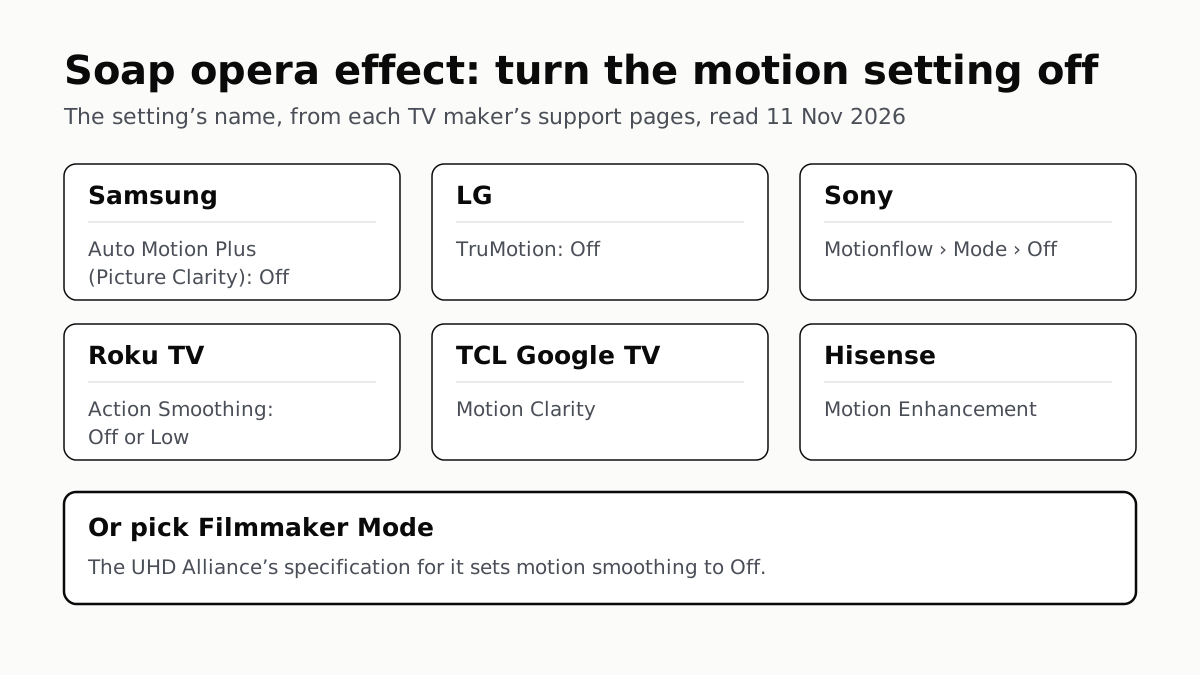
Samsung calls it Auto Motion Plus, LG TruMotion, Sony Motionflow, Roku Action Smoothing. Filmmaker Mode switches it off where offered.
4 of 5 TV Platforms: Antenna and HDMI Work Without Sign-In
Google TV’s basic mode needs no account or internet. Vizio and Samsung let you skip signing in; on Roku it depends on the model.