JBL Go to Xtreme: 10 to 28 Hours, Two Can Charge a Phone
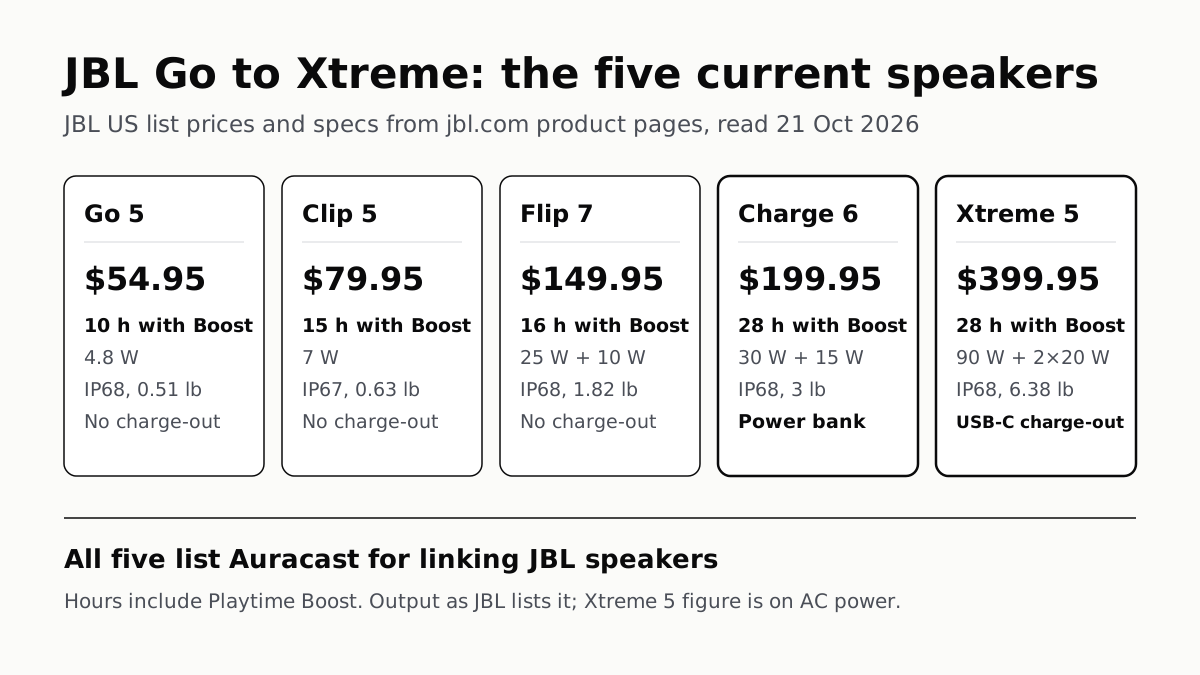
From the 0.51 lb Go 5 to the 6.38 lb Xtreme 5, all five list Auracast; the Clip 5 is the one rated IP67, not IP68.
If you buy through our links, we may earn a commission. It never affects our verdicts or scores — how that works. As an Amazon Associate I earn from qualifying purchases.
JBL sells five current portable speaker lines in the US, and they step up in size, battery and price: the Go 5, Clip 5, Flip 7, Charge 6 and Xtreme 5, rated from 10 to 28 hours with Playtime Boost. Two of them can charge a phone: the Charge 6 has a built-in power bank and the Xtreme 5 lists a USB-C charge-out. All five list Auracast for linking with other JBL speakers.
Prices are JBL’s US list prices on 21 October 2026. That day JBL had the Go 5 on sale for $39.95; the other four showed list price. Black Friday is 27 November, and a list price is the figure to measure a deal against.
The five lines
| Go 5 | Clip 5 | Flip 7 | Charge 6 | Xtreme 5 | |
|---|---|---|---|---|---|
| JBL US list price, 21 Oct 2026 | $54.95 | $79.95 | $149.95 | $199.95 | $399.95 |
| Battery, as JBL rates it | 8 h + 2 with Boost | 12 h + 3 with Boost | 14 h + 2 with Boost | 24 h + 4 with Boost | 24 h + 4 with Boost |
| Output power, as JBL lists it | 4.8 W RMS | 7 W | 25 W + 10 W RMS | 30 W + 15 W RMS | 90 W + 2 × 20 W RMS on AC; 60 W + 2 × 15 W on battery |
| Water and dust rating | IP68 | IP67 | IP68 | IP68 | IP68 |
| Weight | 0.51 lb | 0.63 lb | 1.82 lb | 3 lb | 6.38 lb |
| Width × height × depth | 3.98 × 3.05 × 1.7 in | 3.4 × 5.3 × 1.8 in | 7.2 × 2.7 × 2.8 in | 9.0 × 3.9 × 3.7 in | 13.6 × 6.5 × 6.1 in |
| Charges a phone | No output listed | No output listed | No output listed | Yes, power bank | Yes, USB-C charge-out |
| Linking speakers | Auracast; AirTouch tap-to-pair | Auracast; stereo pair | Auracast; stereo pair | Auracast; stereo pair | Auracast; AirTouch tap-to-pair |
| Bluetooth version | 6.0 | 5.3 | 5.4 | 5.4 | 6.0 |
| In the box, besides the speaker | No USB cable | USB-C cable | Carabiner | Strap; no charging cable | PD power adaptor |
Specs are from the Features, Specs and What’s in the Box sections of each speaker’s page on jbl.com. The Clip 5 is the one rated IP67 rather than IP68, and JBL describes the other four as drop-proof; the Clip 5’s page does not use the word.
Two of JBL’s own figures need a note. Its spec field for “maximum music playing time” gives the Go 5 (affiliate link to Amazon, opens in a new tab)’s 8 hours and the Flip 7 (affiliate link to Amazon, opens in a new tab)’s 14 without Playtime Boost, but the Clip 5’s 15 and the Charge 6 (affiliate link to Amazon, opens in a new tab)’s and Xtreme 5 (affiliate link to Amazon, opens in a new tab)’s 28 with it, so the table uses the Features text, which gives both. And the Clip 5’s 7 W carries no RMS label, so it may not be measured the same way as the others.
What each step up adds
Go 5 to Clip 5: battery and a carabiner. The Clip 5 adds four hours of rated battery before Boost, 12 against 8, and a built-in carabiner JBL says clips to a backpack or belt loop. It is taller and slightly heavier, at 0.63 lb against 0.51, and its rating drops from IP68 to IP67. It lists multi-point connection and ships with a USB-C cable; the Go 5’s box notes that no cable is included.
Clip 5 to Flip 7: a tweeter and more power. The Flip 7 is the first of the five with a separate tweeter, listed at 25 W RMS for the woofer and 10 W for the tweeter. It is rated IP68 and drop-proof, and weighs 1.82 lb. Battery rises to 14 hours, 16 with Boost.
Flip 7 to Charge 6: battery and phone charging. The Charge 6 is rated at 24 hours plus 4 with Boost, against the Flip 7’s 14 plus 2, and JBL says it “still includes a built-in powerbank to charge your mobile device”. Its listed output rises to 30 W plus 15 W RMS. It weighs 3 lb and comes with a strap but, per its spec list, no charging cable.
Charge 6 to Xtreme 5: output, not battery. The Xtreme 5 has the same 24-plus-4-hour rating as the Charge 6. What it adds is size and power: a woofer and two tweeters, listed at 90 W and 2 × 20 W RMS on AC power and 60 W and 2 × 15 W on battery, in a 6.38 lb body with a shoulder strap. It is the one of the five with a power adaptor in the box, and JBL says a 10-minute charge with it adds 2 hours of play. It also lists a USB-C charge-out.
Linking speakers: Auracast, and the older PartyBoost
All five pages list Auracast, which JBL describes as broadcasting from one speaker to other JBL Auracast-enabled speakers. JBL’s pairing guide says AirTouch, where you tap two speakers together to pair them for stereo, works on “a JBL Go 5 or Xtreme 5 or newer”.
JBL’s US store still sells earlier generations beside these: on 21 October its listing showed the Go 4 at $49.95, the Clip 4 at $64.95, the Flip 6 at $129.95, the Charge 5 at $179.95 and the Xtreme 3 at $329.95. The Flip 6 page describes linking with “JBL PartyBoost-compatible speakers” and lists no Auracast. JBL’s pages we read do not say whether the two systems link, so check the badge on both speakers before planning to pair an old one with a new one.
The Go 5 and Xtreme 5 pages list their Bluetooth codecs as SBC, AAC and LC3. A codec list names what the speaker accepts, not what a given link delivers.
Who each one suits, by the specs
- A pocket or a small bag: the Go 5, at 0.51 lb and under 4 inches wide.
- Hanging from a backpack: the Clip 5, with its integrated carabiner and 15 hours with Boost.
- The smallest with a separate tweeter and IP68: the Flip 7.
- A day away from a socket, with a phone to top up: the Charge 6, which pairs the longest rated battery of the five (tied with the Xtreme 5) with a power bank at about half the Xtreme 5’s list price.
- The most listed output, where there is mains power: the Xtreme 5, whose figures are highest on AC.
How these speakers score in published reviews is on our portable speaker shortlist, which averages three outlets; the Clip 5 is not on it. JBL’s earbuds use a different set of names, and which JBL earbuds are which sorts those. Sony’s ULT Field and ULT Tower range is set out in which Sony speaker is which. Before Black Friday, the checks for telling a real deal from a fake one apply to speakers as much as to anything else.
Questions people ask
What is the difference between the JBL Flip 7 and Charge 6?
Battery, size and phone charging. JBL rates the Charge 6 at 24 hours plus 4 with Playtime Boost against the Flip 7’s 14 plus 2, and builds in a power bank the Flip lacks. The Charge weighs 3 lb to the Flip’s 1.82 lb. Both are IP68 and list Auracast.
Which JBL speaker can charge my phone?
Of the five current lines, the Charge 6 and Xtreme 5. JBL says the Charge 6 has a built-in power bank, and the Xtreme 5 lists a USB-C charge-out. The Go 5, Clip 5 and Flip 7 pages list no charging output.
Which JBL speaker has the longest battery life?
The Charge 6 and Xtreme 5 tie. JBL rates both at up to 24 hours, plus 4 with Playtime Boost, for 28. The Flip 7 is 16 with Boost, the Clip 5 15 and the Go 5 10.
Can JBL Auracast speakers connect to PartyBoost speakers?
JBL’s pages we read do not say. The Go 5, Clip 5, Flip 7, Charge 6 and Xtreme 5 list Auracast; older models such as the Flip 6 list PartyBoost, and each page describes linking with speakers of its own kind.
Is the JBL Clip 5 waterproof?
Yes, to IP67, which JBL lists as waterproof and dustproof. The Go 5, Flip 7, Charge 6 and Xtreme 5 are rated IP68. JBL describes those four as drop-proof; the Clip 5’s page does not.
Do JBL speakers come with a charger?
The Xtreme 5 comes with a PD power adaptor. The Clip 5 includes a USB-C cable. The Go 5’s box says USB cable not included, the Charge 6 lists no charging cable, and the Flip 7’s box list names none.
Is the JBL Go 5 or Clip 5 smaller?
The Go 5, at 3.98 × 3.05 × 1.7 inches and 0.51 lb, against the Clip 5’s 3.4 × 5.3 × 1.8 inches and 0.63 lb. The Clip has an integrated carabiner and a longer rated battery, 15 hours with Boost to 10.
How we researched this
No one at bitcritiq has handled this product. Everything here comes from published sources, listed below.
- What this cannot tell you
- We have not heard any of these speakers, and this page does not rank them. Prices are JBL US list prices on 21 October 2026; the Go 5 was on sale that day, and Black Friday prices may differ. JBL’s spec field “Maximum music playing time” mixes two bases: it gives the Go 5 and Flip 7 without Playtime Boost and the Clip 5, Charge 6 and Xtreme 5 with it, so we use the Features figures, which state both. Output power is as JBL lists it: the Clip 5’s 7 W carries no RMS label, and the Xtreme 5 has separate AC and battery figures. JBL’s pages we read do not say whether an Auracast speaker can link with a PartyBoost one. Older generations are listed with the price JBL’s listing showed, which we did not check against each product page.
How we chose this, and what we did
- Why this subject
- Searchers reach our portable speaker shortlist on “best portable speakers”, and four of its five picks are JBLs from different lines, so the next question is what separates the lines themselves. Black Friday is 27 November. JBL’s US store still sells older generations of each line beside the new ones, which makes the names harder to read. The shortlist ranks speakers on published review scores; no bitcritiq page sets JBL’s own five current lines side by side on the maker’s figures.
- How we looked at it
- Read through a browser on 21 October 2026: JBL’s US Bluetooth speakers listing (48 per page) for the range and the prices shown, and the US product pages for the Go 5, Clip 5, Flip 7, Charge 6 and Xtreme 5, including each page’s Features, Description, Specs and What’s in the Box sections (read from the page text, as the Specs section is collapsed). The newest model of each line is the one with the highest number on JBL’s listing. List price is the struck-through figure where JBL showed a sale, otherwise the one price shown. JBL’s “How do I pair JBL speakers with Auracast, PartyBoost or AirTouch?” blog (UK store) and the Flip 6 product page for the older pairing system. Where we say a speaker lacks a phone-charging output, the control is that the Charge 6 page lists “Powerbank Yes” under Features and the Xtreme 5 page lists “USB-C Charge Out” under its connection specs; neither line appears on the Go 5, Clip 5 or Flip 7 pages, whose Go 5 entry reads “Connection Ports USB-C (in)”.
What this rests on
6 claims, all official. Nothing here was measured by bitcritiq — see how we test for why. Open a claim to read the source it came from.
JBL’s US list prices on 21 October 2026: Go 5 $54.95, Clip 5 $79.95, Flip 7 $149.95, Charge 6 $199.95, Xtreme 5 $399.95.Official
jbl.com product pages and Bluetooth speakers listing, 21 October 2026. Go 5: “$39.95 each $54.95 … SAVE 27%”. Clip 5: “$79.95 each”. Flip 7: “$149.95 each”. Charge 6: “$199.95 each”. Xtreme 5: “$399.95 each”.
JBL rates the Go 5 at 8 hours plus 2 with Playtime Boost, the Clip 5 at 12 plus 3, the Flip 7 at 14 plus 2, and the Charge 6 and Xtreme 5 at 24 plus 4.Official
Go 5: “up to 8 hours, plus an extra 2 with Playtime Boost”. Clip 5: “up to 12 hours of playtime … adding up to 3 hours”. Flip 7: “14 hours on a single charge … an extra 2 hours with Playtime Boost”. Charge 6: “24 hours on a single charge … an extra 4 hours”. Xtreme 5: “up to 24 hours straight, plus four more with Playtime Boost”.
The Clip 5 is rated IP67; the Go 5, Flip 7, Charge 6 and Xtreme 5 are rated IP68.Official
Specs, IP Code: Clip 5 “IP67”; Go 5, Flip 7, Charge 6 and Xtreme 5 “IP68”.
The Charge 6 has a built-in power bank and the Xtreme 5 lists a USB-C charge-out; the Go 5, Clip 5 and Flip 7 pages list neither.Official
Charge 6: “still includes a built-in powerbank to charge your mobile device”; Features “Powerbank Yes”. Xtreme 5 specs: “USB-C Charge Out 5V / 3A, 9V / 2A , 11V / 2A”. Go 5: “Connection Ports USB-C (in)”.
JBL lists output of 4.8 W RMS for the Go 5, 7 W for the Clip 5, 25 W plus 10 W RMS for the Flip 7, 30 W plus 15 W RMS for the Charge 6, and for the Xtreme 5 90 W plus two 20 W RMS on AC power, 60 W plus two 15 W on battery.Official
Specs, Output power: Go 5 “4.8 W RMS”; Clip 5 “7”; Flip 7 “25 W RMS for woofer, 10 W RMS for tweeter”; Charge 6 “30 W RMS for woofer, 15 W RMS for tweeter”; Xtreme 5 “1 x 90W RMS Woofer + 2 x 20W RMS Tweeter (AC power mode) 1 x 60W RMS Woofer + 2 x 15W RMS Tweeter (Battery mode)”.
All five list Auracast for linking with other JBL Auracast speakers; the older Flip 6, still on JBL’s store, uses PartyBoost instead.Official
Specs, Features: “Supports Auracast Yes” on all five pages. Flip 6: “PartyBoost allows you to pair two JBL PartyBoost-compatible speakers together”; Features “JBL PartyBoost Yes”.
Sources 8
- Bluetooth Speakers — JBL (US)Officialaccessed Oct 21, 2026
- JBL Go 5 — JBL (US)Officialaccessed Oct 21, 2026
- JBL Clip 5 — JBL (US)Officialaccessed Oct 21, 2026
- JBL Flip 7 — JBL (US)Officialaccessed Oct 21, 2026
Show 4 more · 4 official or standards
- JBL Charge 6 — JBL (US)Officialaccessed Oct 21, 2026
- JBL Xtreme 5 — JBL (US)Officialaccessed Oct 21, 2026
- JBL Flip 6 — JBL (US)Officialaccessed Oct 21, 2026
- How do I pair JBL speakers with Auracast, PartyBoost or AirTouch? — JBLOfficialaccessed Oct 21, 2026
Pass it on
Know someone weighing this up? Send them the answer.
bitcritiq.com/pf9aThe link is permanent: it opens this article for good, even if the title changes.
No email, no account
Follow bitcritiq
Every new article, in whatever reader you already use.
Subscribe by RSSAll the ways to follow
Using Chrome on Android? Open the browser menu and tap Follow. New articles then turn up in the Following tab in Discover.
read next
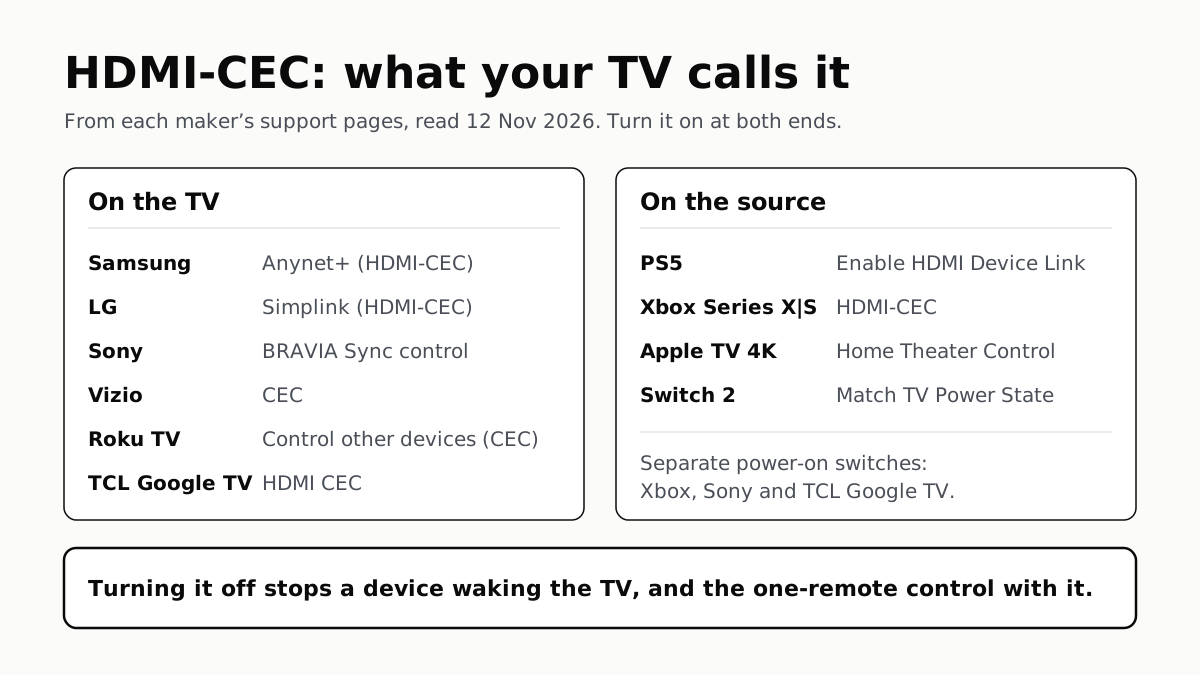
To Use One TV Remote, Turn On HDMI-CEC at Both Ends
Samsung calls it Anynet+, LG Simplink, Sony BRAVIA Sync, Vizio CEC. Consoles, Apple TV and Switch 2 have their own switch.
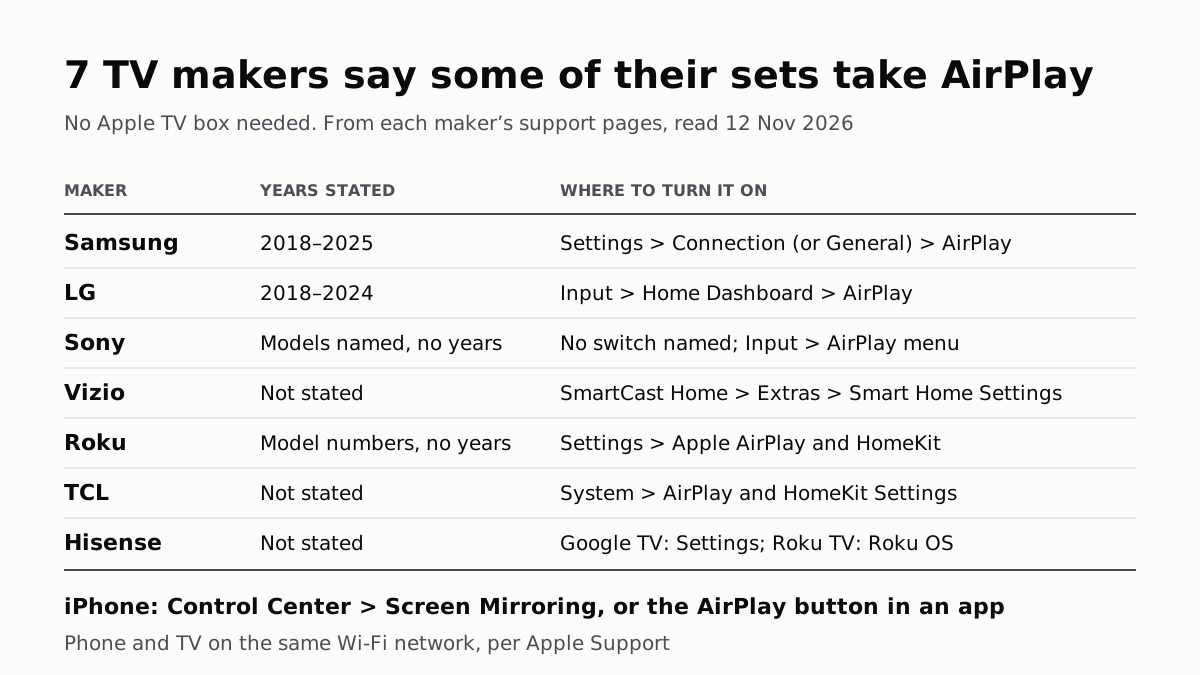
7 TV Makers Build AirPlay Into Some Sets, No Apple TV Needed
Samsung lists 2018–2025 sets and LG 2018–2024. Switch AirPlay on in the TV’s settings, then use Screen Mirroring in Control Center.
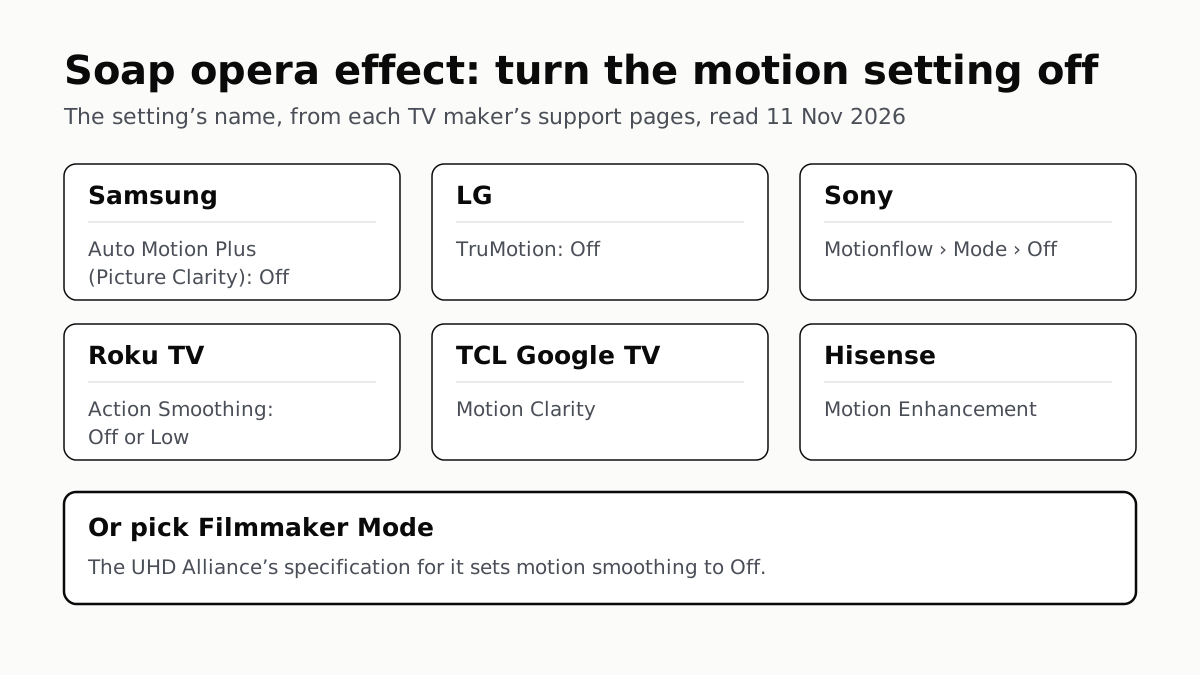
Soap Opera Effect: Set the TV’s Motion Setting to Off
Samsung calls it Auto Motion Plus, LG TruMotion, Sony Motionflow, Roku Action Smoothing. Filmmaker Mode switches it off where offered.
4 of 5 TV Platforms: Antenna and HDMI Work Without Sign-In
Google TV’s basic mode needs no account or internet. Vizio and Samsung let you skip signing in; on Roku it depends on the model.