Hisense’s 2026 TVs: U6 and U7 Mini LED, UR8 and UR9 RGB
From Hisense’s US spec tables and 2026 launch releases: backlight, refresh rate, HDMI, speakers, sizes and launch prices where given.
If you buy through our links, we may earn a commission. It never affects our verdicts or scores — how that works. As an Amazon Associate I earn from qualifying purchases.
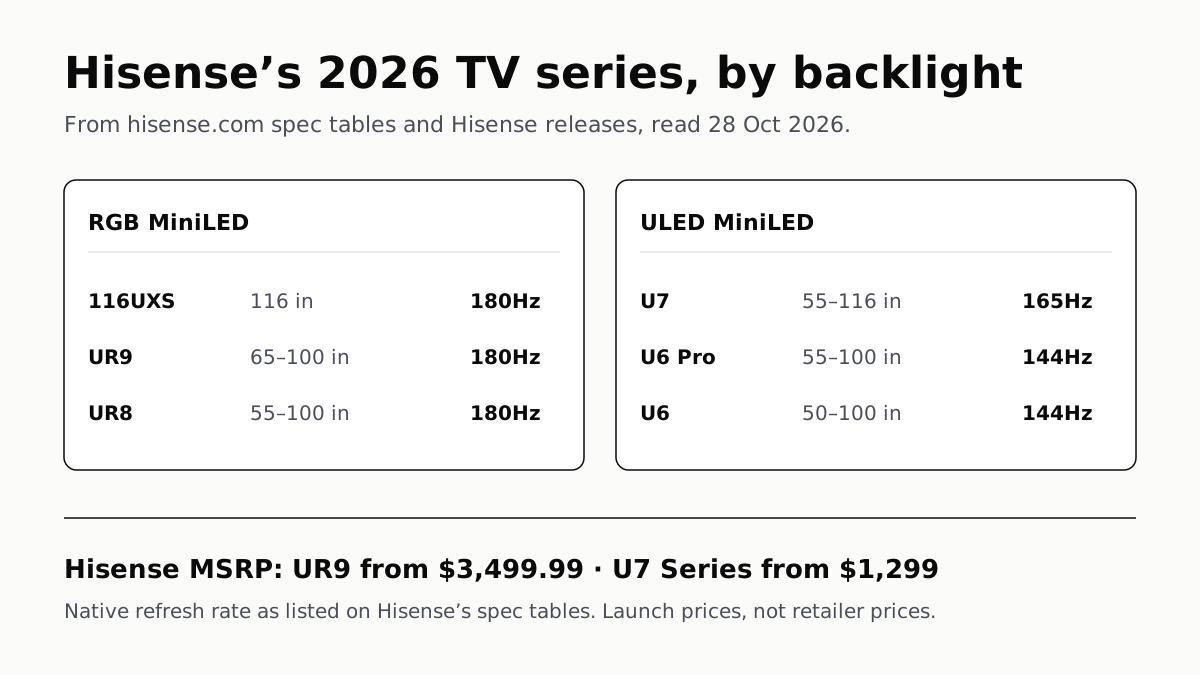
Hisense’s 2026 TVs split into two backlights: RGB MiniLED in the 116UXS, UR9 and UR8, and ULED MiniLED in the U7, U6 Pro and U6. Refresh rate steps with them on Hisense’s own spec tables: 180Hz for the three RGB series, 165Hz for the U7 (affiliate link to Amazon, opens in a new tab) and 144Hz for the U6 pair.
Hisense’s US TV menu shows 37 results, including two gaming monitors and series its 2026 releases do not name, so a series name on a shelf is not proof of a 2026 set. The six series here are the ones Hisense’s own January and March 2026 releases name.
The six series side by side
From the specification table on one hisense.com product page per series, read 28 October 2026, with sizes from the menu cards. Prices are Hisense’s launch MSRPs from its March 2026 releases; hisense.com lists no prices of its own.
| Series | Backlight, as Hisense lists it | Native refresh | HDMI inputs (page read) | Speakers (page read) | OS | Sizes | Hisense MSRP |
|---|---|---|---|---|---|---|---|
| UX (116UXS) | RGB MiniLED (“RGB MiniLED evo”, adds cyan) | 180Hz | 3 × HDMI 2.1 | 6.4.2 channels, 140 W | Google TV | 116 in | not stated |
| UR9 | RGB MiniLED | 180Hz | 3 × HDMI 2.1 (65 in) | 80 W (65 in) | Google TV | 65–100 in | $3,499.99 (65 in) to $8,999.99 (100 in) |
| UR8 | RGB MiniLED | 180Hz | 4 × HDMI 2.1 (100 in) | 2.1.2 channels, 60 W (100 in) | Google TV | 55–100 in | not stated |
| U7 (U7SG) | ULED MiniLED | 165Hz | 4 × HDMI 2.1 (65 in); 3 (116 in) | 50 W (65 in); 110 W (116 in) | Google TV | 55–116 in | U7 Series from $1,299 |
| U7 (U7SF) | ULED MiniLED | 165Hz | 4 × HDMI 2.1 (75 in) | 50 W (75 in) | Fire TV | 55–75 in | U7 Series from $1,299 |
| U6 Pro (U6SF Pro) (affiliate link to Amazon, opens in a new tab) | ULED MiniLED | 144Hz | 2 × HDMI 2.1, 2 × HDMI 2.0 (100 in) | 50 W (100 in) | Fire TV | 55–100 in | not stated |
| U6 (U6SF) | ULED MiniLED | 144Hz | 2 × HDMI 2.1, 2 × HDMI 2.0 (100 in) | 50 W (100 in) | Fire TV | 50–100 in | not stated |
Each table we read lists LCD as the screen type, and none gives a dimming-zone count. Hisense’s MSRPs are launch figures, not what a retailer charges today. Best Buy’s pages could not be read on 28 October, so the table has no retailer price column.
RGB MiniLED: the UR range and the 116UXS
Hisense says each LED in an RGB MiniLED backlight uses separate red, green and blue diodes that make colour at the source, and quotes up to 100% of the BT.2020 colour range for the UR9. Its January release calls the UR9 and UR8 the second generation of the RGB design it first sold in 2025, and its March release places RGB MiniLED above ULED as what it calls its “ultra-premium tier”.
The 116UXS, which Hisense calls its flagship, goes further: Hisense says it adds cyan as a fourth primary, calls the result RGB MiniLED evo, and quotes up to 110% of BT.2020. Its table lists Wi‑Fi 7 and VRR from 48 to 180Hz at 4K. Our explainer on how Mini LED and OLED make light covers what local dimming does and where its limits sit.
Between the two UR series, the tables we read separate them on size and sound more than on the panel: both list 180Hz and Google TV, the UR8 runs down to 55 inches where the UR9 starts at 65, and the 65-inch UR9 lists 80 W against the 100-inch UR8’s 60 W. The UR9 page also quotes 8,000-nit peaks and a 4.1.2 Devialet speaker system; the UR8 page gives no peak figure.
ULED MiniLED: U7, U6 Pro and U6
Hisense’s March release calls the U6 and U7 its “performance-to-value sweet spot”. The U7 lists 165Hz against the U6’s 144Hz, and the 65- and 75-inch U7 tables list four HDMI 2.1 inputs where the U6 tables list two HDMI 2.1 and two HDMI 2.0. Anyone connecting more than two HDMI 2.1 devices, such as two consoles and a PC, gets two such inputs on the U6 tables and four on those U7 sizes.
The U7 comes in two versions that Hisense names by operating system: U7SG with Google TV, from 55 to 116 inches, and U7SF with Fire TV, from 55 to 75. Size changes the sheet: the 116-inch U7SG lists three HDMI 2.1 inputs and 110 W of sound, the 65-inch four inputs and 50 W.
The U6 Pro (affiliate link to Amazon, opens in a new tab) and U6 tables we read match on refresh rate, HDMI and speaker power. Hisense’s release calls the U6SF Pro the lead model and the U6SF “an additional entry MiniLED model”, but it does not list what the Pro adds, and neither do the two tables. A VIDAA version, the U6SV Pro, is in the menu at 55 to 75 inches.
HDR formats and operating systems
The UR8 and 116UXS tables list Dolby Vision, Dolby Vision IQ, HDR10, HDR10+, HDR10+ Adaptive and HLG. The UR9, U7 and U6 tables we read have no HDR row, though the UR9 page names Dolby Vision among its certifications. Our HDR10+ and Dolby Vision explainer covers which services use which.
The RGB sets list Google TV. The U7 comes with Google TV or Fire TV, the U6 and U6 Pro with Fire TV, and the U6 Pro with VIDAA as well. Hisense calls its viewing-recognition feature the Enhanced Viewing Service; our guide to turning off TV tracking has what Hisense says about switching it off.
The other series in the menu
The menu also carries series Hisense’s 2026 releases do not name, among them the U8, the QD and E ranges with Hi-QLED, the S7 CanvasTV, the R6 and A-series 4K sets, and a 116UX listing beside the 116UXS. We did not read their spec tables, so they are not in the table above. For how Hisense sets have fared in outlets’ reviews, see our shortlist of the best-reviewed TVs.
Where Hisense’s pages disagree
Several hisense.com pages contradict themselves or a Hisense release on 28 October. The 116UXS release describes a 6.2.2 Devialet sound system; the product table lists 6.4.2 channels. The 100-inch U6 Pro page is titled Fire TV, but its table lists Google TV as the smart platform. The 100-inch UR8 page describes a 6.2.2 system in its feature copy and lists 2.1.2 in its table. The 100-inch U6 page carries copy about RGB dimming zones and 8,000 nits, which belongs to the RGB range. Where the two disagree, this page uses the specification table.
Questions people ask
What is the difference between Hisense U6 and U7?
Refresh rate and inputs, on Hisense’s own tables. The U7 lists a native 165Hz panel and, on the 65- and 75-inch pages, four HDMI 2.1 inputs; the U6 and U6 Pro list 144Hz with two HDMI 2.1 and two HDMI 2.0. All of them are ULED MiniLED with local dimming.
What is the difference between Hisense UR8 and UR9?
Both are RGB MiniLED sets with a native 180Hz panel and Google TV. The UR9 runs from 65 inches and its 65-inch table lists 80 W of sound; the UR8 starts at 55 inches and its 100-inch table lists 60 W in a 2.1.2 layout.
What does RGB MiniLED mean on a Hisense TV?
Hisense says each LED in the backlight uses separate red, green and blue diodes, making colour at the source instead of filtering white light, and quotes up to 100% of BT.2020 for the UR9. The 116UXS adds a fourth colour, cyan, which Hisense calls RGB MiniLED evo.
What do the letters at the end of Hisense model numbers mean?
In the U6, U7, UR8 and UR9 codes we read, the last letter matches the operating system in the product name: U7SG is the Google TV U7, U7SF the Fire TV U7, and U6SV Pro a VIDAA U6 Pro. We found no key on Hisense’s pages, so check the OS on the listing.
Is the Hisense U7 120Hz?
Higher. Hisense lists the 2026 U7 at a native 165Hz on both the Google TV and Fire TV pages, and its release says the same. The U6 and U6 Pro list 144Hz, and the UR8, UR9 and 116UXS 180Hz.
Do Hisense TVs support Dolby Vision?
The UR8 and 116UXS tables list Dolby Vision and HDR10+, plus HDR10+ Adaptive. The UR9 page names Dolby Vision among its certifications, and the U6 Pro page names Dolby Vision. The U6, U6 Pro, U7 and UR9 tables we read have no HDR row.
How we researched this
No one at bitcritiq has handled this product. Everything here comes from published sources, listed below.
- What this cannot tell you
- hisense.com shows no prices and sends buyers to retailers. Best Buy’s product page could not be read on 28 October, and Walmart’s search did not return the 2026 U7, so there is no retailer price column; the MSRPs are Hisense’s launch figures, and retailers sell below them. Hisense gave no MSRP for the UR8, U6, U6 Pro or 116UXS in the releases we read. Specs were read for one size per series except the U7, and the U7 shows that HDMI count and speaker power change with size. Hisense’s own pages disagree in places, listed in the last section. The tables give no dimming-zone counts and, outside the UR8 and 116UXS, no HDR row. We have not used any of these TVs; nothing here is a review or a score.
How we chose this, and what we did
- Why this subject
- Search Console shows bitcritiq’s best-TVs page drawing searches for “best tv 2026”, “best new tvs” and “best new televisions”, and Black Friday falls on 27 November. We have laid out TCL’s, Sony’s and Vizio’s ranges; Hisense sells its 2026 sets under letter-and-number names (U6, U7, UR8, UR9, UX) beside older series in the same menu, and none of our pages explains which is which.
- How we looked at it
- Read hisense.com’s US site (hisense-usa.com now redirects there) on 28 October 2026. The TV menu (hisense.com/us/en/tv) reported 37 results after Load More, two of them gaming monitors marked Coming Soon. Which series are 2026 comes from Hisense’s own releases, not from the menu: the CES release of 5 January 2026 names the 116UXS, UR9 and UR8, and the release of 9 March 2026 names the U7 (U7SG and U7SF), U6SF Pro and U6SF; that gives six series, shown as seven rows because the U7 is split by operating system, counted by hand. For each we read the specification table on one product page: 116UXS, 65UR9SG, 100UR8SG, 65U7SG and 116U7SG, 75U7SF, 100U6SF Pro and 100U6SF. Sizes are the size buttons on each menu card. Prices are Hisense’s MSRPs from its 9 March and 26 March 2026 releases. Absence check: the UR8 and 116UXS tables have an HDR Formats row; the UR9, U7 and U6 tables we read have none, with Native Refresh Rate and HDMI rows present on each as the control.
What this rests on
6 claims, all official. Nothing here was measured by bitcritiq — see how we test for why. Open a claim to read the source it came from.
Hisense’s 2026 releases name six series: the 116UXS, UR9 and UR8 with RGB MiniLED, and the U7, U6 Pro and U6 with ULED MiniLED.Official
CES release, 5 January 2026: “led by the flagship 116UXS and expands RGB into a more accessible RGB MiniLED lineup for the first time via the new UR9 and UR8 Series”. 9 March 2026 release: “its 2026 ULED MiniLED TV lineup, focusing on the latest U6 and U7 Series … Led by the U6SF Pro … an additional entry MiniLED model within the lineup, U6SF”.
The 116UXS, UR9 and UR8 spec tables list a native 180Hz refresh rate; the U7 tables list 165Hz and the U6 and U6 Pro tables 144Hz.Official
116UXS: “Native Refresh Rate 180 Hz”; 65UR9SG: “180 Hz”; 100UR8SG: “180Hz”; 65U7SG and 75U7SF: “165 Hz”; 100U6SF Pro and 100U6SF: “144 Hz”.
Hisense says the 116UXS adds cyan to red, green and blue in what it calls RGB MiniLED evo.Official
CES release: “RGB MiniLED evo backlight system, a four-primary architecture that adds cyan to the current RGB structure … up to 110% of BT.2020 color coverage”.
Hisense set the UR9’s MSRP at $3,499.99 for 65 inches up to $8,999.99 for 100 inches, and the U7 Series from $1,299.Official
26 March 2026 release: “starting at $3,499.99 MSRP for the 65-inch model … with pricing up to $8,999.99 MSRP for the 100-inch model.” 9 March 2026 release: “The U7 series, starting at $1,299 MSRP”.
The U6 and U6 Pro tables list two HDMI 2.1 and two HDMI 2.0 inputs; the UR8 and 65-inch U7 list four HDMI 2.1.Official
100U6SF and 100U6SF Pro: “HDMI 2 x HDMI 2.1, 2 x HDMI 2.0”. 100UR8SG: “4 x HDMI 2.1”; 65U7SG: “4 x HDMI 2.1”; 116U7SG: “3 x HDMI 2.1”.
The UR8 and 116UXS tables list Dolby Vision, HDR10+ and HDR10+ Adaptive.Official
100UR8SG and 116UXS: “HDR Formats Dolby Vision, Dolby Vision IQ, HDR10, HDR 10+, HDR10+ Adaptive, HLG”.
Sources 12
- Television — Hisense US (TV menu)Officialaccessed Oct 28, 2026
- Hisense Pioneers the Evolution of RGB MiniLED at CES 2026 — Hisense US newsroom, 5 January 2026Officialaccessed Oct 28, 2026
- Hisense 2026 ULED MiniLED TVs: Bringing Premium Big-Screen Experiences Home at Every Budget — Hisense US newsroom, 9 March 2026Officialaccessed Oct 28, 2026
- Hisense Opens UR9 RGB MiniLED TV Pre-Orders — Hisense via PR Newswire, 26 March 2026Officialaccessed Oct 28, 2026
Show 8 more · 8 official or standards
- Hisense 116" UX Series RGB-MiniLED Google TV (116UXS) — Hisense USOfficialaccessed Oct 28, 2026
- Hisense 65" Class UR9 Series RGB MiniLED 4K Google TV (65UR9SG) — Hisense USOfficialaccessed Oct 28, 2026
- Hisense 100" UR8 Series RGB MiniLED Google TV (100UR8SG) — Hisense USOfficialaccessed Oct 28, 2026
- Hisense 65" Class U7 Series ULED MiniLED 4K Google TV (65U7SG) — Hisense USOfficialaccessed Oct 28, 2026
- Hisense 116" Class U7 Series ULED MiniLED 4K Google TV (116U7SG) — Hisense USOfficialaccessed Oct 28, 2026
- Hisense 75" Class U7 Series ULED MiniLED 4K Fire TV (75U7SF) — Hisense USOfficialaccessed Oct 28, 2026
- Hisense 100" Class U6 Pro Series ULED MiniLED 4K Fire TV (100U6SF Pro) — Hisense USOfficialaccessed Oct 28, 2026
- Hisense 100" Class U6 Series ULED MiniLED 4K Fire TV (100U6SF) — Hisense USOfficialaccessed Oct 28, 2026
Pass it on
Know someone weighing this up? Send them the answer.
bitcritiq.com/9qzuThe link is permanent: it opens this article for good, even if the title changes.
No email, no account
Follow bitcritiq
Every new article, in whatever reader you already use.
Subscribe by RSSAll the ways to follow
Using Chrome on Android? Open the browser menu and tap Follow. New articles then turn up in the Following tab in Discover.
read next
To Use One TV Remote, Turn On HDMI-CEC at Both Ends
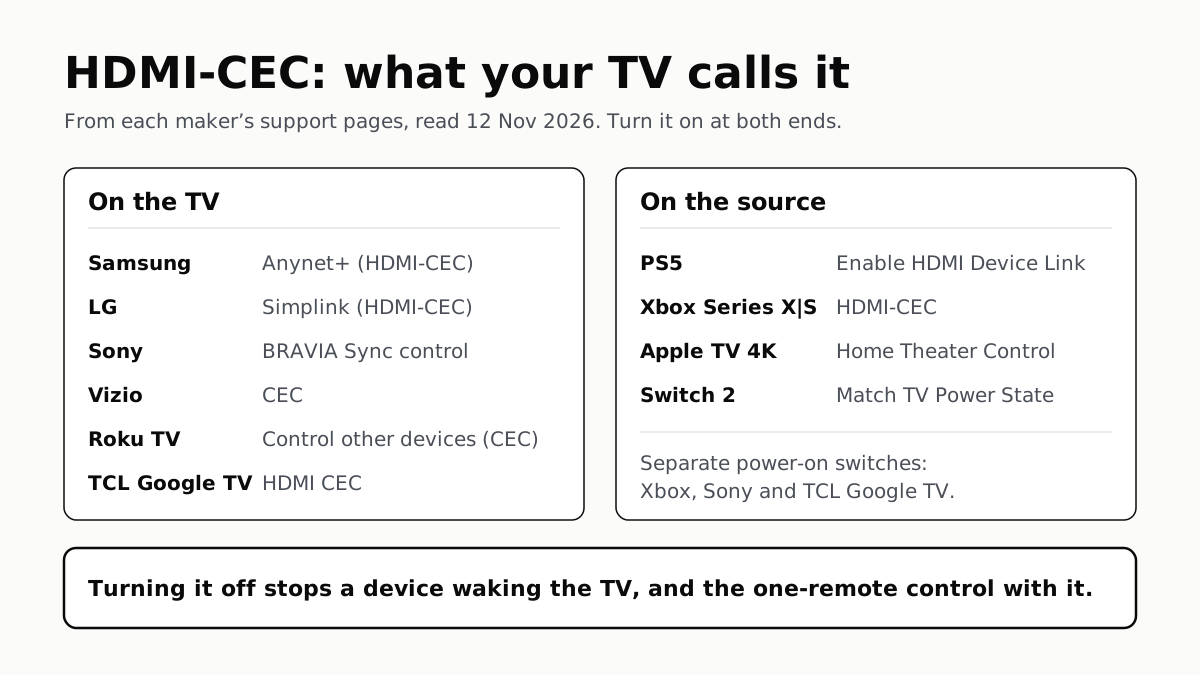
Samsung calls it Anynet+, LG Simplink, Sony BRAVIA Sync, Vizio CEC. Consoles, Apple TV and Switch 2 have their own switch.
7 TV Makers Build AirPlay Into Some Sets, No Apple TV Needed
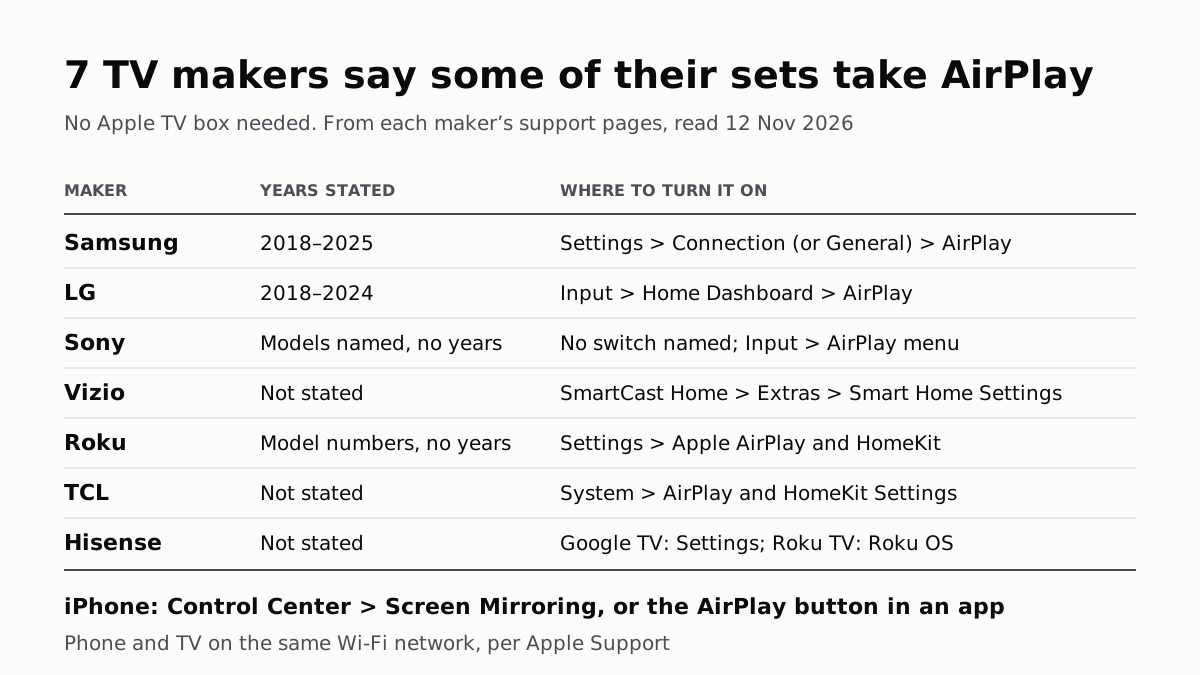
Samsung lists 2018–2025 sets and LG 2018–2024. Switch AirPlay on in the TV’s settings, then use Screen Mirroring in Control Center.
Soap Opera Effect: Set the TV’s Motion Setting to Off
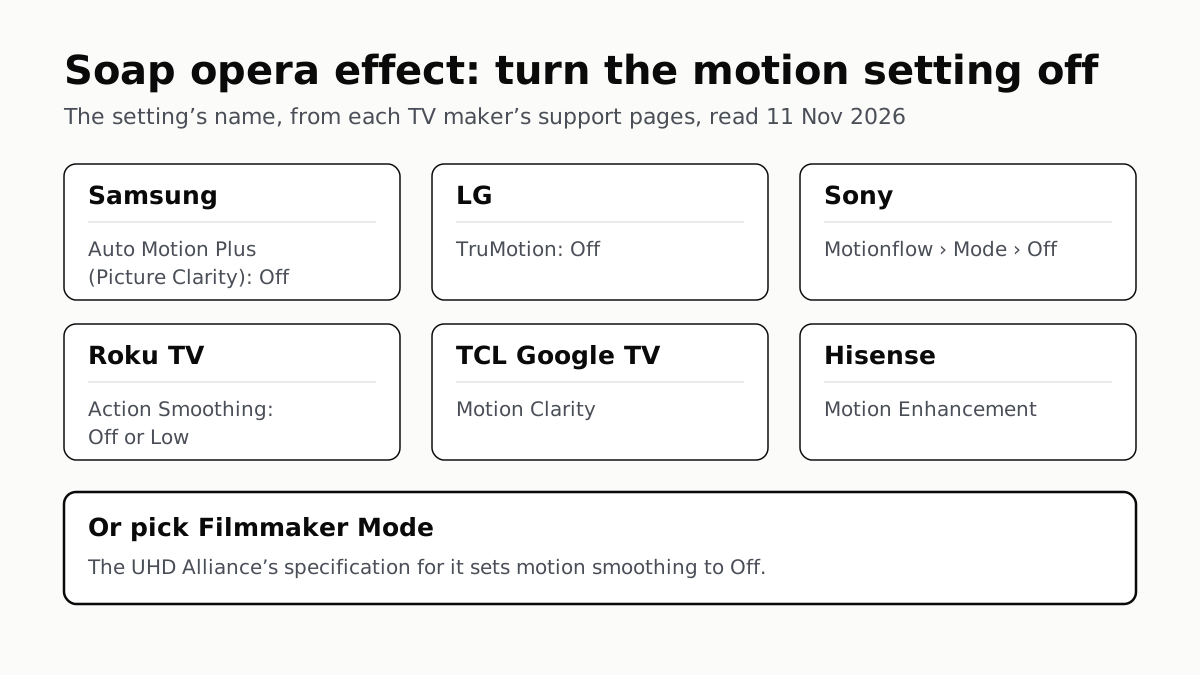
Samsung calls it Auto Motion Plus, LG TruMotion, Sony Motionflow, Roku Action Smoothing. Filmmaker Mode switches it off where offered.
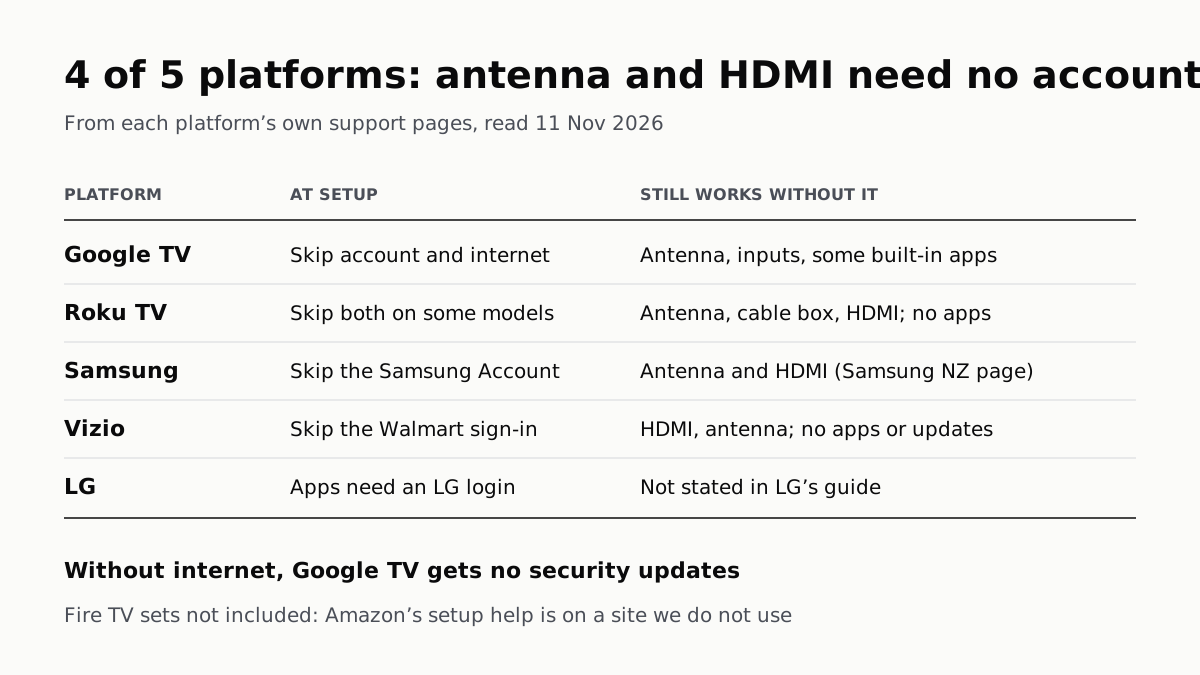
4 of 5 TV Platforms: Antenna and HDMI Work Without Sign-In
Google TV’s basic mode needs no account or internet. Vizio and Samsung let you skip signing in; on Roku it depends on the model.