Meta Glasses Light Up to Record; Most Stay Dark for AI
A white light on the frame blinks for photos, video and livestreams, and covering it disables the camera. Meta’s terms forbid hiding it.
If you buy through our links, we may earn a commission. It never affects our verdicts or scores — how that works. As an Amazon Associate I earn from qualifying purchases.
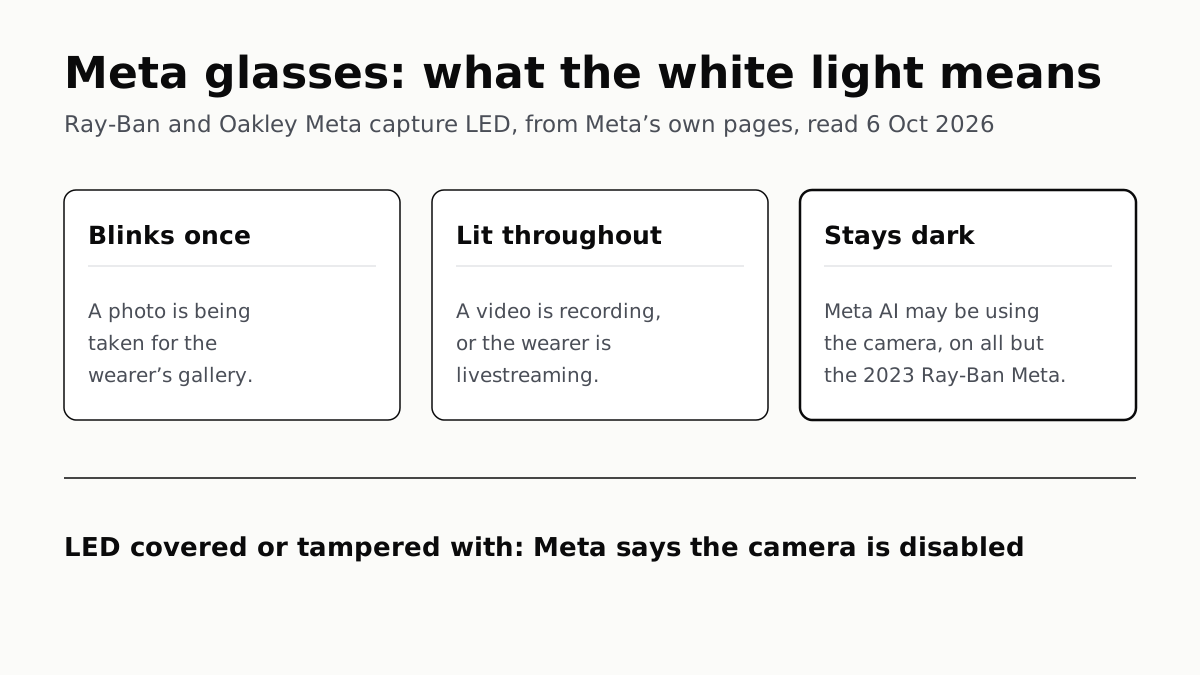
A white light on the front of Ray-Ban Meta (affiliate link to Amazon, opens in a new tab) and Oakley Meta (affiliate link to Amazon, opens in a new tab) glasses blinks when the wearer takes a photo, and stays active for as long as they record video or livestream. It does not tell you everything: Meta says that when the wearer asks Meta AI about what they are looking at, the camera works with the light off, on all its glasses except the 2023 Ray-Ban Meta.
So a lit LED means something is being saved or broadcast. A dark one means nothing is going to the wearer’s gallery, not that the camera is idle.
Not every pair has a camera to light up: Meta’s camera-free Ray-Ban Meta Audio, announced in September, has none. Meta’s 2026 glasses, on paper sets out which models do.
What the light means
| What you see | What Meta says is happening |
|---|---|
| One brief white blink | A photo is being taken for the wearer’s gallery |
| White light for the whole time | A video is recording, or the wearer is livestreaming |
| Nothing | No photo or video for the gallery; Meta AI may still be using the camera |
| Nothing, and the light seems covered | Meta says the camera is disabled until it is cleared |
Meta’s Help Center places the camera in one top corner of the frame and the capture LED in the matching spot on the other side. Meta calls it “a bright white light” and says it tested brightness so it is visible during the day. Its 2025 paper says the LED on Ray-Ban Meta grew to 2mm, from 0.9mm on the earlier Ray-Ban Stories.
Meta’s own pages disagree on one detail. Its privacy page and July newsroom post say the light keeps blinking during video; its Help Center says the white LED “will stay on”. Either way, it should be lit for the whole recording.
What happens if someone covers it
Meta says that if the glasses detect the capture LED “was covered, physically tampered or destroyed, they’ll automatically disable the camera”, and that the wearer is told to clear it before taking a photo, recording or going live. The covering check dates from the second generation of the glasses; in July 2026 Meta added detection of physical tampering. The LED has no off switch.
Meta’s terms make it a rule as well as a design. Section 2.1 of its device terms says wearers “may not tamper with the MPT Products, or otherwise obscure or modify any features that are intended to signal to others that the product is recording”, and makes them responsible for any notice or consent that recording laws require. Meta also says it removes ads and Marketplace listings for LED tampering services and takes legal action against sellers.
Enforcement has gone further than warnings. Quartz reported on 2 September 2026, citing Semafor, that Meta had permanently disabled the cameras on thousands of pairs whose LED had been physically altered, fewer than one in a thousand sold, and that an update now catches a light covered mid-recording. Meta’s wearables chief called it “a little bit of a cat and mouse game”.
What the light does not tell you
That the camera is off. Meta’s paper on bystander privacy separates “active capture” from AI features, and keeps the LED for capture so people do not learn to ignore it. When the wearer asks Meta AI to read a menu or identify a plant, the camera runs with the LED off on all but the 2023 Ray-Ban Meta, whose LED signals all camera use. Meta says it blurs faces and licence plates in those images and keeps them out of the gallery.
Where the images go. Meta’s Help Center says it stores visual data from those AI requests and may use it to train AI models, including through human review, unless the wearer turns off Store visual data from AI experiences. Meta is adding more AI to the glasses; its Muse agent is “coming soon” to them.
Whether you can see it. A light only warns people who notice it. Ireland’s Data Protection Commission and Italy’s regulator told Facebook in 2021 that it had not shown the first glasses’ “very small indicator light” was effective notice. In September 2026, the UK ICO’s chief executive, who is severely visually impaired, wrote that visual cues are often unavailable to people with low vision.
Snap’s glasses
| Meta (Ray-Ban, Oakley) | Snap Specs | Snap Spectacles 3 | |
|---|---|---|---|
| Outward light | Capture LED, top corner of frame | LED in the centre of the frame | LEDs inside and outside the frame |
| Lights for | Photos, video, livestreams | Photos, video and audio recording | Video; Snap mentions only an inner LED for photos |
| Covering it | Camera disabled, per Meta | Snap does not say | Snap does not say |
| AI camera use | Unlit, except 2023 Ray-Ban Meta | Snap says spatial processing saves no photo or video | Not described |
Snap’s Specs, due later this fall, light “a prominent external LED in the center of the frames” for photos and video or audio recording, and the wearer hears a sound. Snap says the cameras process the scene in real time for spatial tracking without creating or saving a photo or video. Its privacy page does not say what happens if the LED is covered, though it describes the light’s position and the sound in the same passage.
If you think you are being recorded
Look for the light, and ask. Meta’s guidance to its own wearers is to stop recording if anyone asks and to switch the glasses off in sensitive places such as doctors’ offices, locker rooms and schools. Meta’s terms leave notice and consent to the wearer.
Whether recording you is lawful depends on where you are and what the footage is used for. The ICO notes that UK data protection law does not cover purely personal photos, but a public post may fall under it. This piece describes what the makers and regulators say, not what the law allows where you live.
Questions people ask
How can you tell if Meta glasses are recording?
Look at the top corners of the frame. One holds the camera; the matching spot on the other side is the capture LED. A brief white blink means a photo; a white light that stays on or keeps blinking means a video or a livestream.
What does the white light on Ray-Ban Meta glasses mean?
It is the capture LED. Meta says it blinks briefly when the wearer takes a photo for their gallery and stays active for as long as they record video or go live. It has no off switch.
Can Meta glasses record without the light on?
Not photos or videos for the gallery, by Meta’s account: if the glasses detect the LED is covered or tampered with, the camera is disabled. But Meta says the camera can be used for Meta AI features with the LED off, on all models except the 2023 Ray-Ban Meta.
What happens if you cover the light on Meta glasses?
Meta says the camera is disabled and the wearer is told to clear the LED before taking a photo or video. Meta’s terms also forbid obscuring or modifying the recording signal.
Do Snap Specs have a recording light?
Yes. Snap says a prominent external LED in the centre of the frame lights up or flashes when the wearer takes a photo or records video or audio, and the wearer hears a sound. Snap does not say whether covering it blocks capture.
Are Meta glasses always recording?
Meta says no: recording happens only when the wearer starts it by voice or the capture button. Meta AI features can use the camera briefly when asked, without lighting the LED on models newer than the 2023 Ray-Ban Meta.
How we researched this
No one at bitcritiq has handled this product. Everything here comes from published sources, listed below.
- What this cannot tell you
- We have not handled the glasses, so we cannot say how visible the light is in daylight or from what distance. Meta's own pages disagree on how the light behaves during video: its privacy page and newsroom say it keeps blinking, its Help Center says the white LED stays on. Meta's AI paper dates from July 2025; nothing newer we read contradicts it, but Meta does not restate the AI exception on its current privacy page. Meta does not say how its tamper detection works or how reliable it is. Snap Specs have not shipped, and Snap does not say whether covering their LED blocks capture. Nothing here says what is lawful where you live.
How we chose this, and what we did
- Why this subject
- Meta's AI glasses drew a summer of complaints about covert recording, a July FAQ from Meta about its recording light, and reports in September that it had disabled cameras on pairs whose light had been tampered with. The bystander's question is simple — how do I know if those glasses are recording me — and the useful answer includes what the light leaves out, which Meta states in a paper most coverage did not quote.
- How we looked at it
- Meta's behaviour and rules are from its own pages, read on 6 October 2026: the Meta AI glasses privacy page (with its collapsed FAQ read from the page source), the newsroom post 'Meta’s AI Glasses: Your Questions Answered' (7 July 2026), the paper 'Bystander Privacy: Evolving with the AI Glasses Landscape' (July 2025, PDF on about.fb.com), three Meta AI Glasses Help Center articles, and the Supplemental Meta Platforms Technologies Terms of Service (updated 29 April 2025), section 2.1. Snap's are from the specs.com Privacy Philosophy page and the Spectacles Support article on capturing photos and videos. Regulator statements are from the Irish Data Protection Commission (17 September 2021) and the UK ICO (17 September 2026). The absence claim about Snap is controlled: the same Specs privacy page states where the LED sits and that the wearer hears a sound, so a covering rule would sit beside them. The permanent-disabling figures are reported, from Quartz citing Semafor.
What this rests on
6 claims, 5 official and 1 reported. Nothing here was measured by bitcritiq — see how we test for why. Open a claim to read the source it came from.
The capture LED on Meta's AI glasses blinks briefly for a photo and keeps going for as long as a video records, and it has no off switch.Official
Meta Newsroom, 7 July 2026: “Whenever content is being captured for your gallery, this white light blinks… For a photo, it blinks briefly, while for a video, it continues to blink for as long as you are recording. The capture LED has no off switch.” The Help Center adds that the LED covers capture “for your gallery or streaming”.
If the glasses detect that the capture LED is covered, tampered with or destroyed, Meta says they disable the camera.Official
Meta's privacy page: “If the glasses detect the Capture LED light was covered, physically tampered or destroyed, they’ll automatically disable the camera.” Its FAQ: “No photos or videos can be taken for your gallery until the glasses detect that the light is unblocked.”
Meta's terms forbid obscuring or modifying the recording signal and make the wearer responsible for any notice or consent recording laws require.Official
Supplemental Meta Platforms Technologies Terms of Service, 2.1: users are responsible for “providing any notice to or obtaining any consents from other individuals… as may be required under video recording, audio recording, biometric data, or other privacy or data protection laws… you may not tamper with the MPT Products, or otherwise obscure or modify any features that are intended to signal to others that the product is recording.”
When the camera is used for Meta AI features, the LED stays off, except on the first-generation Ray-Ban Meta glasses of 2023.Official
Meta, Bystander Privacy (July 2025): “introducing privacy protections for AI features that don’t leverage the LED signal” and “for AI features that have the LED off.” Footnote: “The capture LED will continue to signal for all camera use cases in the first generation of Ray-Ban Meta glasses (launched in 2023) due to the device architecture.”
Snap says a prominent external LED in the centre of Specs lights up or flashes when the wearer takes a photo or records video or audio.Official
specs.com, Privacy Philosophy: “When someone takes a photo or records video or audio, a prominent external LED in the center of the frames lights up or flashes so people nearby can see that recording is happening. The wearer also hears a sound.”
Meta has permanently disabled the cameras on thousands of pairs whose LED was physically altered or destroyed, fewer than one in a thousand of those sold.Reported
Quartz, 2 September 2026, citing Semafor: Meta “has permanently disabled the cameras on thousands of its smart glasses after detecting that users had physically altered or destroyed the LED indicator light”, covering “fewer than one in a thousand of all Meta glasses ever sold.”
Sources 12
- Privacy settings for Meta AI glasses — MetaOfficialaccessed Oct 6, 2026
- Meta’s AI Glasses: Your Questions Answered — Meta Newsroom, 7 July 2026Officialaccessed Oct 6, 2026
- Bystander Privacy: Evolving with the AI Glasses Landscape — Meta, July 2025 (PDF)Officialaccessed Oct 6, 2026
- Capture photos and videos with AI glasses — Meta AI Glasses Help CenterOfficialaccessed Oct 6, 2026
Show 8 more · 7 official or standards
- Storing visual data from AI experiences — Meta AI Glasses Help CenterOfficialaccessed Oct 6, 2026
- How to call a volunteer using Be My Eyes on AI glasses — Meta AI Glasses Help CenterOfficialaccessed Oct 6, 2026
- Supplemental Meta Platforms Technologies Terms of Service — Meta, updated 29 April 2025Officialaccessed Oct 6, 2026
- Our approach to privacy — SPECS, specs.comOfficialaccessed Oct 6, 2026
- Capturing photos and videos — Spectacles SupportOfficialaccessed Oct 6, 2026
- Data Protection Commission statement concerning Facebook View (glasses) — Irish DPC, 17 September 2021Officialaccessed Oct 6, 2026
- Enabling technology for good: smart glasses, privacy and a broader challenge for public trust — ICO, 17 September 2026Officialaccessed Oct 6, 2026
- Meta disables cameras on thousands of smart glasses over LED tampering — Quartz, 2 September 2026accessed Oct 6, 2026
Pass it on
Know someone weighing this up? Send them the answer.
bitcritiq.com/rw6jThe link is permanent: it opens this article for good, even if the title changes.
No email, no account
Follow bitcritiq
Every new article, in whatever reader you already use.
Subscribe by RSSAll the ways to follow
Using Chrome on Android? Open the browser menu and tap Follow. New articles then turn up in the Following tab in Discover.
read next
Chargers Rated 100–240V Need Only a Plug Adapter Abroad
Apple, Samsung and Google rate their chargers, and the MacBook Air, for 100–240V. A hair dryer built for 110–120V is a different case.
Send Your AirTag Link to United, Delta, American, JetBlue
Find My’s Share Item Location makes a seven-day link a bag agent can open. Apple says more than 50 airlines accept it.
Family Link Works From an iPhone. Screen Time Needs Apple
Neither app supervises the other maker’s phones. App limits, downtime, web filters and more, side by side, with iOS 27’s changes.
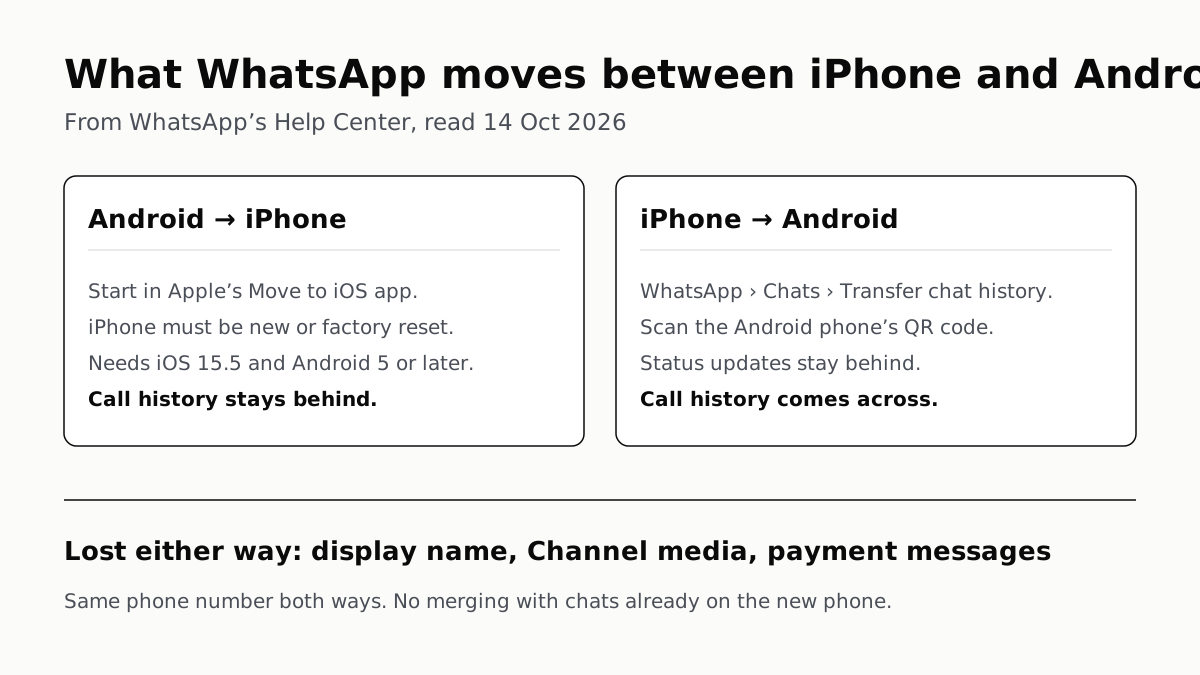
WhatsApp Chats Can Cross Between iPhone and Android
Messages, media and settings move both ways. Display names, Channel media and payment messages don’t, and call logs reach Android alone.