Razer Sells Three Blades, From 1.63 kg to 3.20 kg
The 14 came only with an RTX 5060 on Razer’s US store; the 16 and 18 offer up to an RTX 5090. Specs and prices read 31 October 2026.
If you buy through our links, we may earn a commission. It never affects our verdicts or scores — how that works. As an Amazon Associate I earn from qualifying purchases.
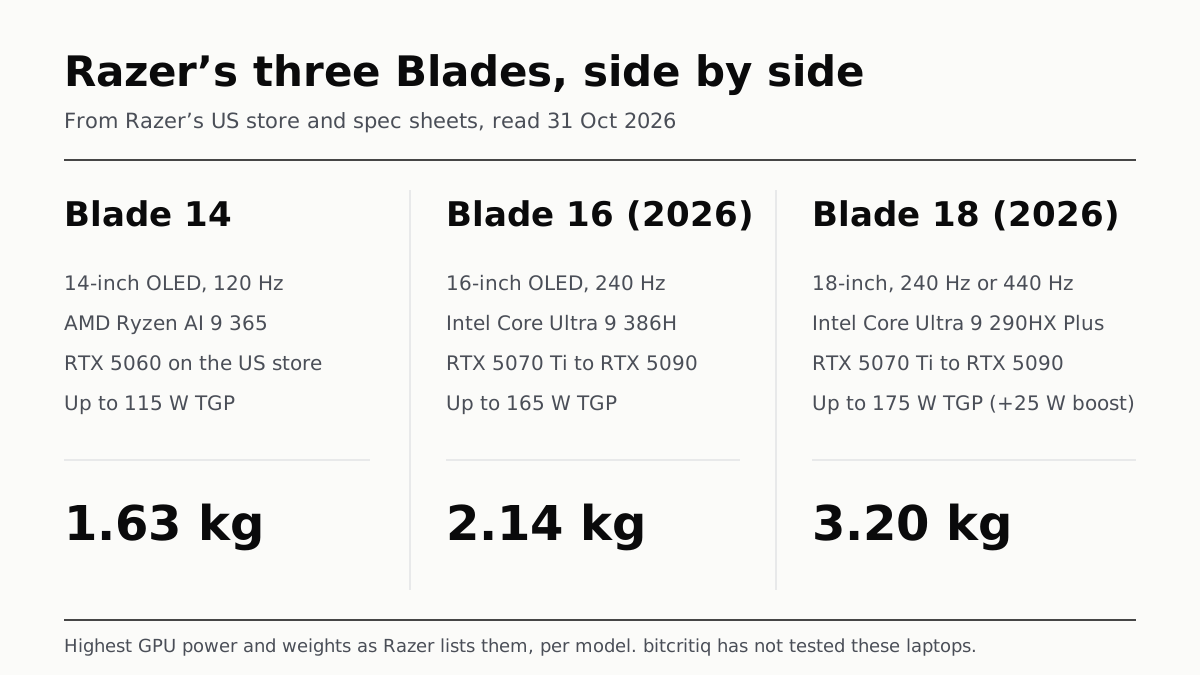
Razer sells three Blade laptops in the US, named for their screen sizes: the Blade 14, Blade 16 and Blade 18. The 14 is the light one at 1.63 kg, with an AMD chip and, on Razer’s US store on 31 October 2026, a single RTX 5060 configuration; the 2026 Blade 16 and Blade 18 use Intel Core Ultra 9 chips and offer an RTX 5070 Ti, 5080 or 5090, at 2.14 kg and 3.20 kg.
Every figure below is from Razer’s own US pages, read on 31 October 2026: the spec sheet for each configuration, and the price Razer’s configurator showed for it. We have not used these laptops.
The three Blades at a glance
| Blade 14 | Blade 16 (2026) | Blade 18 (2026) | |
|---|---|---|---|
| Screen | 14-inch OLED, 2880 × 1800, 120 Hz | 16-inch OLED, 2560 × 1600, 240 Hz | 18-inch dual-mode, 3840 × 2400 at 240 Hz or 1920 × 1200 at 440 Hz |
| Processor | AMD Ryzen AI 9 365 (10 cores, 20 threads) | Intel Core Ultra 9 386H (16 cores, 16 threads) | Intel Core Ultra 9 290HX Plus |
| GPUs on the US store | RTX 5060 | RTX 5070 Ti, 5080, 5090 | RTX 5070 Ti, 5080, 5090 |
| Memory | 16 GB LPDDR5X-8000, soldered | 32 GB LPDDR5X-9600 onboard; 64 GB option | 32 GB DDR5-6400 in SO-DIMM slots; up to 128 GB |
| Weight (kg) | 1.63 | 2.14 | 3.20 |
| Thickness (mm) | 15.8 to 16.2 | 14.9 to 17.4 | 22.79 to 28.7 |
| Battery (Wh) | 72 | 90 | 99 |
| Power adapter (W) | 200 | 280 | 400 |
The Blade 14 (affiliate link to Amazon, opens in a new tab) product page says the model goes up to an RTX 5070 and 64 GB of memory, but Razer’s US store offered one configuration on 31 October: RTX 5060, 16 GB, 1 TB, marked out of stock.
Memory on the two smaller models is fixed; the 18-inch model uses replaceable SO-DIMM slots. Razer’s Blade 16 (affiliate link to Amazon, opens in a new tab) page says its memory is “soldered/onboard and not upgradeable”, and the Blade 14 sheet says “Soldered”.
GPU power, as Razer states it
The same GPU name runs at different power limits from one laptop to the next, which is why Razer prints a TGP figure per configuration. Our explainer on laptop GPU wattage sets out Nvidia’s ranges and how Dynamic Boost fits in.
| GPU | Blade 14 | Blade 16 (2026) | Blade 18 (2026) |
|---|---|---|---|
| RTX 5060 | Up to 115 W (100 W sustained, per Razer’s FAQ) | On the store as a 2025 AMD configuration only | Not offered |
| RTX 5070 Ti | Not offered | Up to 140 W (115 W + 25 W Dynamic Boost) | Up to 140 W (+15 W Dynamic Boost) |
| RTX 5080 | Not offered | Up to 165 W (140 W + 25 W Dynamic Boost) | Up to 175 W (+25 W Dynamic Boost) |
| RTX 5090 | Not offered | Up to 165 W (140 W + 25 W Dynamic Boost) | Up to 175 W (+25 W Dynamic Boost) |
Razer writes the two larger models differently. On the Blade 16 the boost sits inside the headline figure; on the Blade 18 (affiliate link to Amazon, opens in a new tab) it is written as an addition, and Razer does not say whether the 175 W already includes it. Either way, the Blade 18’s RTX 5080 and 5090 carry a higher stated limit than the same GPUs in the Blade 16, in a body Razer lists as 22.79 to 28.7 mm thick against 14.9 to 17.4 mm.
Prices on Razer’s US store
| Model | Processor | GPU | Memory, storage | Price shown, razer.com, 31 Oct 2026 |
|---|---|---|---|---|
| Blade 14 | Ryzen AI 9 365 | RTX 5060 | 16 GB, 1 TB | $2,299.99, out of stock |
| Blade 16 (2026) | Core Ultra 9 386H | RTX 5070 Ti | 32 GB, 1 TB | $3,499.99 |
| Blade 16 (2026) | Core Ultra 9 386H | RTX 5080 | 32 GB, 1 TB | $3,999.99 |
| Blade 16 (2026) | Core Ultra 9 386H | RTX 5090 | 32 GB, 2 TB | $4,899.99 |
| Blade 16 (2025) | Ryzen AI 9 365 | RTX 5060 | 16 GB, 1 TB | $2,399.99 |
| Blade 18 (2026) | Core Ultra 9 290HX Plus | RTX 5070 Ti | 32 GB, 1 TB | $3,999.99 |
| Blade 18 (2026) | Core Ultra 9 290HX Plus | RTX 5080 | 32 GB, 1 TB | $4,499.99 |
| Blade 18 (2026) | Core Ultra 9 290HX Plus | RTX 5090 | 32 GB, 2 TB | $5,399.99 |
| Blade 18 | Core Ultra 9 275HX | RTX 5080 | 32 GB, 1 TB | $4,099.99 |
| Blade 18 | Core Ultra 9 275HX | RTX 5090 | 32 GB, 2 TB | $4,899.99, out of stock |
Two generations share each larger buy page. Razer’s Blade 16 configurator still sells AMD Ryzen AI 9 365 configurations, which Razer’s own footnote calls the 2025 models, including the RTX 5060 option; the three 2026 Intel configurations we read carry an RTX 5070 Ti, 5080 or 5090. The Blade 18 page likewise mixes the Core Ultra 9 290HX Plus with an older Core Ultra 9 275HX on DDR5-5600 memory. Check the processor line before you add one to the cart: it is the quickest way to tell which generation a configuration is.
The prices above are what Razer showed for each configuration we selected, not every memory and storage combination; Black Friday pricing moves weekly.
Who each one suits, by the spec sheet
- Blade 14: the smallest and lightest, at 1.63 kg and a 120 Hz OLED. Its spec sheet lists two USB4 Type-C ports and no Thunderbolt; if you plan an external GPU, what limits an eGPU explains why that port type matters.
- Blade 16 (2026): the thinnest of the three at its thinnest point, 14.9 mm, with a 240 Hz OLED, one Thunderbolt 5 and one Thunderbolt 4 port, and up to an RTX 5090.
- Blade 18 (2026): the largest screen, the highest stated GPU limit and slotted memory, at 3.20 kg with a 400 W adapter.
For what reviewers made of one configuration of each, see our gaming laptop shortlist. MSI splits its gaming laptops into six named lines rather than three sizes; our MSI lineup explainer sets them out.
Questions people ask
What is the difference between the Razer Blade 14, 16 and 18?
Screen size first: 14, 16 and 18 inches. The 14 uses an AMD Ryzen AI 9 365, the 2026 16 and 18 Intel Core Ultra 9 chips. Razer lists them at 1.63, 2.14 and 3.20 kg, and the 16 and 18 offer GPUs up to an RTX 5090.
What is the TGP of the Razer Blade 16?
Razer’s 2026 Blade 16 spec sheets give up to 165 W for the RTX 5080 and RTX 5090 (140 W plus 25 W Dynamic Boost) and up to 140 W for the RTX 5070 Ti (115 W plus 25 W).
Does the Razer Blade 18 have an OLED screen?
Razer’s Blade 18 spec sheet does not call it OLED; it lists an 18-inch dual-mode display that runs at 3840 by 2400 at 240 Hz or 1920 by 1200 at 440 Hz, at 600 nits. The Blade 14 and Blade 16 sheets both say OLED.
Can you upgrade the RAM in a Razer Blade?
On the Blade 18, Razer lists DDR5 SO-DIMM slots with a maximum of 128 GB. The Blade 14 sheet says its memory is soldered, and the Blade 16 page says its memory is onboard and not upgradeable.
Is the Razer Blade 16 2025 still sold?
Razer’s US Blade 16 buy page still offered AMD Ryzen AI 9 365 configurations on 31 October 2026, and Razer’s own footnote calls those the 2025 models. The 2026 models use an Intel Core Ultra 9 386H.
Which Razer Blade is the lightest?
The Blade 14, which Razer lists at 1.63 kg (3.59 lb). Razer lists the Blade 16 at 2.14 kg and the Blade 18 at 3.20 kg.
How we researched this
No one at bitcritiq has handled this product. Everything here comes from published sources, listed below.
- What this cannot tell you
- Razer’s configurator shows a price per configuration and option differences as plus or minus amounts; we record the price it showed for each configuration we selected, and did not price every memory and storage combination. Razer showed no struck-through price on the configurations we read; Black Friday prices move weekly. Razer writes Blade 18 GPU power as “up to N W TGP (+N W Dynamic Boost)” and Blade 16 as a total with the split in brackets, and does not say whether the Blade 18’s boost is inside the headline figure. Razer’s own pages disagree in places: the comparison strip on the Blade 14 page still lists the Blade 16 at up to 160 W with an AMD Ryzen AI 9 HX 370, and the Blade 18 at 3.10 kg with a Core Ultra 9 275HX, while the current models’ own pages say 165 W and 3.20 kg; the Blade 16 overview says 4.6 lbs while its spec sheet says 4.71 lbs. We use each configuration’s own spec sheet. We did not read the Blade 18’s port list or its panel type. We have not used any of these laptops, and this page does not rank them.
How we chose this, and what we did
- Why this subject
- Search Console shows our best-laptops shortlist collecting impressions for best-laptop and gaming-laptop searches (94 impressions). Razer sells three Blade sizes in the US, each with several GPU tiers and, on two of them, an older processor generation still on the same buy page. No bitcritiq post sets out which Blade is which: best-gaming-laptops gathers outlets’ review scores for one configuration of each, and gaming-laptop-gpu-wattage-tgp explains GPU wattage using a Blade as one example.
- How we looked at it
- Read on 31 October 2026 in the research browser. Razer’s US gaming-laptops page lists three models, Blade 14, Blade 16 and Blade 18, each marked New in its menu; we counted those three. For each we opened Razer’s buy page and selected each GPU and processor option in turn, reading the configuration Razer showed, its price, and its stock line, and then opened each configuration’s own URL to read its spec sheet (graphics with TGP, display, memory, weight, dimensions, battery, adapter), which Razer embeds in the page data. Ten configurations in all: one Blade 14, four Blade 16, five Blade 18. Razer’s Blade 16 footnote identifies the Ryzen AI 9 models on that page as 2025 models. TGP figures are quoted in Razer’s own notation. Core counts are from the Blade 14 spec sheet and the Blade 16 product page. Absence check on the Blade 18 panel: its spec sheet’s Display field names resolution, refresh, brightness and response time but no panel type, while the same field on the Blade 14 and Blade 16 sheets says OLED. Absence check on Blade 14 Thunderbolt: its I/O field lists USB 3.2 Gen 2 Type-A and USB4 Type-C ports, while the Blade 16 I/O field names Thunderbolt 5 and Thunderbolt 4.
What this rests on
6 claims, all official. Nothing here was measured by bitcritiq — see how we test for why. Open a claim to read the source it came from.
Razer’s US gaming-laptops page lists three Blade models: the Blade 14, Blade 16 and Blade 18.Official
razer.com/pc/gaming-laptops, 31 October 2026: “THE RAZER BLADE LINE … RAZER BLADE 14 … RAZER BLADE 16 … RAZER BLADE 18”; the menu marks “Blade 14 New”, “Blade 16 New”, “Blade 18 New”.
On 31 October 2026 Razer’s US store offered the Blade 14 in one configuration, with an RTX 5060, 16 GB and 1 TB, at $2,299.99, marked out of stock.Official
Blade 14 buy page: “AMD Ryzen™ AI 9 365 … 14" QHD+ 120 Hz OLED … GeForce RTX 5060 … 16 GB 8000 MHz RAM, 1 TB SSD … US$2,299.99 Out of stock”; each option shows “Selected Option” with no alternatives.
Razer rates the 2026 Blade 16’s RTX 5080 and RTX 5090 at up to 165 W TGP, and its RTX 5070 Ti at up to 140 W.Official
Blade 16 spec sheets: “RTX™ 5090 Laptop GPU 24 GB GDDR7 Up to 165 W TGP (140 W + 25 W Dynamic Boost)”; “RTX™ 5080 Laptop GPU 16 GB GDDR7 Up to 165 W TGP (140 W + 25 W Dynamic Boost)”; “RTX™ 5070 Ti Laptop GPU 12 GB GDDR7 Up to 140 W TGP (115 W + 25 W Dynamic Boost)”.
Razer lists the Blade 18’s RTX 5080 and RTX 5090 at up to 175 W TGP plus 25 W Dynamic Boost, and its RTX 5070 Ti at up to 140 W plus 15 W.Official
Blade 18 spec sheets: “RTX 5090 — 24 GB GDDR7, up to 175 W TGP (+25 W Dynamic Boost)”; “RTX 5080 — 16 GB GDDR7, up to 175 W TGP (+25 W Dynamic Boost)”; “RTX 5070 Ti — 12 GB GDDR7, up to 140 W TGP (+15 W Dynamic Boost)”.
Razer lists the Blade 14 at 1.63 kg, the Blade 16 at 2.14 kg and the Blade 18 at 3.20 kg.Official
Spec sheets, “Weight”: Blade 14 “1.63 kg / 3.59 lbs”; Blade 16 “2.14 kg / 4.71 lbs”; Blade 18 “3.20 kg / 7.06 lbs”.
The Blade 16’s buy page also sells AMD Ryzen AI 9 365 configurations, which Razer’s footnote identifies as 2025 models.Official
Blade 16 page footnote: “2026 models equipped with Intel Core Ultra 9 processors (Model Codes beginning with RZ09-0581xxxx-xxxx) to 2025 models equipped with AMD Ryzen AI 9 processors (Model Codes beginning with RZ09-0528xxxx-xxxx)”. Buy page, RTX 5060 option: URL RZ09-05285EN3-R3U1, “AMD Ryzen™ AI 9 365 … 16 GB 8000 MHz RAM, 1 TB SSD … US$2,399.99”.
Sources 10
- Gaming Laptops — Razer United StatesOfficialaccessed Oct 31, 2026
- Razer Blade 14 — RazerOfficialaccessed Oct 31, 2026
- Buy Razer Blade 14 — RazerOfficialaccessed Oct 31, 2026
- Razer Blade 16 — RazerOfficialaccessed Oct 31, 2026
Show 6 more · 6 official or standards
- Buy Razer Blade 16, RTX 5070 Ti — RazerOfficialaccessed Oct 31, 2026
- Buy Razer Blade 16, RTX 5080 — RazerOfficialaccessed Oct 31, 2026
- Buy Razer Blade 16, RTX 5090 — RazerOfficialaccessed Oct 31, 2026
- Buy Razer Blade 18 — RazerOfficialaccessed Oct 31, 2026
- Buy Razer Blade 18, RTX 5080 — RazerOfficialaccessed Oct 31, 2026
- Buy Razer Blade 18, RTX 5090 — RazerOfficialaccessed Oct 31, 2026
Pass it on
Know someone weighing this up? Send them the answer.
bitcritiq.com/rum5The link is permanent: it opens this article for good, even if the title changes.
No email, no account
Follow bitcritiq
Every new article, in whatever reader you already use.
Subscribe by RSSAll the ways to follow
Using Chrome on Android? Open the browser menu and tap Follow. New articles then turn up in the Following tab in Discover.
read next
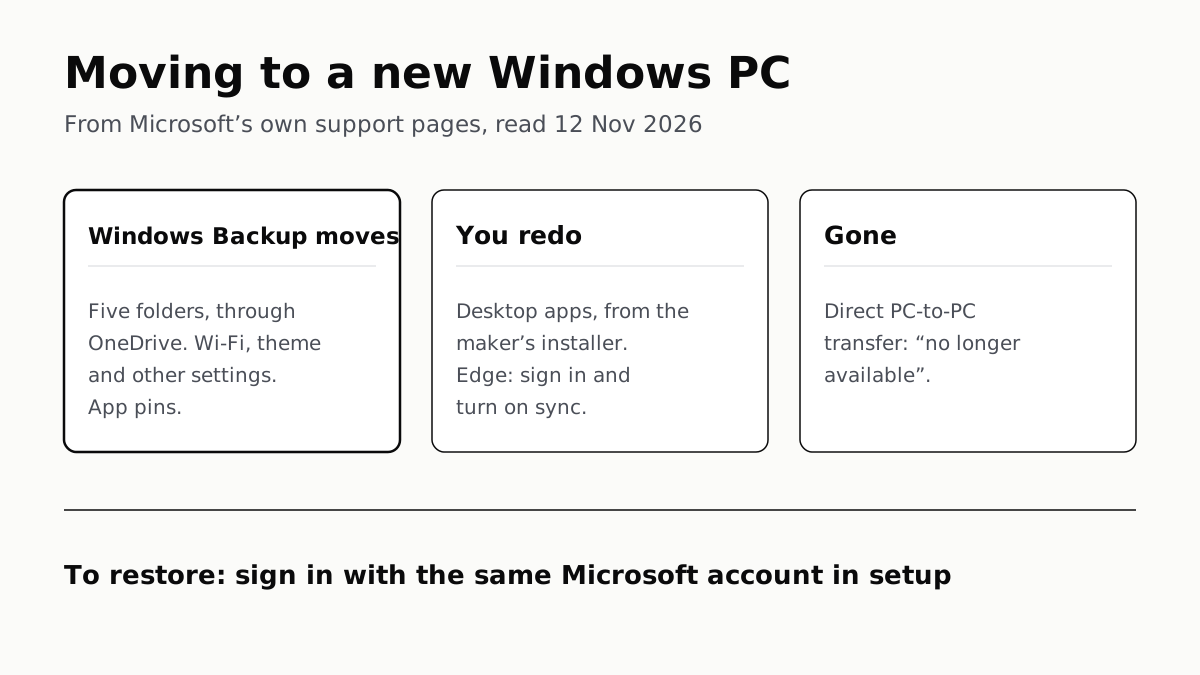
Windows Backup Moves Files and Settings, Not Desktop Apps
Sign in with the same Microsoft account during setup to restore. Files travel through OneDrive, whose free tier is 5 GB.
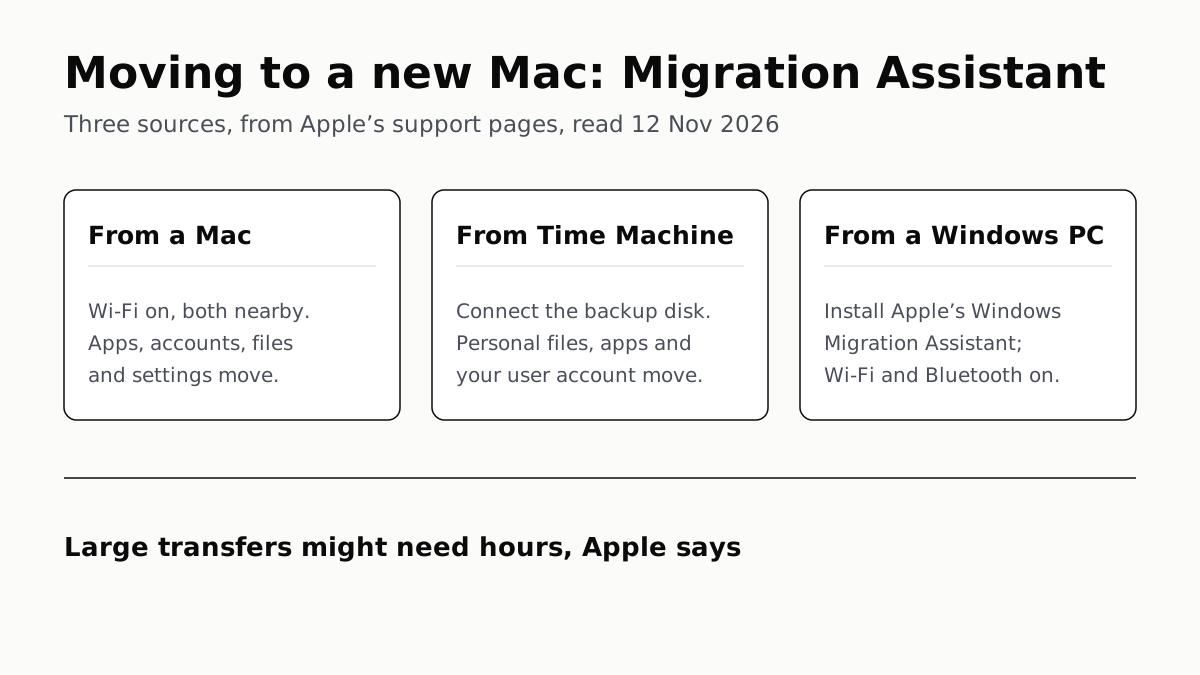
Migration Assistant Moves Your Old Mac or PC to a New Mac
It comes with your Mac. A PC needs Apple’s Windows Migration Assistant, and Apple warns large transfers might need hours.
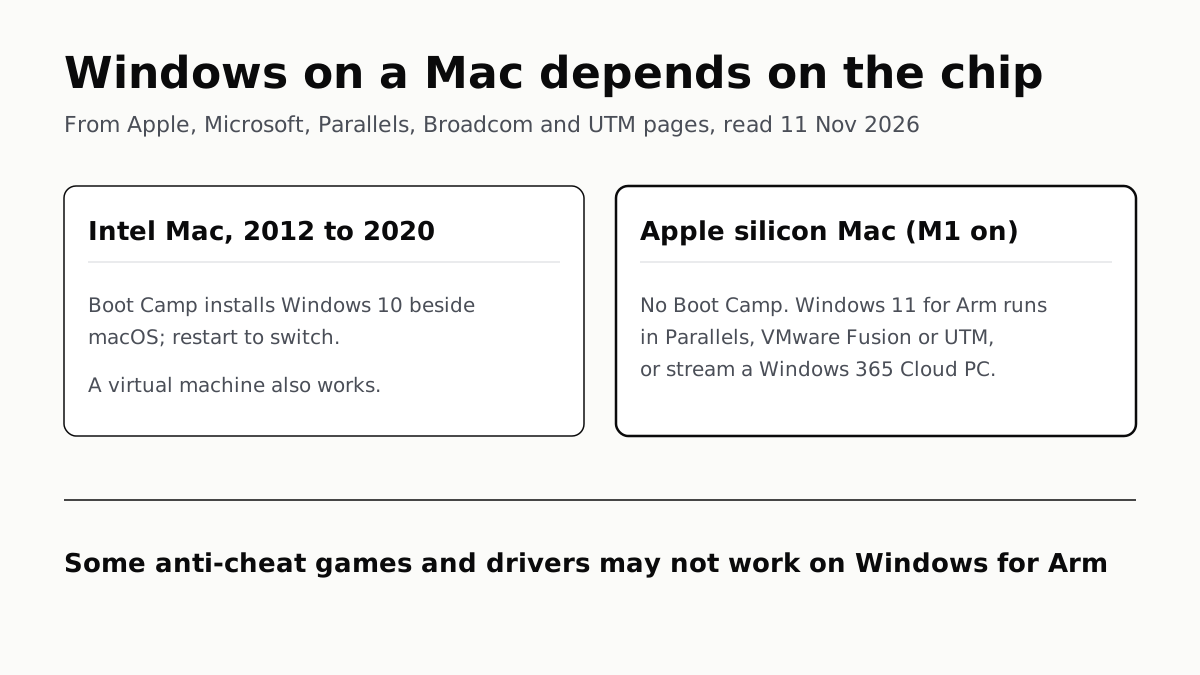
A Mac Can Run Windows, but Apple Silicon Means No Boot Camp
Microsoft authorizes Parallels on M1 to M3; Fusion and UTM are free. All run Windows 11 for Arm, where some games may not work.
Windows 11 Pro Adds BitLocker, Remote Desktop and VMs
Home can encrypt the drive on supported laptops. Pro adds a Remote Desktop host, Hyper-V, Windows Sandbox and domain join.