Three TV Platforms Publish an Update Promise. Three Do Not
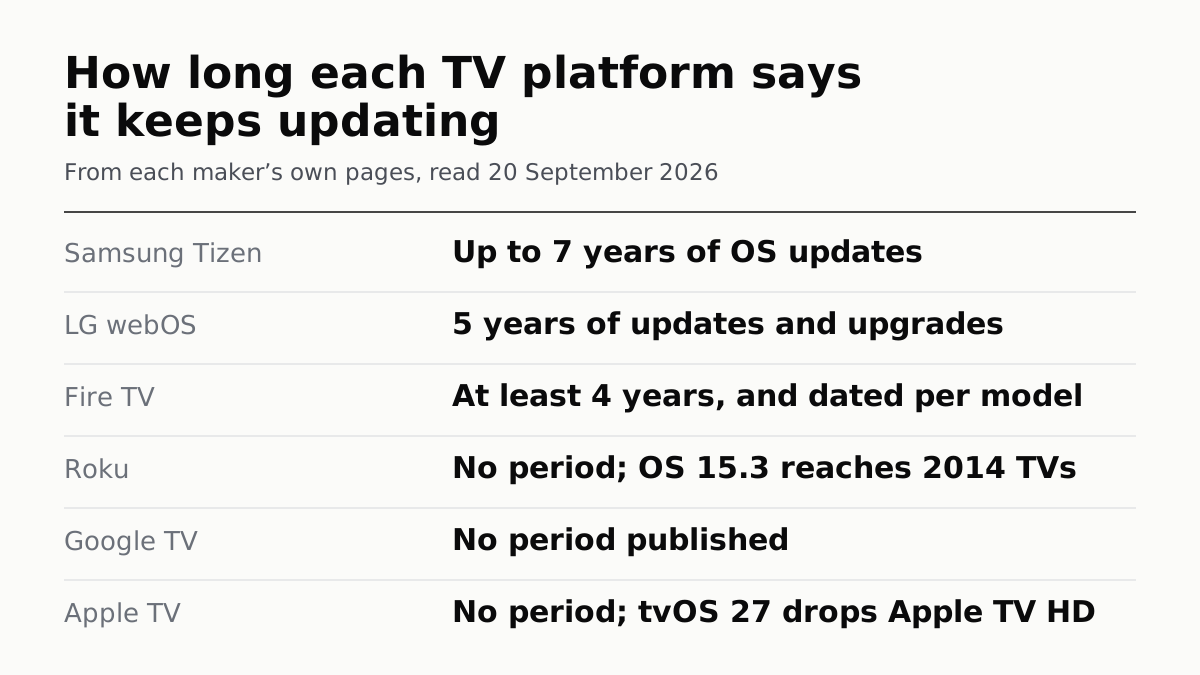
Samsung says up to seven years of Tizen, LG five of webOS, Amazon at least four with dates per model. Google, Roku and Apple name no period.
If you buy through our links, we may earn a commission. It never affects our verdicts or scores — how that works. As an Amazon Associate I earn from qualifying purchases.
Three of the six big TV platforms publish a number of years, and three do not. Samsung says up to seven years of Tizen OS upgrades, LG five years of webOS updates and upgrades, and Amazon at least four years of Fire TV security updates with a dated table by model. Google, Roku and Apple name no period on the pages that carry their update information.
The three numbers are not the same promise. Samsung’s seven years and LG’s five are version upgrades; Amazon’s four years are security updates. A platform can keep patching a TV for years without ever giving it a new home screen, and a maker that promises upgrades is not thereby promising patches.
What each maker publishes
| Platform | What the maker publishes | The wording it uses |
|---|---|---|
| Samsung Tizen | Up to 7 years of OS upgrades | “seven years of Tizen OS upgrades” · “Based on model year” |
| LG webOS | 5 years of updates and version upgrades | “for 5 years.*” — the asterisk is unexplained on the page |
| Fire TV | At least 4 years of security updates, plus a date per model | “until at least four years from when you bought it new” |
| Roku | No period | Release notes list the models each Roku OS reaches |
| Google TV | No period | End of support is announced after it happens |
| Apple TV | No period | Each release lists the Apple TVs it is “Available for” |
Samsung: seven years, counted from the model year
Samsung’s CES 2026 presentation on 4 January put it plainly: “Users can now enjoy seven years of Tizen OS upgrades, ensuring that TVs continue to evolve long after they have entered the home.”
Its own product release is more careful. The 2026 OLED announcement of 2 April says “up to 7 years of OS updates”, and the footnote behind that line reads: “Based on model year; requires Internet connection.” Two things follow from Samsung’s own wording. The clock is attached to the model year rather than to the day the set leaves the shop, so a discounted previous-year model starts part-way through it. And a TV kept off the network gets none of it.
LG: five years, with an asterisk LG does not explain
LG’s current webOS page says the Re:New programme “automatically equips you with new software updates and version upgrades for 5 years.*” The page carries four other asterisked footnotes — about supported menus, keyword recommendations, AI Concierge languages and simulated screen images — and none of them is about the five years. What the five years is measured from is not stated there.
The programme itself was announced on 4 January 2024, and the announcement is narrower than the marketing line. It brought the latest webOS to “every model in LG’s 2022 OLED TV lineup, LG OLED Flex, LG OLED Objet Collection Posé, as well as LG’s 2022 QNED Mini LED 8K (QNED99/95 series), promising users the joy of a new TV experience for the next five years,” and said the upgrade would be extended to more LG TVs later.
Amazon: the only maker that prints a date
Amazon’s Fire TV page is the one a reader can actually act on. It states the rule — “We’ll support your device with software security updates until at least four years from when you bought it new, from Amazon as the seller, on Amazon.com (or until the date stated below if later)” — and then prints the dates.
Almost every current model is listed through 31 December 2030: every Fire TV stick from the Stick Lite up, the Fire TV Cube (3rd Generation), the Fire TV and Ember smart TVs, and the Fire TV soundbars. The Fire TV Stick 4K (1st Generation) is 31 December 2029. Amazon adds that after those dates it “may continue to provide software security updates for as long as we can”, and that “the update period is not a guarantee as to how long your device will last”.
Read the unit of measurement, though. These are security updates. Amazon publishes the current software version for each Fire TV device on a separate page, and makes no promise there about future FireOS versions.
Roku: no promise, and the longest record in the table
Roku publishes neither a number of years nor an end date. What it publishes instead is which devices each release actually reached, and that list is long. Roku OS 15.3 went to “All Roku TV models (2014-2026)”, excluding three model numbers. Players and Streambars in eight series are named alongside them.
Roku’s security page logs sixteen dated releases and the CVEs each one addressed, the most recent on 6 August 2026. It describes the update mechanism and it names no support period, which makes the twelve model years in the release notes a record rather than a commitment. A 2014 Roku TV is on the current OS today; nothing on Roku’s pages says it will be next year.
Apple: no period, and a device list that moved this month
Apple’s security releases page is a table of every release, the devices it is “Available for”, and its date. For tvOS 26.6, released 27 July 2026: “Apple TV HD and Apple TV 4K (all models)”. For tvOS 27, released 14 September 2026: “Apple TV 4K 2nd generation and later”.
So the Apple TV HD was inside the supported set through the summer and is outside the new major version. Apple states no support period for Apple TV anywhere on that page, and there is no equivalent of the model-year promise Samsung and LG print. What Apple publishes is the list, updated each time it changes.
Google: nothing in advance, a notice afterwards
Google’s firmware page for Chromecast and the Google TV Streamer, last updated 23 June 2026, opens with an ending rather than a commitment: “Support for Chromecast (1st gen) has ended. It no longer receives software or security updates, and Google doesn’t provide technical support.” One of its firmware entries reads “Security patch updates to April 2026”.
The Google Store spec page for the Google TV Streamer (4K) lists the operating system, memory, storage, every port, the video and audio formats and the recycled-plastic content of the case. It has no row for software support. We found no Google page giving a period for a Google TV device, and none at all for the Google TV sets other makers build.
What a streaming player changes
A player puts a current platform on an old panel, and it is cheap relative to a TV. Roku’s own store listed the Roku Streaming Stick at $39.99 when we read it on 20 September 2026, marked down to $29.99 on a limited-time offer; the Google TV Streamer (4K) is $149.99 on the Google Store. Against that, a Fire TV stick bought new from Amazon carries the four-year minimum and a table entry of 31 December 2030 whatever year the TV was made.
It does not change three things.
The panel. Brightness, local dimming and the native refresh rate are fixed in the glass, and no platform update moves them. Those are the specifications that separate a $400 TV from a $1,200 one, and they are the reason a picture ages differently from a home screen.
The TV’s own viewing-data collection. LG says its automatic content recognition can work on HDMI-connected devices, and Roku says its version covers devices connected to the TV. Plugging in a player does not put your viewing outside the set’s reach — the switch has a different name at every brand, and it is on the TV, not on the stick.
The TV’s own software. The set keeps whatever platform it shipped with, on whatever schedule its maker keeps, whether you ever open it again or not.
So should you just buy a stick?
If what has aged is the software — apps that will not install, a home screen that crawls — a player replaces that layer for less than a tenth of the price of a new set, and Amazon’s is the only one of the six with a date you can look up before you buy. If what has aged is the picture, a player changes none of it, and the money belongs in the set itself.
One thing the table does not support is paying more for a longer software life. None of the six commitments is scaled to price: Amazon gives the same 31 December 2030 date to a Fire TV Stick Lite and to an 85-inch Ember Mini-LED, and Samsung states its seven years for its TVs generally rather than for a tier. That is consistent with what we found looking at price against review scores across our own corpus.
How we researched this
No one at bitcritiq has handled this product. Everything here comes from published sources, listed below.
- What this cannot tell you
- We have not run any of these platforms for years, and a published promise is not a record. None of these commitments says which apps will still install, which is what owners of old TVs actually notice. Samsung's and LG's numbers are marketing-page figures rather than warranty terms, and LG's carries an asterisk its own page does not explain. Amazon's dates apply to devices bought in the US, and it says an update period is not a guarantee of how long a device lasts. We could not find a Google page giving any support period for Google TV sets or boxes. Prices were read on the makers' own stores on 20 September 2026 and move.
How we chose this, and what we did
- Why this subject
- Smart TVs are bought on picture and kept for a decade, and the thing that usually ages first is the software. Every maker talks about updates in marketing copy, but a reader who wants to know how many years they are being promised has to find six different pages written in six different units — upgrades, security patches, or nothing at all. The same question decides whether a cheap streaming player is worth buying for an older set.
- How we looked at it
- Every figure is from the platform owner's own page, read on 20 September 2026: Samsung's CES 2026 newsroom post and its 2 April 2026 OLED release, including the footnote; LG's webOS page and its January 2024 Re:New announcement; Amazon's Fire TV software security updates help page and its per-model table; Roku's OS release notes and its security updates article; Apple's security releases list, which prints the device list and date for every tvOS release; and Google's Chromecast and Google TV Streamer firmware page plus the Google Store spec page for the Google TV Streamer. Where a maker publishes no period, we say so and name the page that does carry its update information.
What this rests on
6 claims, all official. Nothing here was measured by bitcritiq — see how we test for why. Open a claim to read the source it came from.
Samsung publishes seven years of Tizen OS upgrades, written as “up to 7 years” on its product release and tied to model year.Official
Samsung US Newsroom, CES 2026, 4 January 2026: “Users can now enjoy seven years of Tizen OS upgrades, ensuring that TVs continue to evolve long after they have entered the home.” Its 2026 OLED release of 2 April 2026 says “With up to 7 years of OS updates, your TV will stay current with the latest advancements”, with the footnote “Based on model year; requires Internet connection.”
LG publishes five years of webOS updates and version upgrades, with an asterisk its own page does not explain.Official
LG USA’s webOS page: “our webOS Re:New program automatically equips you with new software updates and version upgrades for 5 years.*” The same page prints four other asterisked footnotes — on supported menus, keyword recommendations, AI Concierge languages and simulated screen images — and none of them refers to the five years. LG’s Re:New announcement of 4 January 2024 brought the latest webOS to “every model in LG’s 2022 OLED TV lineup, LG OLED Flex, LG OLED Objet Collection Posé, as well as LG’s 2022 QNED Mini LED 8K (QNED99/95 series), promising users the joy of a new TV experience for the next five years.”
Amazon promises Fire TV security updates for at least four years from purchase, and publishes a date for every model — 31 December 2030 for almost all current ones.Official
Amazon’s Fire TV software security updates page: “We’ll support your device with software security updates until at least four years from when you bought it new, from Amazon as the seller, on Amazon.com (or until the date stated below if later).” Its tables list 31 December 2030 for every current stick, Fire TV smart TV and Fire TV soundbar named, and 31 December 2029 for the Fire TV Stick 4K (1st Generation). It adds: “the update period is not a guarantee as to how long your device will last.”
Roku publishes no support period, and its newest OS release still reaches Roku TV models going back to 2014.Official
Roku’s release notes for Roku OS 15.3 list “All Roku TV models (2014-2026), excluding models 65R648, 75R648, and 75U800GMR”, plus players and Streambars in the 9100, 4800, 4600, 4200, 3900, 3800, 3700 and 3600X series. Roku’s security updates article logs sixteen dated releases and the CVEs each addressed, 15.3 on 6 August 2026, and states no number of years anywhere on it.
Apple publishes no support period for Apple TV; tvOS 27 requires an Apple TV 4K (2nd generation) or later, and the Apple TV HD was still covered two months earlier.Official
Apple’s security releases page lists, for tvOS 27 released 14 September 2026, “Apple TV 4K 2nd generation and later”, and for tvOS 26.6 released 27 July 2026, “Apple TV HD and Apple TV 4K (all models)”. The page prints an “Available for” device list and a release date for every entry, and no support period for any Apple TV.
Google publishes no support period for Google TV, and announces end of support after it has happened.Official
Google’s Chromecast and Google TV Streamer firmware page, last updated 23 June 2026, says: “Support for Chromecast (1st gen) has ended. It no longer receives software or security updates, and Google doesn’t provide technical support.” One of its firmware entries reads “Security patch updates to April 2026”. The Google Store spec page for the Google TV Streamer (4K) lists operating system, memory, storage, ports, video and audio formats and recycled-plastic content, and carries no software-support row.
Sources 11
- Samsung Presents ‘Your Companion to AI Living’ at The First Look During CES 2026 — Samsung US Newsroom, 4 January 2026Officialaccessed Sep 20, 2026
- Samsung Upgrades 2026 OLED TVs with New Designs and Expanded Premium Features — Samsung US Newsroom, 2 April 2026Officialaccessed Sep 20, 2026
- What is webOS? — LG USAOfficialaccessed Sep 20, 2026
- More LG Smart TV Owners Set to Enjoy the Latest webOS Upgrade, Making Their TVs Feel Brand New — LG Global Newsroom, 4 January 2024Officialaccessed Sep 20, 2026
Show 7 more · 7 official or standards
- Amazon Fire TV Software Security Updates — Amazon Customer ServiceOfficialaccessed Sep 20, 2026
- Roku OS software release notes — Roku SupportOfficialaccessed Sep 20, 2026
- Roku OS security updates — Roku SupportOfficialaccessed Sep 20, 2026
- Apple security releases — Apple SupportOfficialaccessed Sep 20, 2026
- Chromecast & Google TV Streamer firmware versions and release notes — Google Streaming HelpOfficialaccessed Sep 20, 2026
- Google TV Streamer (4K) Tech Specs — Google StoreOfficialaccessed Sep 20, 2026
- Roku Streaming Players — RokuOfficialaccessed Sep 20, 2026
No email, no account
Follow bitcritiq
Every new article, in whatever reader you already use.
Subscribe by RSSAll the ways to follow
Using Chrome on Android? Open the browser menu and tap Follow. New articles then turn up in the Following tab in Discover.
read next
PS Audio and Naim Each Lost a Disc Product to Drive Supply
The TV Viewing Tracker Has a Different Name at Each Brand
Bose Ultra Open Earbuds 2nd Gen: Two More Hours, Same $299